The labours are a punishment. This is the first thing modern versions remove, and removing it makes nonsense of the whole career. In Euripides' Heracles, the hero returns from the underworld having completed his tasks, saves his family from a usurper, and is then struck with madness sent by Hera through the spirit Lyssa; he shoots his own children with the bow he has just used to rescue them, and kills his wife Megara. Apollodorus and the general tradition put the madness before the labours instead, making the twelve tasks the expiation, imposed by the Delphic oracle, for the murder. Either order leaves the same fact standing: the strongest man in Greek myth is defined by an atrocity he did not intend and cannot undo.
That is why he is not a straightforward figure of triumph. He is a figure of endurance — ponos, toil — and of a debt that cannot be paid off, only worked at.
Born to be hated
Zeus, on the night Heracles was to be conceived on Alcmene at Thebes, boasted that a descendant of Perseus born that day would rule Mycenae. Hera extracted the oath, then delayed Alcmene's labour and hastened the birth of Eurystheus. The kingship went to a cousin, and Heracles spent his life taking orders from him. His birth name was Alcides or Alcaeus; "Heracles" means "glory of Hera", which is either an appeasement, a bitter joke, or — as some scholars argue — a sign that the pair were originally connected in a way the myths have inverted.
Hera sent snakes to his cradle; the infant strangled one in each hand, which is the scene Pindar chose to open Nemean 1. Later she drove him mad, delayed his adoption of glory, and pursued him across the Mediterranean. He is her creation as much as Zeus'.
The twelve, and why there are not really twelve
The canonical set is a systematisation. Different authors give different orders, different numbers, and different tasks, and the count of twelve is generally credited to the arrangement of the metopes of the Temple of Zeus at Olympia in the 460s BCE, which required a fixed and symmetrical set — six at each end. Two labours are traditionally disallowed by Eurystheus and replaced, which is itself a seam showing where the list was patched.
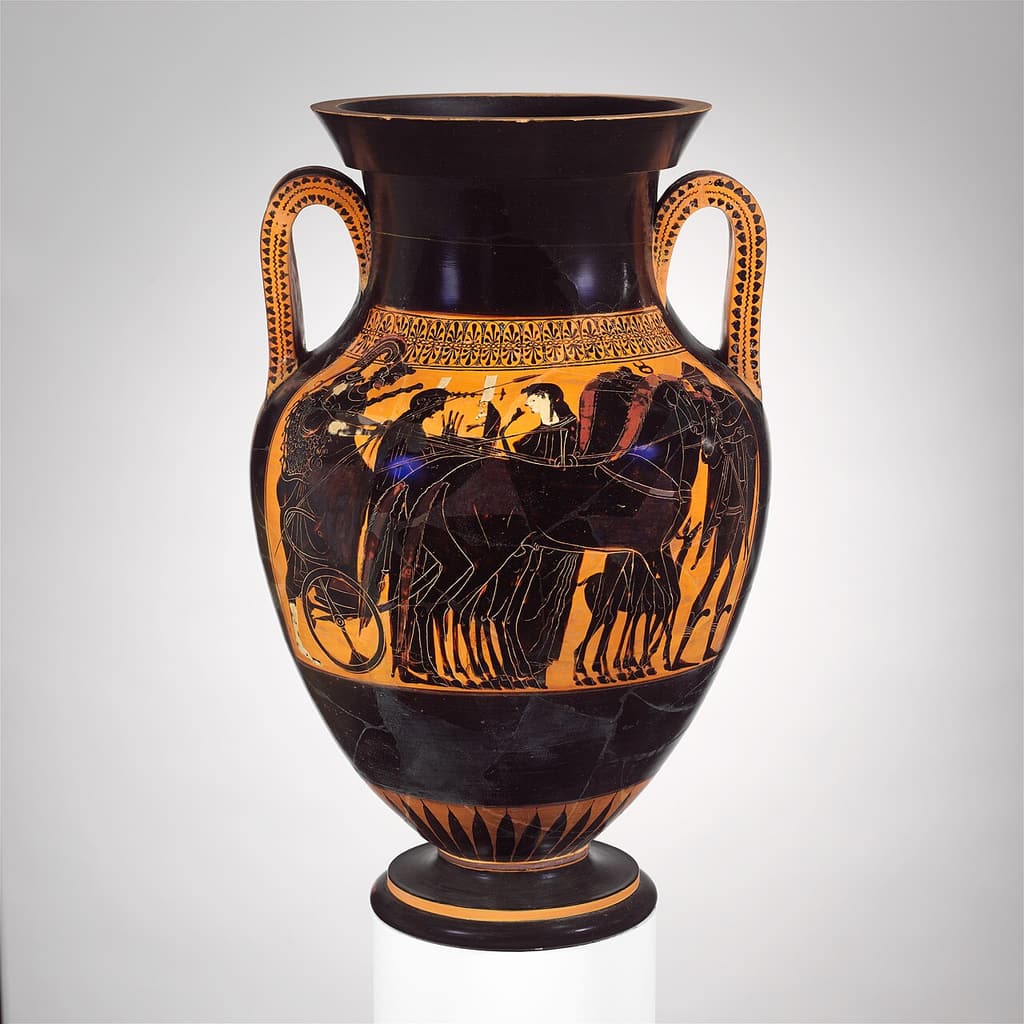
The standard sequence runs: the Nemean lion, whose hide no weapon could pierce and which he strangled, thereafter wearing the skin — and which some traditions place in the sky as Leo; the Lernaean Hydra, whose heads multiplied until his nephew Iolaus cauterised the stumps, a labour Eurystheus rejected because he had help; the Ceryneian hind, sacred to Artemis, taken alive after a year's pursuit; the Erymanthian boar, carried back on his shoulders to a king who hid in a storage jar; the Augean stables, cleaned by diverting two rivers, disallowed because he asked for payment; the Stymphalian birds, flushed out with a bronze rattle made by Hephaestus; the Cretan bull; the mares of Diomedes, which ate human flesh; the belt of Hippolyte, queen of the Amazons; the cattle of Geryon, in the far west, on the trip during which he set up the Pillars at the strait; the apples of the Hesperides, fetched by persuading Atlas to get them while he held up the sky; and Cerberus, brought up from the underworld alive and returned.
Each of these is treated in detail in the account of the labours themselves. The pattern of the sequence is geographical as much as heroic: the early labours are in the Peloponnese, then Crete and Thrace, then the Black Sea, then the far west, then the world's edge, then the underworld. It is a map of the Greek imagination expanding outward, and the western labours in particular grew as Greek colonists moved into Italy, Sicily and Spain.
The parerga: what happens between the tasks
Ancient authors called the side-adventures parerga, and there are dozens: freeing Prometheus by shooting the eagle; wrestling Antaeus, who drew strength from the earth, and lifting him off it; wrestling Death itself for Alcestis in Euripides' play, in a scene played half for comedy; sacking Troy a generation before the Iliad over Laomedon's broken promise; killing the centaur Nessus; being sold as a slave to Queen Omphale of Lydia for a year and made to spin wool in women's clothes while she wore the lion skin; joining the Argonauts and leaving the voyage early; and fighting on the gods' side in the Gigantomachy, where prophecy required a mortal for the Giants to be beaten.
The last of these matters more than it looks. Heracles is the mortal without whom the Olympian order does not survive its second war.
Death by a wedding gift
Sophocles' Women of Trachis is the ending, and it is a domestic tragedy rather than an epic one. Deianeira, his wife, was once carried across a river by the centaur Nessus, whom Heracles shot with an arrow poisoned by the Hydra's blood. Dying, Nessus told her to keep some of his blood as a love charm. Years later, jealous of the captive Iole, she smears it on a robe and sends it to him. The poison burns into him; he cannot get the fabric off; Deianeira kills herself when she learns what she has done. Heracles has himself carried to Mount Oeta and burned alive on a pyre, which his companion Philoctetes lights in exchange for the bow — the bow the Greeks will later need at Troy.
The play's cruelty is that the two people involved both act out of love and neither is warned by the gods they have served.
The only mortal who becomes a god
After the pyre, the mortal part burns away and the divine part ascends. He is received on Olympus, reconciled with Hera, and married to her daughter Hebe, goddess of youth. This is unique in Greek myth, and the Greeks themselves found it awkward: Herodotus reports that at Athens sacrifice was made to him as a god, while other places treated him as a hero — and he recommends doing both, with two separate rites. That double status is unusually well attested in inscriptions and is genuinely, formally different in practice: heroes receive offerings at a tomb-like altar in the evening; gods receive them at a raised altar with the worshippers eating the meat.
The Odyssey splits the difference in a passage most editors think is an interpolation: Odysseus sees Heracles' phantom in the underworld, while "he himself" feasts among the immortals.
Hercules, the Romans, and the enormous afterlife
Rome took him early as Hercules, and his oldest Roman cult, the Ara Maxima in the Forum Boarium, has him as a patron of merchants and of oaths sworn by men — the traditional exclamation mehercule is his. Roman generals and emperors modelled themselves on him: Commodus had himself portrayed in the lion skin, and Antony claimed descent.
Since then he has been more thoroughly reused than any other figure from Greek myth, and almost always reduced. The medieval and Renaissance tradition made him an allegory of virtue, through the "Choice of Heracles" fable that Xenophon attributes to Prodicus, in which the young hero chooses the hard road of Virtue over the easy road of Vice. Steroid-era bodybuilding, the Farnese Hercules and every strongman poster descend from Hellenistic sculpture. Disney's 1997 film removes the madness, the infanticide, the death by poisoned robe and Hera's hostility — Hera becomes his loving mother — leaving a coming-of-age story with the same name and nothing else. The Kevin Sorbo television series, the Marvel character, the Rock's 2014 film and dozens of games mostly follow the same subtraction. Where the hard version survives it tends to be on stage: Euripides' and Sophocles' plays are performed regularly, and both are about a man destroyed by his own strength.
The club, the Heracleidae, and the labour that does not belong
Is any of it historical?
There is no evidence for a historical individual, but the cult is very old and very widespread — from Thebes and Argos to Gadeira (Cadiz), where a sanctuary identified with him by Greeks was in fact of the Phoenician god Melqart, and remained an important shrine into the Roman period. That equation, made early and by everyone, is one of the clearest documented cases of Greeks recognising a foreign god as one of their own, and it fed material back into his myth, particularly the western labours.
Why does he use a club rather than proper weapons?
The club and the lion skin mark him as pre-civilised — closer to the beasts he fights than to a hoplite in armour. He does also use the bow, which in Greek terms is an ambiguous weapon associated with cunning rather than courage, and Euripides has a character attack him for it directly. His equipment is a running argument about what kind of hero he is.
What is the Heracleidae story?
His descendants, the Heracleidae, were said to have returned to the Peloponnese generations later and taken it — the mythical charter for the Dorian population of Sparta, Argos and Messenia, and for the Spartan kings' claim of descent from him. It converted a hero's biography into a political title deed, which is what Greek genealogy was usually for. Euripides wrote a play about the family's persecution before the return.
Which labour is the odd one out?
The Augean stables, and deliberately so. It is the only one that involves no monster, no combat and no divine opponent — the problem is thirty years of dung and the solution is hydraulic engineering. Ancient authors seem to have relished the deflation, and Eurystheus' refusal to count it, on the grounds that Heracles took a fee from Augeas, makes it also the only labour disallowed on a technicality about payment.