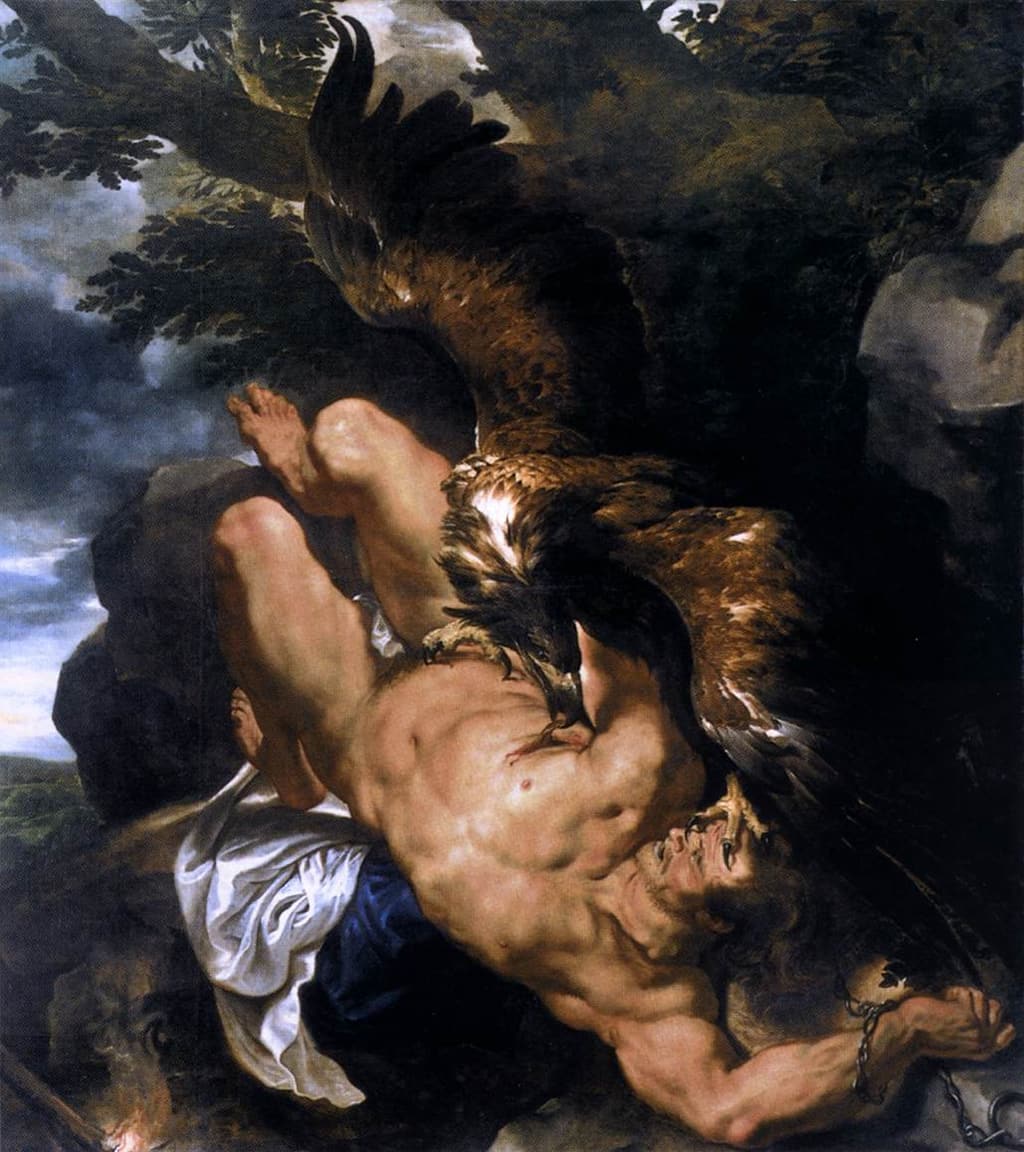
Everyone knows he stole fire. Far fewer know what he did first, and the first act is stranger and more consequential than the theft.
At Mecone, with the terms between gods and men still unfixed, the carving of a sacrificial ox was handed to him and he rigged the packaging. Everything edible went under a repellent skin of tripe; the stripped skeleton went under a glossy coat of suet. Offered the pick, Zeus took the handsome parcel, and Greek altar practice was thereby settled for good: the gods get burnt bone and fat-smoke, the worshippers get the roast. The full Mecone episode sets out both readings of what happened next.
Hesiod's Theogony insists, awkwardly, that Zeus saw through the trick and chose anyway in order to have a pretext for punishing mankind, which reads like a poet protecting his god's omniscience from a story that does not need it. And the point of the story is not the joke. It is the explanation of Greek sacrifice: from that day, the gods received the bones and fat burned on the altar, and the worshippers ate the meat. The central act of Greek religion — a communal barbecue in which the deity gets the smoke — is founded on a swindle. Nothing else in the ancient Mediterranean quite matches that as a piece of theological candour.
Fire in a fennel stalk
Zeus responded by withholding fire from mortals. Prometheus stole it back, carrying it in the hollow pith of a narthex, a giant fennel stalk — a real technology, since dried fennel pith smoulders slowly inside its green casing and was genuinely used to carry embers.
Fire here is not merely warmth. In Aeschylus and in Plato's Protagoras it stands for the whole technical apparatus of civilisation: metalwork, medicine, ships, writing, the reading of omens. The Protagoras version makes the logic explicit — Epimetheus, "afterthought", distributes the natural advantages among the animals and runs out before reaching humans, leaving them naked and defenceless, so his brother steals craft and fire from the workshop of Athena and Hephaestus to compensate.
Two irreconcilable readings, and the fight between them
Hesiod's Prometheus is a criminal. His cleverness is the direct cause of everything wrong with human life: the theft brings Pandora as the answering punishment, and with her the jar, and with the jar disease, toil and old age. In Works and Days the message is that you cannot outwit Zeus and that trying makes things worse. He is the reason men must work.
Aeschylus' Prometheus, in Prometheus Bound, is a martyr. The play opens with the Titan being nailed to a Scythian crag by Kratos and Bia — Power and Force — while a reluctant Hephaestus does the work. Zeus is a new tyrant consolidating a regime; Prometheus is the only being who defied him for humanity's sake and who knows the secret of his eventual downfall: that a certain marriage will produce a son greater than his father. He will not tell. The play ends with him defiant as the crag is blasted into the abyss.
These are not two versions of one attitude; they are opposed judgements on the same act, made by Greeks roughly two centuries apart, and every subsequent use of the figure picks a side. Note also that Prometheus Bound's authorship has been seriously questioned since the nineteenth century on stylistic and metrical grounds — it may not be by Aeschylus at all — and that it was the first of a trilogy whose other parts, including Prometheus Unbound, survive only in fragments. What we have is the defiant half of a story that appears to have ended in reconciliation.
The eagle, and who let him down
The punishment in Hesiod is an eagle that comes each day to eat his liver, which grows back each night — a detail sometimes noticed as an accurate observation of hepatic regeneration, which Greek medicine did know something about. Heracles shoots the eagle during his own wanderings, and Zeus permits it because it adds to his son's glory. The release requires a substitution: the centaur Chiron, immortal and in incurable agony from a poisoned arrow, gives up his immortality in Prometheus' place. Prometheus is thereafter said to have worn a ring set with a piece of the rock, so that Zeus could claim he was still bound.
The secret he was holding is real and pays off elsewhere in the mythology: the sea-nymph Thetis was fated to bear a son greater than his father, which is why the gods married her off to a mortal, Peleus, and why their son is Achilles. Prometheus' one piece of leverage over Zeus is the reason the Iliad exists.
The other job: making people
A separate strand, prominent from the fourth century BCE onward and standard by the Roman period, makes Prometheus the actual creator of humanity, moulding the first men out of clay and water. Pausanias reports that at Panopeus in Phocis visitors were shown two large lumps of clay smelling like human skin, said to be left over from the job. Ovid gives the version in Metamorphoses 1. Hesiod knows nothing of it — his humans simply exist — and the sculptor-Prometheus of later art, with Athena breathing soul into the figures, is a Hellenistic elaboration that then became the dominant image.
His son Deucalion and Epimetheus' daughter Pyrrha are the survivors of the Greek flood, warned by Prometheus in time to build a chest — and the human race is restarted afterwards from stones the two of them throw backwards without looking.
Cult, and the torch race
He is not a much-worshipped figure, but he is not uncultivated either. Athens held the Prometheia, with a relay torch race from his altar in the Academy grove into the city — runners passing a live flame, in which the point was to arrive with it still burning. He shared that altar precinct with Athena and Hephaestus and was honoured particularly by potters, whose kilns depended on controlled fire. The torch relay is one of the very few ancient practices with an unbroken conceptual line to a modern one.
Frankenstein, Shelley, Marx, and the Romantic Prometheus
Prometheus Bound was made a manifesto in the early nineteenth century. Percy Shelley's Prometheus Unbound (1820) deliberately rejects the reconciliation of the lost Aeschylean sequel, on the grounds that he could not write a hero who forgave his oppressor. Byron's ode reads him as the emblem of unrewarded defiance. Goethe's earlier poem has him renounce Zeus outright. Mary Shelley subtitled Frankenstein "The Modern Prometheus" in 1818, and her subtitle points at the creator of humanity from clay quite as much as at the fire-thief — Victor Frankenstein steals a divine prerogative and is punished by the consequence rather than by a god.
Marx, in the preface to his doctoral dissertation, called Prometheus the noblest saint in the philosophical calendar. Beethoven wrote a ballet for him; Liszt and Scriabin wrote symphonic poems. In the twentieth century the figure attached itself to nuclear physics, to genetic engineering, to the Rockefeller Center's gilded statue over an ice rink, and to the naming of promethium, the element isolated from fission products in 1945 and named, its discoverers said, for the daring and the possible misuse of stealing fire.
That entire tradition rests on the Aeschylean reading, and it inverted Hesiod so thoroughly that a modern reader typically finds Hesiod's version bewildering. Both are ancient. Only one has descendants.
The mountain, the liver, and what Mecone is really explaining
Where exactly was he chained?
Aeschylus puts him in Scythia at the world's edge; other sources say the Caucasus, and the mountain now called Kazbek in Georgia carries a local legend of a chained giant, Amirani, which is probably an independent Caucasian tradition rather than a borrowing. Hesiod does not specify the location beyond binding him with inescapable fetters and driving a shaft through his middle.
Does the liver mean something specific?
Probably. The liver was regarded in Greek thought as a seat of emotion and appetite and was the organ read for omens in sacrificial divination — the hepatoscopy practised across the ancient Near East. Choosing the liver rather than the heart for a daily consumption connects the punishment both to prophecy, which is his own gift, and to the sacrifice he corrupted at Mecone.
What is Epimetheus for?
He exists to be the counterweight. The names are transparent: Prometheus is "forethought", Epimetheus "afterthought", and their pairing turns the myth into an argument about the two halves of practical intelligence. Epimetheus distributes the animal gifts badly, and it is Epimetheus who accepts Pandora despite being warned by his brother never to take a gift from Zeus.
Is the Mecone story really about sacrifice?
Directly. Hesiod concludes the episode by stating that this is why the tribes of men burn white bones on smoking altars — an aetiology stated in so many words. What makes it remarkable is the implication that the practice is a fraud on the gods which the gods have chosen to allow, which sits oddly beside the ordinary Greek view of sacrifice as an honour rendered. Ancient readers noticed the awkwardness; Hesiod's insistence that Zeus was not really deceived is the first attempt to smooth it over.