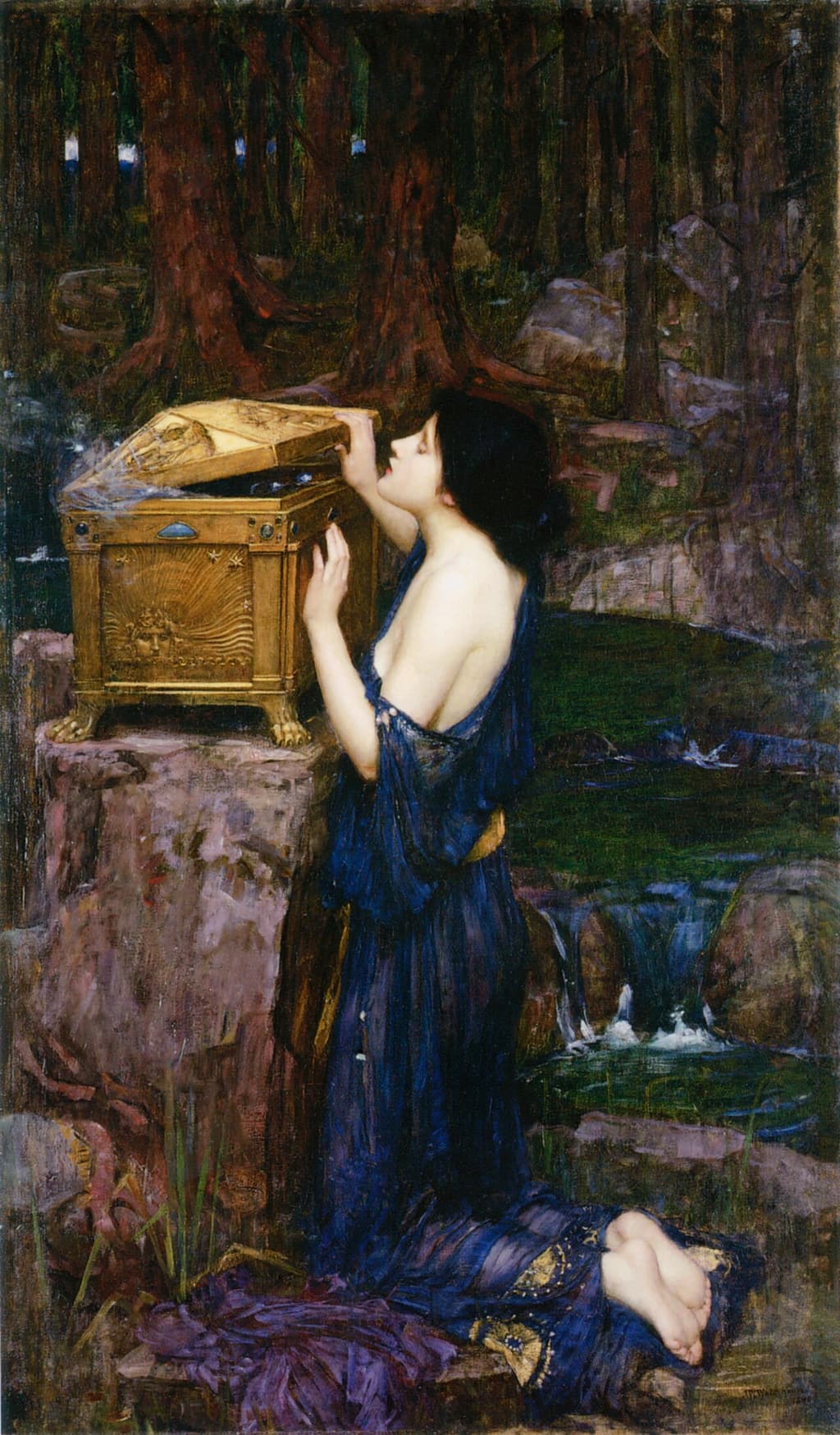
It was a jar.
The Greek word in Hesiod is pithos — a large storage vessel, waist-high or taller, usually ceramic, often partly sunk into the floor, used for grain, oil and wine. Every Greek house had them. In the sixteenth century Erasmus, translating the story into Latin for his Adagia, rendered it pyxis, a small box, apparently confusing it with the box of Psyche in Apuleius. The mistranslation took, and "Pandora's box" is now a fixed phrase in every European language, attached to an object she never had.
The correction is not pedantry. A jar is a food-store: the thing that keeps a household alive through the year, the container of accumulated surplus. Hesiod's story is about a woman opening the household's supplies and letting the contents escape, in a poem that is otherwise a manual about farming, storage and not going hungry. A box is a curiosity item. The change flattens an agricultural parable into a fairy tale about nosiness.
Two tellings, and only one has the jar
Hesiod tells the story twice and they do not match. The Theogony gives the making of the woman as a punishment for Prometheus's theft of fire, dwells on her adornment, and then delivers a long diatribe about women as an evil men cannot live without: a man who avoids marriage has no one to care for him in old age, and a man who marries gets trouble along with his wife. There is no jar and no name.
Works and Days gives the fuller version. Zeus orders Hephaestus to mould her from earth and water, Athena to teach her weaving, Aphrodite to pour grace and painful longing over her head, and Hermes to put in a shameless mind and a deceitful nature. Each god contributes, which is where the name comes from — Pandora, "all-gifted", or, as Hesiod glosses it, the one to whom all the Olympians gave a gift. Hermes delivers her to Epimetheus, who accepts despite his brother's standing warning never to take anything from Zeus.
Then she lifts the great lid of the jar and scatters what is inside: sorrows, diseases, hard labour, and the countless troubles that now wander among men silently, because Zeus took their voices away. Only Elpis — hope, or expectation — remains inside under the rim, because she put the lid back first.
The oldest interpretive problem in Greek literature
What is Hope doing in there, and is it good news?
The difficulty is genuine and structural. Everything else in the jar is an evil. If the jar is a container of evils, then hope being retained inside means humanity does not have it — a bleak reading, in which the last cruelty is that we are denied even expectation. If the jar is a store of goods that has been squandered, then hope is the one thing kept safe, and the ending is a consolation. Both readings are available in the Greek, and the poem does not adjudicate.
There is a third possibility that ancient and modern readers have both taken seriously: that elpis is not "hope" in the modern encouraging sense at all, but expectation of the future, which for a Greek farmer could be exactly the wrong thing to have. Hesiod's advice throughout Works and Days is to work now and not to rely on what may come; he says elsewhere that the man who sits idle in expectation comes to grief. On that reading, hope in the jar is a delusion humanity has been mercifully spared, or a temptation still shut away.
Nietzsche took the harshest line, arguing in Human, All Too Human that Zeus intended hope as the worst of the evils because it prolongs human torment. Others have read the jar itself as her body, or as the household stores, or as the tomb — pithoi really were used for burials. Twenty-seven centuries of argument have not resolved it, and any retelling that presents "hope was left to comfort us" as the meaning has quietly picked one side of a live dispute.
She is not a punishment for her own curiosity
Modern versions almost universally make the opening of the jar a moral failure — she was told not to, and she did. Hesiod does not say she was forbidden. He says she was made deceitful by design, given to Epimetheus as a trap, and that she lifted the lid; the plan is Zeus', and she is the instrument of it. The blame in Works and Days falls on Epimetheus for accepting the gift and on Prometheus for provoking it.
The parallel with Eve is drawn constantly and is worth handling carefully. Both are the first woman, both are associated with the arrival of suffering, both are read in later tradition as curious. But Eve is forbidden and disobeys; Pandora is manufactured as a punishment already in progress. The similarity is real, the mechanism is different, and there is no demonstrated line of transmission — the resemblance is most likely a case of two patriarchal traditions arriving independently at the same explanatory structure.
The other Pandora, who is the earth
There is a competing and much less known use of the name. Pandora appears as a title of the earth goddess — "all-giving", rather than "all-gifted" — in scattered sources, and a fragmentary satyr play of Sophocles called Pandora, or The Hammerers seems to have shown her being hammered up out of the ground. A famous Attic vase in the British Museum shows a female figure rising from the earth between hammering satyrs, labelled in one reading as Pandora and in another as Anesidora, "she who sends up gifts", which is also a cult title of the earth.
If that strand is old, then Hesiod may have taken an earth goddess whose name meant "giver of all" and rewritten her as an artificial woman to whom all was given — an inversion of a bounty figure into a source of scarcity, in a poem obsessed with scarcity. This is a hypothesis rather than a fact, but the name's two possible readings are a real linguistic feature, not an invention.
The image, from Jean Cousin to Rossetti
She was rare in ancient art and common after the Renaissance. Jean Cousin's Eva Prima Pandora around 1550 made the Eve comparison literal in a single reclining figure holding both a skull and a vase. Rossetti painted her repeatedly, red-haired, holding a casket with smoke escaping. Klee, Redon and Beckmann all made versions. In every case she has the box, not the jar.
Her afterlife in language is enormous and entirely idiomatic: opening Pandora's box is a standard metaphor in journalism, law and science policy, invoked for genetic engineering, artificial intelligence, nuclear weapons and any irreversible technical decision. The jewellery company, the music service and the planetary satellite of Saturn all carry the name, and the moon at least is appropriately paired: Saturn's Pandora and Prometheus are the two shepherd moons of the F ring.
The jar, the box, and what becomes of her afterwards
Does she have any story after the jar?
Almost none in Hesiod, but the genealogies give her a daughter, Pyrrha, who marries Prometheus' son Deucalion. When Zeus floods the world, those two survive in a chest and repopulate the earth by throwing stones over their shoulders, which become men and women. So the first woman is the grandmother of the human race in its post-flood form, and the line runs through her rather than around her.
Was there a cult of Pandora?
Not of the Hesiodic figure. Offerings to a Pandora as an earth power are attested in a small number of sources, and the name Anesidora appears as a cult title, but there is no evidence for worship of the manufactured woman. She is a figure of poetry and moral argument, which is unusual — most major Greek mythological names have some cult attached somewhere.
Why do all the gods contribute to making her?
Because the poem is describing the manufacture of an artefact, and Hesiod itemises the labour like a specification: material from Hephaestus, textile skill from Athena, desirability from Aphrodite, deceit and speech from Hermes, clothing and adornment from the Graces and the Hours, a golden crown engraved with all the beasts of land and sea. The result is a kalon kakon, a beautiful evil — a phrase Hesiod uses and which encapsulates the whole misogynist logic of the passage. She is the first manufactured being in Greek literature, which puts her in the same technical lineage as Hephaestus' golden servants and the bronze giant Talos.
Is "Pandora's box" ever going to be corrected?
No, and it is worth understanding why: Erasmus' Adagia was one of the most widely read books in sixteenth-century Europe, and the phrase entered dozens of languages before anyone checked the Greek. The error has now been documented for well over a century — the classicist Jane Ellen Harrison and later Dora and Erwin Panofsky in their 1956 study of the box traced it in detail — and it has made no difference whatever to usage. It is a useful reminder of how much of what people "know" about Greek myth arrived through Latin, and how few of those channels ran straight.