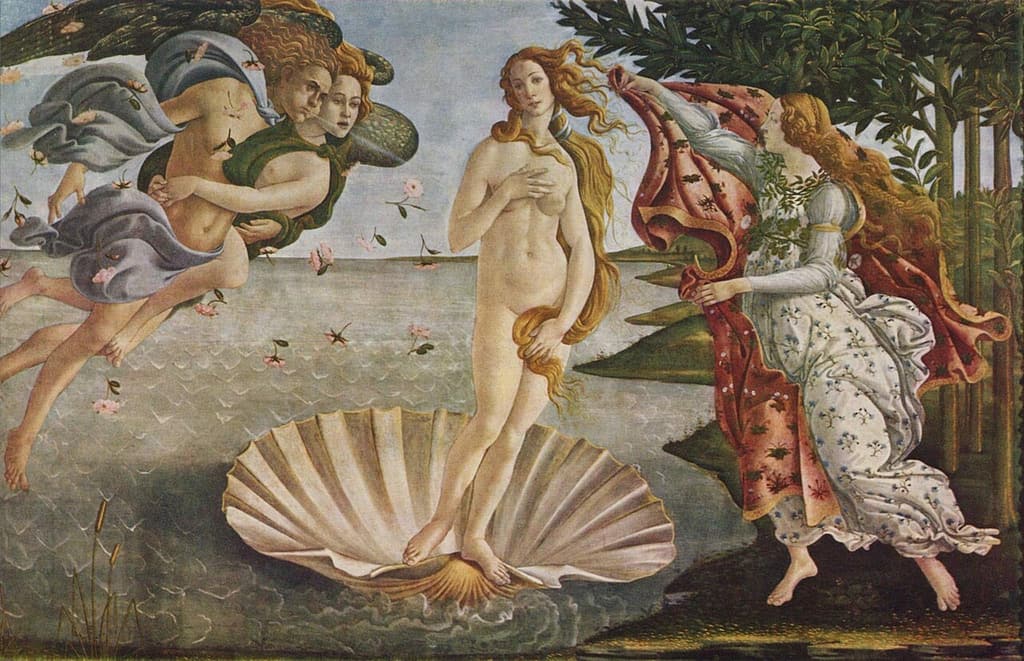
There are two accounts of where Aphrodite came from and they cannot both be true. Hesiod's Theogony has Cronus castrate his father Ouranos and throw the severed parts into the sea; white foam gathers around them, and out of it a goddess grows and comes ashore at Cythera and then at Cyprus, with grass springing up under her feet. She is therefore older than Zeus, born of a mutilation, and her name is glossed — by folk etymology, but an ancient one — from aphros, foam. Homer's Iliad simply calls her the daughter of Zeus and Dione, and in Book 5, when Diomedes wounds her hand, it is Dione who comforts her on Olympus. Both versions circulated in the same centuries among the same audiences, and neither was regarded as an error.
Later Greeks made the split productive rather than embarrassing. In Plato's Symposium, Pausanias distinguishes Aphrodite Urania, the heavenly one born from Ouranos alone with no female parent, from Aphrodite Pandemos, "of all the people", the daughter of Zeus and Dione — and assigns a higher and a commoner love to each. That is philosophy building on a genuine textual conflict, and the distinction has shaped European thinking about love ever since, usually without anyone noticing it began as a discrepancy between two poets.
Cyprus, and a goddess who travelled
Aphrodite's Cypriot connection is not a poetic conceit. Paphos on Cyprus held her oldest major sanctuary, where the cult object was not a statue but a conical stone — a baetyl — shown on Roman coins of the site. Herodotus states outright that the Cypriots themselves said the Paphian sanctuary was founded from Ascalon in Syria, and calls the Ascalon shrine of the "heavenly Aphrodite" the oldest of them all. Her epithets Kypris and Kythereia name islands, not qualities.
The comparative case is strong and specific. The Semitic Astarte and the Mesopotamian Ishtar/Inanna share with her a cluster that is unusual in Greece: association with the planet Venus, with the dove, with sacred gardens, with a dying young consort mourned annually, and with war. Adonis, her mortal lover killed by a boar and lamented in the women's festival of the Adonia — where seedlings were forced in potsherds on Athenian rooftops and left to wither — carries a name that is simply the Semitic adon, "lord". Cyprus is the plausible transmission point, and the Greeks half-remembered it.
The armed Aphrodite
Modern readers meet a goddess of desire and nothing else. Greek cult in several cities knew an Aphrodite Areia, armed. Pausanias, describing Sparta, records a wooden image of an armed Aphrodite and another shown veiled with fetters on her feet — the latter, he says, dedicated by Tyndareus to signify a wife's fidelity, an interpretation that reads like a later rationalisation of an unnervingly old cult object. At Corinth her temple stood on the summit of Acrocorinth, the citadel; at Cythera Pausanias calls her sanctuary the holiest and oldest of her Greek shrines, with the image armed.
The Corinthian cult raises a second, contested question. Strabo reports that the temple owned more than a thousand hierodouloi, sacred slaves who were courtesans, whose earnings enriched the city. The claim is repeated in later sources and has been widely doubted by modern historians, who point out that Strabo was writing about a city refounded as a Roman colony after 146 BCE, that no comparable institution is well documented elsewhere in Greece, and that "sacred prostitution" as a category has been challenged across the whole Near East. The evidence is a real ancient statement and a genuinely disputed modern reading, and it should be presented as one.
What she does in the poems
The Homeric Hymn to Aphrodite is her finest text and it is about humiliation. Zeus, tired of her making gods fall for mortals, makes her desire the Trojan herdsman Anchises. She dresses, is escorted up Mount Ida by fawning wolves and lions, presents herself as a Phrygian princess, and sleeps with him. Afterwards she reveals herself, tells him he will father Aeneas, warns him never to boast of it, and — in the emotional core of the poem — grieves that she of all beings has now been shamed, and that Anchises will grow old, since the gods cannot grant what they gave Tithonus without also granting youth. The poem ends with a goddess who has lost an argument with her own nature.
In the Iliad she is protective and out of her depth: she rescues Paris from his duel in a mist, gets her wrist cut by a mortal spear when carrying Aeneas off the field, and is told by Zeus to stay with the works of marriage and leave war to Athena and Ares. Her most chilling moment is Book 3, where she orders Helen to Paris' bed and, when Helen refuses, threatens to hate her as fiercely as she has loved her. Desire in Homer is not tender.
Sappho's first fragment is the counterweight — an intimate summons in which the goddess arrives in a sparrow-drawn chariot, smiling, and asks who is hurting her this time, in a tone between exasperation and affection. It is the only surviving text that treats a prayer to her as a conversation between people who know each other well.
Her household and the smith
Homer's Odyssey makes her the wife of Hephaestus and gives the story of the invisible net that catches her with Ares; Hesiod instead marries the smith to Aglaea, one of the Graces, and does not mention the affair at all. Her children are a genealogical map of what desire produces: Harmonia, whose Theban marriage begins a cursed line; Eros, whose parentage varies wildly by source and who in Hesiod is a primordial power older than she is; the double-natured Hermaphroditus by Hermes; Priapus by Dionysus in some versions; and Aeneas, through whom the Julian family at Rome claimed her as an ancestor.
The girdle — the kestos himas, an embroidered strap holding persuasion and longing — is her one item of equipment, and the Iliad's best joke about her is that Hera has to borrow it to seduce her own husband.
Venus, and the shell
The Roman Venus began as something much vaguer: a numen of gardens and cultivated charm, whose name is an abstract noun of the same root as venerari, to worship. She was pulled into Aphrodite's orbit under Greek influence and then made politically enormous — Venus Genetrix, ancestress of the Julii, given a temple by Julius Caesar in his new forum; Venus Victrix on Pompey's theatre; Sulla styling himself Felix and her favourite. A goddess of desire became a claim to rule.
Botticelli's Birth of Venus fixed the visual image around 1485 and quietly changed the story: Hesiod's goddess simply walks ashore, whereas the scallop shell that everyone now assumes is ancient comes into prominence in later antique art and reaches the modern imagination through that painting. The Praxitelean Aphrodite of Knidos, the first monumental female nude in Greek art and reportedly so admired that Knidos refused to sell it to pay off its debts, is the other lasting image; the Venus de Milo and the Capitoline Venus descend from that tradition.
From love goddess to aphrodisiac: a reception with the edges filed off
She has fared oddly. As "love goddess" she is everywhere and means very little — a shorthand for beauty in advertising, a supporting player in retellings, the origin of aphrodisiac and, through Venus, of venereal, a word that shows how thoroughly Christian Europe recast her. The planet keeps her Roman name and the day Friday keeps it in the Romance languages through dies Veneris. Recent fiction has begun to recover the harder version — the goddess who is not kind, who compels rather than charms — with Madeline Miller's and Pat Barker's Trojan novels among the clearest examples. What still almost never appears is the armed goddess on the Corinthian citadel or the Near Eastern goddess of the morning star.
Castration, the Adonia, and the two Aphrodites of actual cult
Is the foam-birth story about castration really the standard one?
It is the oldest surviving one, and Hesiod tells it without euphemism: Ouranos' severed genitals fall into the sea and the goddess grows from the foam around them. Nearly every popular retelling keeps the foam and drops the mutilation, which changes the theology — in Hesiod she is a consequence of the succession violence that also produces the Erinyes and the Giants from the same blood, born in the same paragraph.
What was the Adonia actually like?
An unofficial festival, held by women in private houses rather than by the city, in high summer. Shallow potsherds and baskets were planted with fennel, lettuce and wheat, forced into rapid growth on hot rooftops, allowed to die, and thrown out with laments. Ancient male commentators found the noise irritating; Aristophanes complains about it in the Lysistrata. As a rite about wasted potential and premature death it has no real parallel in the official Athenian calendar.
Did the Greeks connect her to the planet Venus?
Eventually. The morning and evening stars were originally two objects to the Greeks, Phosphoros and Hesperos, and their identification as one body is credited variously to Pythagoras or Parmenides. Once identified, the planet took the name of Aphrodite — following, in all likelihood, the earlier Babylonian association of that planet with Ishtar, which arrived along with Babylonian astronomy.
What is the difference between Urania and Pandemos in actual cult?
Both were real cult titles before Plato used them philosophically. Aphrodite Pandemos at Athens had a sanctuary on the southwest slope of the Acropolis and was associated with the civic body and its unity — "of all the people" in a political sense, not a sexual one. Aphrodite Urania at Athens had her own precinct near the Agora with an image by Pheidias. The moralised reading of the pair is Plato's contribution, not Athenian religion's.