In the Iliad he is a secondary Trojan who gets into trouble twice and is pulled out of it twice — once by his mother, once by Poseidon, who saves an enemy because fate requires that Aeneas and his descendants rule over Trojans hereafter. That prophecy, four lines in Book 20, is the crack in the Homeric text through which the whole Roman national epic eventually came.
He reached Italy long before Virgil sent him there
The instinct to treat Aeneas as Virgil's invention is wrong, and the archaeology says so. Attic black-figure vases showing a warrior carrying an old man on his shoulders — the escape from Troy — were being imported into Etruria in the sixth century BCE, and terracotta statuette groups of the same scene have been found at Veii. Greek writers were placing Trojan wanderers in the western Mediterranean well before Rome mattered to anybody.
At Lavinium, thirty kilometres from Rome, excavation has uncovered a line of thirteen archaic altars in use from the sixth century BCE, and a seventh-century tumulus that was reopened and monumentalised in the fourth century as a hero-shrine. Roman tradition knew that shrine as the tomb of Aeneas Indiges or Pater Indiges, and incoming Roman magistrates were required to travel down and make offerings there before taking up their duties. Whatever the original occupant of that tumulus was, by the fourth century BCE Latins were honouring Aeneas at a real site with a real annual obligation.
The chronology never worked. Troy fell, in the conventional Greek reckoning, in 1184 BCE; Rome was founded in 753. Roman historians bridged the four-century gap by inserting a list of Alban kings between Aeneas's son and Romulus — a genealogical splice you can see the seam of, and which the Roman family tree draws as exactly that.
Pietas is not piety
Virgil's stock epithet for him, pius, is the single most misread word in Latin literature. It does not mean devout. Pietas is the discharge of obligation in three directions at once — to the gods, to your father and family, to your community — and it is frequently painful, frequently at the expense of what the man himself wants.
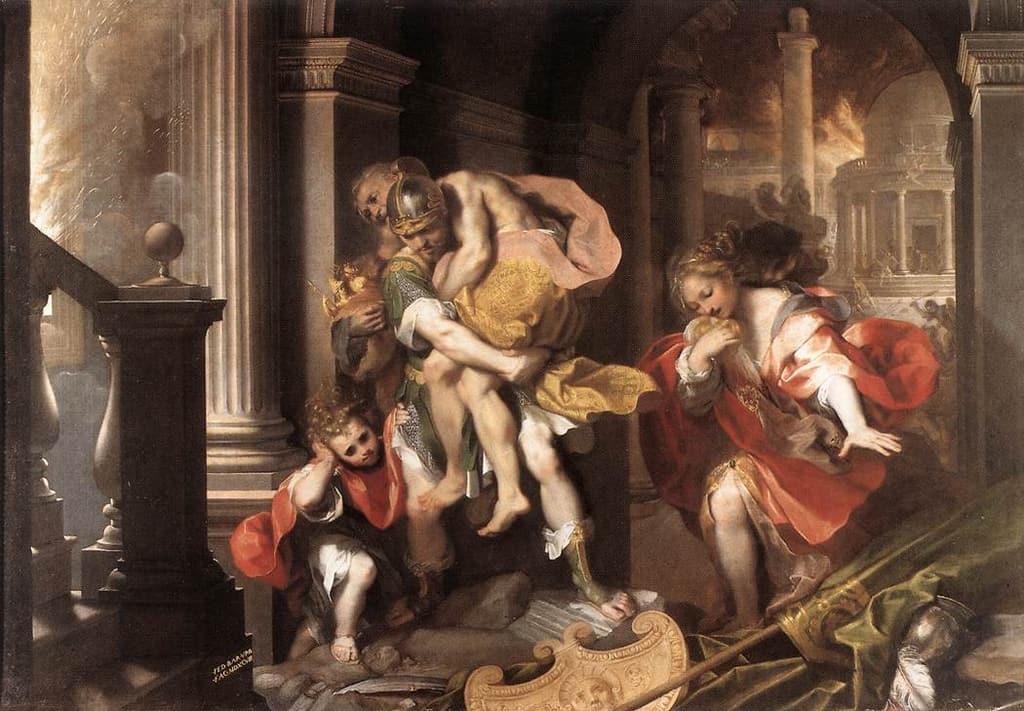
The visual shorthand for it is the image already circulating on those Etruscan vases: Aeneas leaving a burning city with Anchises on his shoulders and Ascanius by the hand, carrying the household gods, while his wife Creusa is lost in the smoke behind. Past, future and cult, all held; the personal loss, unheld. Every serious argument about the Aeneid is an argument about the cost of that arrangement.
Which is why the Dido episode is not a romantic interlude but the poem's crisis. Aeneas leaves Carthage on divine instruction; Dido curses his descendants and kills herself on a pyre; the curse is the Aeneid's explanation for the Punic Wars, written by a poet whose readers' grandparents had razed Carthage. When Aeneas meets her in the underworld she will not speak to him, and turns away. It is the most quoted silence in Latin poetry, and Virgil gives the victim the last word by giving her no words at all. That episode has its own fuller treatment on Dido and Aeneas.
The descent, and a parade of the unborn
Book 6 sends him down at Cumae with the Sibyl, through a gate reached with a golden bough, to find his father. Anchises shows him a queue of souls waiting to be born: the Alban kings, Romulus, and then Roman history in order down to Augustus, ending with a young man in shadow whom the reader recognises as Marcellus, Augustus's nephew and intended heir, dead at nineteen.
The tradition, reported by the ancient biographers, is that Virgil read the passage aloud to Augustus and to Marcellus's mother Octavia, and that she fainted. The story may be embroidery, but it registers accurately what the scene is: the future as consolation and the future as bereavement in the same breath. Anchises' instruction to Rome — to spare the conquered and crush the proud, and to let others make better statues — is the closest thing the poem has to a mission statement, and even that is phrased as a concession that Romans will never be the best at anything except rule. The episode is treated at length on Aeneas in the underworld.
What the poem was for, and who commissioned it
The Aeneid was written between roughly 29 and 19 BCE, and its political function is not concealed. The gens Iulia claimed descent from Iulus, whom Virgil identifies with Ascanius, and therefore from Venus through Aeneas. Julius Caesar built Venus Genetrix — Venus the Ancestress — a temple in his own forum. Augustus, Caesar's adopted heir, filled the Forum of Augustus with statues of the Alban and Julian line and put Aeneas carrying Anchises in one exedra facing Romulus carrying the spolia opima in the other.
Reading the poem as straightforward propaganda, though, has been out of favour for fifty years, and for good textual reasons. The dominant modern arguments concern its second voice: the sympathy given to the defeated, the cost tallied on nearly every page, the sense that the empire is bought at a price the poem keeps itemising. There is no settled answer, and pages that give you one are selling something.
The ending nobody agrees about
The last scene: Turnus, beaten and asking for mercy, and Aeneas about to grant it — until he sees on Turnus's shoulder the sword-belt stripped from the boy Pallas. He kills him in rage, and the poem stops, mid-consequence, with the loser's spirit going down to the shades complaining.
No wedding to Lavinia, no founding, no reconciliation scene. Some lines in the poem are metrically incomplete, and the ancient tradition says Virgil died with the work unrevised and asked for it to be burned; Augustus overrode the request and had Varius and Tucca publish it with minimal editing. So it is genuinely impossible to know whether the abruptness is unfinished business or the point. The most powerful readings take it as the point: a poem about the mastery of passion by duty, ending with duty losing.
The Roman uses of a Greek character
Aeneas gave Rome three things no native founder could. He connected the city to the Homeric world on terms of equality rather than as a Greek colony. He made the Romans the descendants of Troy — that is, of Greece's enemies, which was useful when Rome was conquering the Greek east. And he supplied a genealogy that one family could own.
He is also the reason the Roman state kept objects: the Penates at Lavinium and the Palladium in Vesta's temple were understood as the actual portable gods he carried out of Troy. Roman religion was full of things whose value lay in continuity of possession, and Aeneas is the hinge that gave those things a provenance.
Aeneas since Rome
He is the ancient hero the Middle Ages read most, because Latin survived where Greek did not: Dante takes the Aeneid as his model and Virgil as his guide, and Book 6 is the structural ancestor of the Inferno. British and French medieval chroniclers extended the trick, inventing Trojan descents for their own royal houses on Virgil's pattern — Geoffrey of Monmouth's Brutus, great-grandson of Aeneas, founding Britain.
The love plot then took on its own life: Purcell's Dido and Aeneas, Berlioz's Les Troyens, and a long line of paintings of the departure from Carthage. Ursula K. Le Guin's novel Lavinia retells the last books from the point of view of the woman Virgil gives no lines to at all. And "pious Aeneas" remains the epic hero readers most often report disliking, which may be the most durable evidence that Virgil built him to be admired rather than enjoyed.
What readers usually want clarified about Aeneas
Did Romans believe he was a real person?
By and large, yes, in the same way they believed the early kings were real. Livy opens by saying that traditions from before the founding are better suited to poetry than to reliable record, and then relates them anyway; Dionysius of Halicarnassus assembles competing versions like a historian handling difficult evidence. The doubt was about details — his route, his death, which son was which — not about whether such a man had come.
How did he die?
Not in Virgil, who never gets that far. Roman tradition says he vanished after a battle by the river Numicus and was thereafter worshipped as Iuppiter Indiges or Pater Indiges, with a shrine on the riverbank. It is the same narrative shape as Romulus's disappearance: a founder who is not buried but withdrawn, which conveniently makes a hero-cult possible without a corpse.
Is there a connection between Aeneas and the Trojan horse story?
He is absent from it, which the Greeks noticed and used. A Greek tradition preserved by Menecrates and others accused Aeneas of betraying Troy to the Greeks out of hatred for Priam's family, and of being spared as payment. Roman writers knew that version was circulating and had strong reasons to bury it; Virgil answers it with the whole of Book 2, in which Aeneas fights until fighting is meaningless and leaves only when three separate divine signs order him to.
Why does the poem stop being about Troy so quickly?
Because it is not about Troy. The first six books answer the Odyssey and the last six answer the Iliad, and by Book 7 the subject is the war for Latium — the founding of a mixed Latin-Trojan people. Juno's condition for peace, in Book 12, is that the Trojans give up their name, language and dress and the new people be called Latins. The epic's ultimate answer to "what happened to Troy" is that it stopped existing in order to become somewhere else.