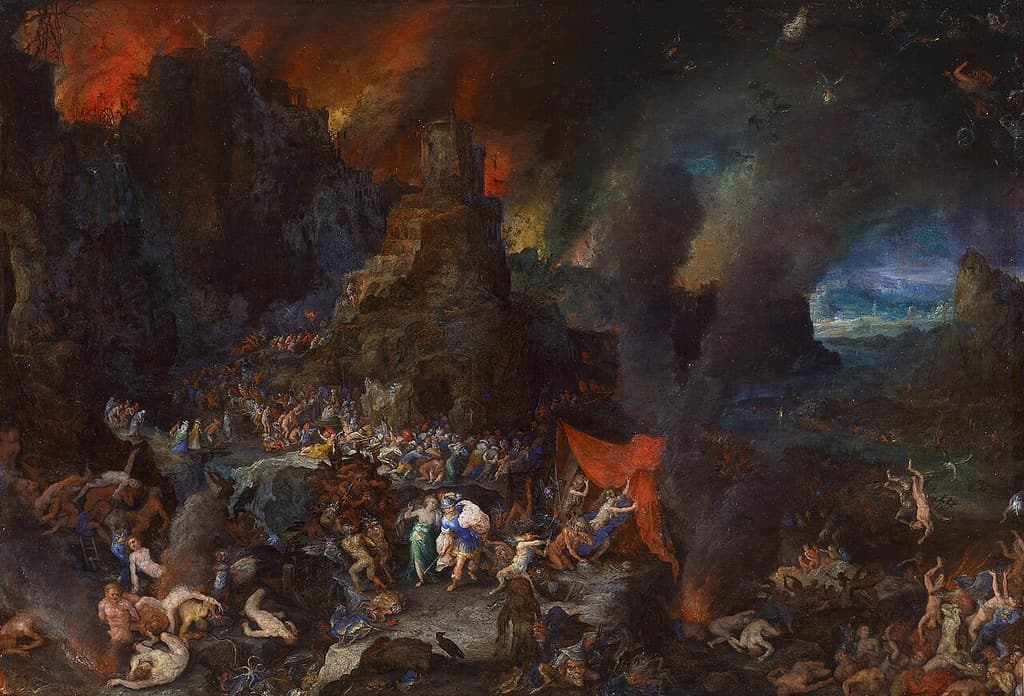
Every underworld in European literature after this one is downstream of it. The geography Dante walks through, the river with the ferryman, the crowd on the wrong bank, the sorting of the dead into regions by what they did — all of it is fixed in a single book of a Latin poem written between 29 and 19 BCE, and much of it was fixed there for the first time. And the poem ends the whole vision by sending its hero back to the world through the gate that dreams come out of when they are false.
Arriving at Cumae
The fleet beaches on the Italian coast at Cumae. While the crews scatter for water and firewood, Aeneas climbs to the temple of Apollo on the height.
Its doors were made by Daedalus, who landed here after his flight and hung up his wings, and he carved his own story into them: Crete, the bull, the Minotaur, the labyrinth and the thread. He tried twice to carve his son falling out of the sky and could not do it, and his hands failed him, and that panel is blank. Aeneas would have stood reading the doors all morning if he had not been called away — the poem's quiet warning that a man on an errand cannot afford to look too long at other people's grief.
Inside is the Sibyl, in a cave cut with a hundred mouths that carry her answers out. The god takes her; her face changes, her breathing goes wrong, she grows taller, and the prophecy comes out of her in pieces: wars, terrible wars, the Tiber foaming with blood, another Achilles waiting in Latium, and again a foreign bride as the cause of it. The advice she ends on is the line Roman schoolboys memorised for two thousand years — do not give way to the disasters, go at them harder than your luck allows.
He asks to go down and see his father. She tells him the descent is easy and open every hour of every night and day; it is the coming back up that is the work. And she sets two conditions. He must find a golden bough hidden in a dark tree, which will come away in his hand if fate wants him and will not be cut if it does not. And there is a dead man lying unburied in his camp who is polluting the whole fleet, and that must be dealt with first.
The dead man is Misenus, the trumpeter, who had challenged the gods to a contest of blowing and been drowned for it. They build his pyre on the headland that still carries his name. And while Aeneas is standing in the wood despairing of ever finding one bough among thousands, two doves come down — his mother's birds — and lead him, feeding as they go, to the tree where the gold is glinting.
Down the throat
At the mouth of the cave they sacrifice black cattle in the dark, the ground bellows under them, dogs howl somewhere, and the Sibyl tells everyone else to get out.
The vestibule is populated by abstractions given bodies, and Virgil's list is one of the most imitated passages in Latin: Grief and vengeful Cares in the doorway; pale Diseases; sad Old Age; Fear; Hunger, who advises men to do wrong; squalid Poverty; Death and Toil; Sleep, the brother of Death; the mind's guilty joys; War; the iron chambers of the Furies; and Discord with vipers braided into her hair. In the middle stands an elm of enormous age with false dreams roosting under every leaf.
Beyond them the monsters are stabled — Centaurs, Scyllas, the hundred-handed one, the Hydra hissing, the Chimaera on fire, Gorgons and Harpies. Aeneas draws his sword at them and the Sibyl stops him: they are shapes without bodies, and he would be slashing at air.
Then the river, and the crowd.
The bank, the ferryman, and Palinurus
The dead are pouring down to the water like leaves coming off in the first cold, and the ferryman takes some and pushes others back. Aeneas asks why the discrimination.
Because the ones being turned away are unburied. The ferryman is not permitted to carry anyone across whose bones have no resting place; they wander this bank for a hundred years before they are allowed over.
Among them is his own helmsman, Palinurus, lost overboard on the last leg of the voyage, who describes exactly how he died and begs to be taken across, or at least to have earth thrown on him. The Sibyl's refusal is severe — nobody crosses without burial and no prayer bends divine decree — but she gives him something instead: the people of the coast where his body washed up will be driven by omens to bury him and to raise a mound over him and make offerings, and the place will carry his name for ever. He is comforted by having a headland named after him, and the poem lets that stand as a real consolation.
Charon challenges them, and the Sibyl says nothing except to have the golden bough uncovered, and he stops arguing and clears the boat, which takes on water under the weight of a living man. Cerberus is dealt with by a drugged honey-cake, and goes to sleep across the whole width of the cave.
The regions of the dead
What follows is a sorting, and its logic is the poem's real innovation.
Infants first, crying on the threshold, dead before they had lived. Then those executed on false charges, whose cases are heard again by Minos with a proper jury. Then the suicides, who threw away their lives from hatred of the light and would give anything now to have back the poverty and the labour they could not stand.
Then the Fields of Mourning, a myrtle wood where those destroyed by love walk, their sufferings still on them: Phaedra, Procris, Eriphyle showing the wounds her son gave her, Evadne, Pasiphaë, Laodamia, and Caeneus, who was a woman and became a man and has been changed back by death.
And Dido, with the wound still fresh.
Aeneas has not known until this moment that she is dead. He weeps and speaks to her — that he left against his will, that the gods compelled him, that he never believed his going would cost her this. She stands with her eyes on the ground and does not look at him and does not answer, no more moved than a piece of flint, and then turns and goes off into the shade of the wood to her first husband, who matches her grief and returns her love. Aeneas stands there and watches her go and then goes on with his errand, in tears. It is the best scene in the poem and it is over in forty lines. The whole of Dido and Aeneas is answered by a silence.
Further on are the soldiers. Trojans crowd round him; Greeks who see him in the half-light turn and run, and their war-cry comes out as a thin squeak, which is the poem's one moment of cruelty towards the dead. Deiphobus is there, mutilated — hands, ears and nose cut away — and tells him what happened in Troy on the last night, and who let the Greeks into the bedroom.
The fork
The road divides. To the left, under a cliff, is Tartarus, ringed three times by a river of fire, with a gate no god can force and a Fury sitting sleepless on the iron tower above it. The Sibyl has been inside and will only describe it: the Titans, the giants who tried to pull the sky down, the man who imitated thunder with a bronze chariot and torches and was struck for it, the one whose liver is eaten and grows back, the wheel, the boulder, the feast that recedes.
And she reports what is shouted from inside as a warning to the living: learn justice, and do not despise the gods.
To the right, past a threshold where Aeneas sprinkles himself and fixes the golden bough in the doorway, is Elysium — and Virgil's Elysium has its own sun and its own stars, which is a startling piece of invention. There are wrestling grounds and dancing floors, a poet in a long robe playing to them, the ancient founders of the Trojan line lying on the grass, arms and chariots and horses maintained in death by men who cared about them in life. Priests who kept themselves clean, poets who said nothing unworthy, inventors who improved life, and people who are remembered for having done good — the criteria are broad and secular and deliberately not aristocratic.
What Anchises says
They find Anchises deep in a green valley, reviewing a crowd of souls as though inspecting recruits.
His son tries three times to put his arms round him and gets nothing each time, and the comparison Virgil uses is a light wind, or a dream that flies away when you wake.
Then Anchises explains the system, and this is where the Aeneid stops being Homeric and becomes philosophical. A spirit sustains the whole universe from within — sky, earth, sea, the moon, the stars — and mind is mixed through the entire mass and moves it. Individual lives are sparks of that, dulled and contaminated by the bodies they are shut into. Death does not clear it; the stains have to be worked out over long periods, by wind, water and fire, until what is left is clean. Then, after a thousand years, they are called to the river of forgetting, and they drink, and they go back up and want to enter bodies again.
That is a Pythagorean and Platonic scheme, imported wholesale into Roman epic, and it sits awkwardly beside the ghosts and the ferryman in the same book. Virgil does not smooth the seam.
The parade
And then the point of the whole descent. The souls waiting at the river are the future of Rome, and Anchises names them as they pass.
The Alban kings. Romulus, with the double crest. Augustus Caesar, promised a second golden age and an empire past the stars. Numa coming with sacred vessels and an olive branch, then the warlike kings and the Tarquins. Brutus, who will execute his own sons for conspiracy against the Republic — and Anchises will not judge him, only says that love of country and an immense appetite for praise will win. The Decii who threw their lives away deliberately. Camillus bringing the standards back. Then Caesar and Pompey, marshalling armies against each other, and the old man breaks off to plead with them not to turn those weapons on their country's guts.
Then the statement of national purpose that every Roman knew by heart: others will hammer bronze into something that breathes, and plead a case better, and measure the sky and predict the risings of the stars. Your art, Roman, is to govern the nations — to impose the practice of peace, to spare those who submit, and to grind down the proud.
And then it ends on a boy. Anchises shows a young man walking with his head down in a cloud of gloom, magnificent and doomed, and will not say his name until he is asked. Virgil's audience needed no telling. It is Marcellus, the young man Augustus had married to his daughter and groomed to succeed him, dead in 23 BCE before he turned twenty. Anchises' lament for him — bring lilies in double handfuls — is the last thing in the vision. An early biography reports that Octavia, the boy's mother, fainted when Virgil read the passage aloud to the imperial family.
The ivory gate
There are two gates out of sleep. One is horn, through which true shades pass easily. The other is ivory, perfectly finished, through which the dead send false dreams up to the world.
Anchises sends his son and the Sibyl out through the ivory gate.
Nobody has ever satisfactorily explained why, and the passage is one of the most argued-over dozen lines in Latin literature. The proposals include: that Aeneas is not a true shade and therefore cannot use the gate reserved for them; that the timing matters, since dreams before midnight were held false; that Virgil is marking the entire vision as poetry rather than doctrine; and — the reading that has dominated since the 1960s — that the poet is quietly withdrawing his endorsement, letting the whole Augustan future he has just paraded exit through the door marked untrue.
The poem gives no help. Aeneas goes to his ships, and the book ends.
Where it came from, and what it made
Virgil's underworld is a construction, not a report of Roman folk belief. He builds it out of the ghost-raising in Odyssey 11, out of Orphic and Pythagorean teaching about purification and rebirth, out of Plato's vision of the afterlife at the end of the Republic, and out of Cicero's dream of Scipio, which had already used a vision of the cosmos to deliver a lesson in Roman public duty. What Virgil adds is moral topography — the idea that the dead are arranged, region by region, according to how they died and what they did.
That idea is what Dante inherited, along with the guide, the descent, the encounters with the recently dead, and the poet's own decision to have Virgil himself lead him down. The golden bough went on to give James Frazer the title of his enormous comparative study, on the strength of a speculative link between Virgil's branch and mistletoe — an association Frazer built rather than found.
Cruxes in Book 6
Is the golden bough from an older source? None is known. It may well be Virgil's invention. He describes it as growing in a dark ilex, gold in leaf and stem, and compares it to mistletoe, which is where the later theorising starts.
Why does Dido not speak? Because the silence is more devastating than anything she could say, and because Virgil is quoting Homer — Ajax refuses to speak to Odysseus in the Odyssey for the same reason. Roman readers heard the allusion and heard what was done with it.
Are the punishments in Tartarus Roman? The named sinners are Greek myth. The crimes generalised alongside them are conspicuously Roman: hating a brother, striking a parent, cheating a client, hoarding wealth without sharing it, taking bribes to pass bad laws, arms taken up against one's own country. Virgil is grafting a Roman ethics onto Greek scenery.
Does the reincarnation doctrine fit the rest of the poem? Not really, and that is not a fault to be explained away. Book 6 holds a Homeric underworld and a philosophical one in the same space, and the friction is part of the effect.
Where is Cumae? On the coast north-west of Naples, and the site is open. A long trapezoidal rock-cut gallery there was identified in 1932 as the Sibyl's cave; whether it is the one Virgil had in mind, and whether it was ever oracular rather than military, is disputed.
Continue with Aeneas, the Cumaean Sibyl, the queen he left at Dido and Aeneas, his escape at Aeneas leaves Troy, and the Roman hub.