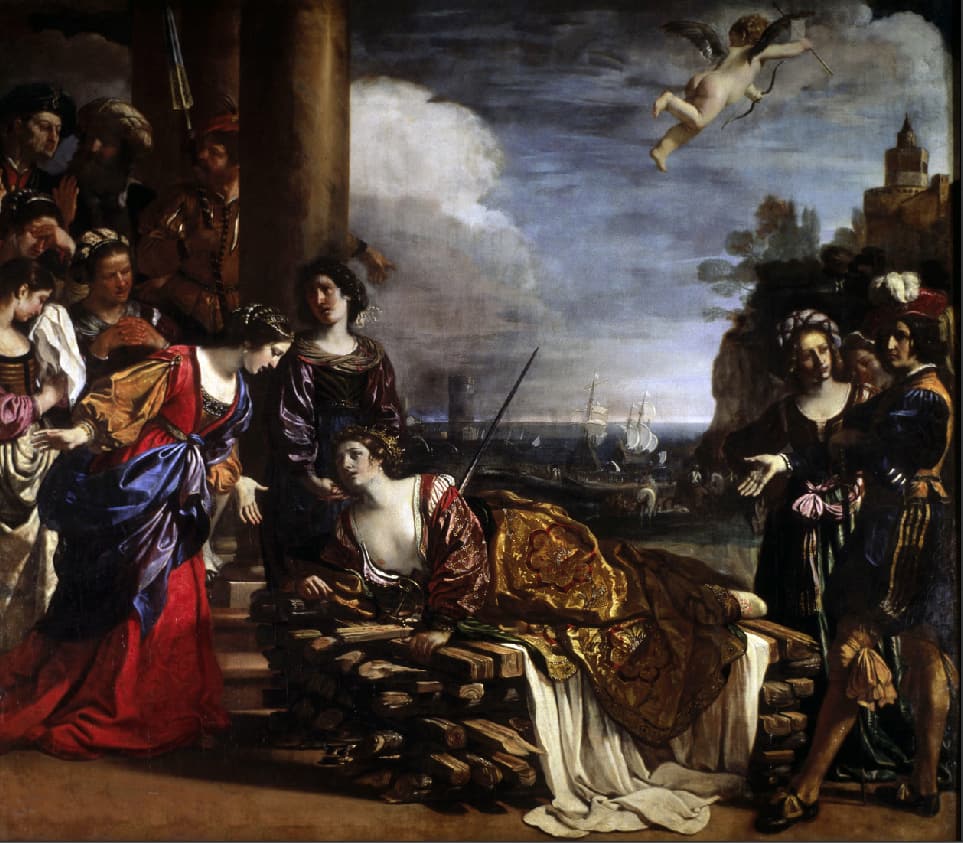
There is a version of this woman in which no Trojan appears at all. She is a Phoenician princess who escaped a murderous brother, outwitted a landlord, founded one of the great cities of the Mediterranean, and killed herself rather than be married off to a neighbouring king who was threatening war. That story is older than Virgil, and it is the one Carthage itself seems to have told. What Latin poetry did to it is one of the boldest acts of appropriation in ancient literature, and the reason most people now know her name.
The queen before the poem
Her Phoenician name was Elissa — a real name, attested in Punic inscriptions as Elishat. She was a daughter of the royal house of Tyre and married to a wealthy priest of Melqart, called Sychaeus in Virgil and Acerbas or Sicharbas in the other tradition. Her brother Pygmalion, king of Tyre, wanted the priest's gold and had him killed at his own altar, then lied about it. The murdered man's ghost came to her in a dream, told her where the body was and where the money was buried, and told her to run.
She ran with a fleet, a following of Tyrian nobles and the treasure, stopping at Cyprus to collect priests and, in one account, eighty young women for the colonists to marry. On the North African coast she asked the local ruler for as much land as could be covered by an oxhide, was granted it as a joke, and had the hide cut into a single continuous thread thin enough to enclose an entire hill. The Romans knew that hill as the Byrsa, and the pun — Greek byrsa, "hide" — is almost certainly a Greek folk etymology attached to a Punic word for citadel. It is a good story regardless, and the archaeology of the Byrsa is real: the earliest occupation material from Carthage dates to the late ninth or early eighth century BCE, close enough to the traditional foundation date of 814 BCE for the tradition to be doing better than usual.
Then a Libyan king named Iarbas demanded her hand and made clear that a refusal meant war. Her own nobles pressed her to accept. She asked for three months, built a great pyre on the pretext of a rite to lay her first husband's spirit to rest, and killed herself on it in front of the city. The point of her death was that a queen who had sworn not to remarry would not break the oath and would not sell her people into a war either. Justin, epitomising the lost universal history of Pompeius Trogus, ends by saying she was worshipped as a goddess at Carthage for as long as the city stood.
That is the whole story, and there is no love in it.
What Virgil did
Aeneid 1 opens with a storm. Juno, who loves Carthage and knows what Rome will one day do to it, bribes the king of the winds to wreck the Trojan fleet; Neptune puts the sea down in irritation at the trespass; the survivors come ashore in Libya. Venus, meeting her son on the beach disguised as a huntress, tells him whose country he has landed in and gives him Elissa's backstory.
He walks into the half-built city — cranes, masonry, a harbour going in, and Virgil's beautiful image of the citizens working like bees — and finds, in the unfinished temple of Juno, the Trojan War painted on the walls. He recognises himself among the figures. It is the moment that produces the most quoted and least translatable line in Latin, three words about tears in things and mortal matters touching the mind, and it is what makes him weep in front of a queen he has not yet met: she has decorated her temple with his catastrophe.
Venus does not trust the Carthaginians and takes precautions. She has Cupid take the shape of the child Ascanius, sit in the queen's lap at the banquet, and burn away her memory of the dead husband while she strokes his hair. This is important and often forgotten: in the poem as written, Dido's love is not something she arrives at. It is done to her by a goddess, as a security measure, using a disguised child.
She asks for the story of Troy, and he tells it — the two longest books of the epic are a reply to her question.
Book 4
The fourth book is the most read hundred and fifty lines-per-section of Latin verse in existence, and it is essentially a clinical study. Dido confesses to her sister Anna that she recognises the traces of an old fire; Anna, thinking politically about a kingdom hemmed in by hostile tribes, tells her to pursue it. She drags priests and victims through sacrifice after sacrifice, and Virgil observes drily that seers are no use to anyone with fire already in the bone marrow. She stops supervising the building work. The cranes stand idle and the walls stop rising — a detail worth more than any speech about what the affair costs.
Juno and Venus then strike a bargain neither believes in, each intending to keep the man in a different place, and arrange a hunt. A storm scatters the party, and the queen and the Trojan shelter in the same cave with lightning outside and, in one of the eeriest lines in the poem, nymphs howling from the ridge. Virgil writes that she called it marriage and used the word to cover the fault — and then unleashes Rumour, personified as a bird-monster covered in eyes and tongues and ears that grows as it travels, to carry the news across Libya.
It reaches Iarbas, who complains to Jupiter about the woman who refused him. Jupiter sends Mercury down to find Aeneas supervising Carthaginian construction in a Tyrian cloak with a jewelled sword — dressed, in other words, as a consort — and to ask him what he thinks he is building, and for whom, and what he imagines his son is owed.
He gives the order to prepare the fleet quietly. She finds out, because she always finds out, and the confrontation is a masterpiece of two people arguing from incompatible premises. She asks whether he is really running from her in winter, whether their nights meant anything, what she is to do now that she has made enemies of her own people and her neighbours for his sake. He answers that he never carried a wedding torch, never entered into that contract, and would rebuild Troy for his own people if the choice were his — and then the sentence that has damned him for two thousand years: it is not by his own will that he sails for Italy.
She curses him: that he die before his time and lie unburied on sand, that his people and hers be at war for ever, and that an avenger rise one day from her bones. Roman readers knew exactly whose name was being withheld, and it was Hannibal's.
She has the pyre built inside the palace courtyard, telling Anna it is a rite to burn away everything he left behind. She climbs it, lies on the bed, takes the Trojan sword he gave her, and says she has lived and finished the course fortune gave her; a city stands that she founded; she saw her walls; she avenged her husband; she would have been happy if the Trojan ships had never touched that shore. Then she falls on it. Juno, watching a death that is neither natural nor deserved and seeing the soul unable to detach, sends Iris to cut the lock of hair that formally releases her.
Out at sea, Aeneas sees the glow of a fire behind the walls and does not know what it is. He learns in book 6, when he meets her in the Fields of Mourning among the suicides for love — and she will not look at him, will not answer a word, and turns away into the shadows to her first husband, who cares about her sorrow and matches it.
Where the sources genuinely disagree
- Timaeus of Tauromenium, writing in the third century BCE, is the earliest known teller of the Elissa story, and he already has the pyre and the suicide. The chronology also refuses the affair flatly: the fall of Troy was conventionally dated to around 1184 BCE and Carthage to 814. They cannot have met, and Roman readers were perfectly aware of it.
- Naevius, in his Bellum Punicum of the third century BCE, appears to have brought Aeneas to Carthage. The poem survives in scraps, and whether the meeting was already a love affair is one of the real unresolved questions in Latin scholarship. Some think Virgil inherited a fully formed romance; others that he took a bare encounter and built book 4 out of nothing.
- Justin, whose epitome preserves the Punic-flavoured version, has no Trojan and no love; the suicide is a political act.
- Ovid, Heroides 7, writes her farewell letter, and takes Virgil's side of the story only to argue against him. His Dido is sharper, more sarcastic, and raises the possibility that she is pregnant — a detail Virgil dangles for one line and drops.
Nothing survives written by a Carthaginian. Punic literature is gone, apart from inscriptions; everything anyone says about Carthage comes from the people who destroyed it. When a Roman poet gives Rome's greatest enemy a founding queen whose dying wish is eternal war, it is worth reading as a Roman document about Roman anxiety rather than as a report from Africa.
Questions this story keeps raising
Is Aeneas meant to look this bad?
Virgil's readers were not unanimous either, and the ancient commentators already argue about it. What is clear is that the poet does not protect him: his self-defence is legally exact and emotionally worthless, he lies about the fleet, and when they meet again in the underworld the silence is designed to humiliate him. St Augustine remembered in the Confessions that as a schoolboy he had wept over Dido's death while feeling nothing about the state of his own soul, and he was not confused about who the sympathetic character was.
Why do people know the story through an opera?
Because Nahum Tate and Henry Purcell built one around it in the late 1680s, and its final aria — a lament over a descending ground bass, in which the dying queen asks to be remembered but not for her fate — is one of the most performed pieces of English music ever written. Marlowe had staged the story a century earlier; Metastasio's libretto was set by dozens of eighteenth-century composers; and Berlioz spent years on Les Troyens, which he did not live to see performed complete.
Was there a real cult of the founder at Carthage?
Justin says there was, and it is plausible: Greek and Phoenician colonies routinely gave their founder heroic honours. There is no direct Punic evidence for it, and a child-sacrifice association sometimes attached to her in modern retellings comes from the disputed interpretation of the tophet burials, which has nothing to do with the foundation legend and is a separate argument entirely.
What does the name mean?
Nobody knows. Elissa is a genuine Phoenician personal name. Dido is generally taken as a byname rather than a birth name, and ancient writers glossed it as "the wanderer", which looks like the kind of etymology invented to fit a story already in circulation. Both forms remain in use as modern given names, and if you have followed a naming trail into mythology, that is a road worth walking.