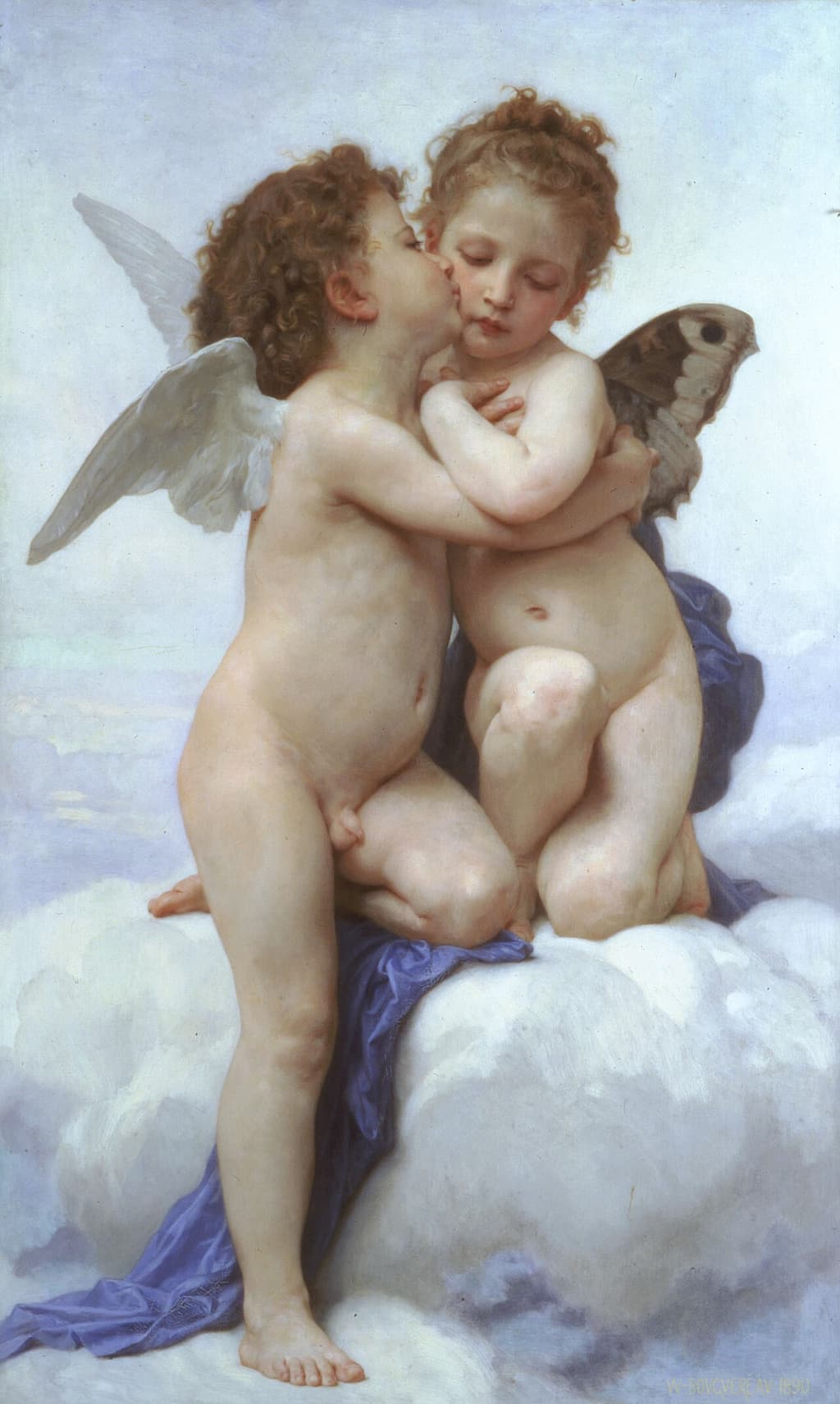
Cupid has no temple, no festival in the Roman calendar, no priesthood and no recorded sacrifice. He is one of the most reproduced figures in Western art and he was, in Roman religious terms, essentially unemployed.
That is the correct starting point, because it explains what he actually is: a personified common noun. Cupido is Latin for desire, amor for love, and Rome had a long habit of giving abstractions a face and a name — Fear, Pallor, Concord, Victory, Hope. Where Greek Eros appears in Hesiod as one of the first powers in existence, older than most of the gods and cosmological in scale, the Roman version is a literary character who works for his mother.
The god who edited a poem
Ovid's Amores opens with the best joke in Latin poetry about him. The poet announces that he was preparing to write epic — arms and violent wars, in hexameters — when Cupid laughed and stole one metrical foot from the second line, turning the couplet into elegiacs and the poem into love poetry. The poet objects that Cupid has no jurisdiction over verse, and loses the argument by continuing in the metre he has been given.
The passage is a precise statement of what Roman writers used the god for. He is not a power to be placated; he is an intrusion, arbitrary and slightly ridiculous, that redirects a life. Roman love elegy — Propertius, Tibullus, Ovid — runs on that premise for a century.
Virgil uses him more coldly. In the first book of the Aeneid, Venus sends her son disguised as the child Ascanius to sit in Dido's lap at the banquet and breathe the poison into her. The queen's destruction begins as a mother's tactical decision about her son's safety, executed by a small boy on someone's knee.
Cupid and Psyche
The one full-scale story he owns is embedded in a novel. In Apuleius's Metamorphoses, written in the second century CE and better known as The Golden Ass, an old woman tells a captive girl a long tale to comfort her, and it runs to some fifty pages.
Psyche — the name means soul — is so beautiful that Venus's worship is neglected, and Venus sends her son to ruin her; he falls in love instead. Psyche is taken to a palace and visited nightly by a husband she may not see. Her sisters persuade her that he is a monster, and she lights a lamp; a drop of hot oil wakes him and he leaves. Pregnant and abandoned, she is set impossible tasks by Venus — sorting a heap of mixed grain, fetching wool from murderous sheep, filling a jar from an unreachable spring, and finally bringing back a box of beauty from Proserpina in the underworld. She is warned not to open it, opens it, and falls into a deathlike sleep from which Cupid wakes her. They are married on Olympus and their daughter is named Voluptas, Pleasure.
Whether Apuleius invented it or shaped an existing folk tale is a genuine open question, and both positions are well argued. What is not in doubt is its place in the record: it is the oldest surviving version of the animal-bridegroom tale type, the pattern that later produces Beauty and the Beast and the Norwegian tale of the bear who is a prince by night, and a large part of European fairy tale besides. An ancient allegorical reading — the Soul, tested and suffering, ultimately united with Love — was already being made by late-antique Platonists, and it is why the story survived the end of the ancient world in respectable company.
Amorini by the square metre
Roman art produced flying winged boys in industrial quantities: on wall paintings, on sarcophagi, on silverware, on lamps, on jewellery. A well-known Pompeian frieze shows them working as goldsmiths, perfumers and wine-sellers, a whole miniature economy staffed by cupids.
That mass production is why he survived. When Renaissance artists revived classical ornament they revived the amorini with it as putti, and the putto then merged, in the visual imagination of Christian Europe, with the cherubim of scripture — who in their biblical description are nothing whatever like naked toddlers with wings. Every chubby cherub on a Baroque ceiling or a Victorian tombstone is a Roman decorative motif wearing a Hebrew name.
The blindfold, the heart and the card shops
Two familiar attributes are not ancient. The blindfold is a medieval development, expressing the moralists' view that love is irrational and unseeing; classical Cupid takes aim and can see perfectly well. The pierced heart is likewise medieval, from a symbolic tradition that made the heart the seat of the affections in a way Roman writers did not.
What is ancient is the bow, the arrows — Ovid gives him two kinds, gold to cause love and lead to repel it — and the torch. Caravaggio's Amor Vincit Omnia, an insolent boy trampling the instruments of art and war, takes its title from Virgil's line that love conquers all. From there the chain to modern greeting cards, February advertising and the arrow-through-heart emblem is unbroken, and it means that the least cultic of all Roman gods is the one most people see most often.
Points worth clarifying about Cupid
Are Cupid and Amor two different gods?
They are two Latin words for the same figure, used interchangeably by the same authors and sometimes in the same poem. Roman writers occasionally exploit the difference in nuance — cupido is sharper and more physical, amor broader — and late antique allegory sometimes separated them. Both are usually rendered as "Cupid" in English, which flattens a distinction Latin readers could hear.
Was there ever more than one of him?
Constantly, in art and increasingly in poetry: the plural Amores or Cupidines, Greek Erotes, appear as a swarm rather than an individual. A tradition also gave him a brother or counterpart, Anteros, understood either as requited love or as the avenger of love unreturned — the figure on the memorial fountain at Piccadilly Circus in London is, according to its sculptor, Anteros rather than Eros, a distinction almost universally ignored.
Did anyone in Rome pray to him?
Not in state cult. Private magic is another matter: erotic spells on lead tablets and papyri from across the Roman world invoke Eros, along with a range of other powers, to compel a specific named person's desire. That material makes unpleasant reading, and it is as close as the Roman period comes to an actual cult of desire — practised individually, illegally and outside the temples.
Where does Psyche's name come in?
Psyche is Greek for both "soul" and "butterfly", and Roman art frequently gives her butterfly wings against Cupid's bird wings, which is how you tell them apart in a sculpture group. The same word is the root of psychology, psychiatry and psyche in English — so a folk tale told by an old woman in a Latin novel supplied the modern vocabulary of the mind with its central term, by way of a girl who was married to Desire and had to work for it.