No consul took office, no treaty bound Rome, and no army marched home in triumph without a transaction on the Capitoline hill. That is the first thing to know about Jupiter, and the storytelling god of the poems barely comes into it. Roman religion was procedure — correct words, correct gestures, correct witnesses — and Jupiter Optimus Maximus was the party on the other side of the contract. Livy's history is full of moments where the Senate stops mid-crisis to work out what he is owed, because getting it wrong was understood to be the cause of the crisis.
His name preserves the grammar of that relationship. Iuppiter is a fossilised vocative — the form you use when you address someone, Diou-pater, "father sky", worn down into a nominative that Latin then had to build oblique cases for out of a different stem entirely, giving Iovis, Iovi, Iovem. The Umbrian ritual bronzes from Gubbio, the Iguvine Tables, carry the cognate Iupater in prayers of the same shape, which is decent evidence that the address-form is genuinely old Italic and not a Latin literary affectation.
What stood on the Capitol
The temple dedicated in the first year of the Republic — traditionally 509 BCE, and the date is part of the Republic's own founding story — was built under the Tarquin kings and it looked Etruscan, because it was. Wide-spaced columns, a deep front porch, three parallel chambers (cellae) and a terracotta cult statue attributed to Vulca of Veii, with a four-horse terracotta chariot group on the roof.
The three chambers held Jupiter, Juno and Minerva — the Capitoline Triad, an arrangement with no Greek precedent and a clear Etruscan one in Tinia, Uni and Menrva. That grouping, not a family of twelve Olympians, is the organising fact of Roman state religion in the city.
The building burned in 83 BCE during the Sullan civil wars, again in 69 CE when Vitellian and Flavian troops fought over the hill, and again in 80 CE. Each rebuilding was more expensive than the last; Domitian's version was gilded. The cult never moved, which is the point — the site held the contract, and the temple was replaceable in a way the hill was not.
Optimus Maximus is only one of the job descriptions
Roman gods were addressed by epithet, and the epithet specified which capacity you were engaging. Jupiter has more of these than any other Roman deity, and several belong to functions with no counterpart in Zeus's cult at all.
- Feretrius, the oldest, whose tiny Capitoline shrine held the flint used for treaty oaths. The spolia opima — armour stripped by a Roman commander from an enemy commander he killed personally — were dedicated here, and were claimed only three times in the whole tradition.
- Stator, "the stayer", who halts a rout. Romulus is said to have vowed the cult during the Sabine fighting when the Roman line broke.
- Latiaris, worshipped on the Alban Mount at the Feriae Latinae, where magistrates of the Latin communities shared the meat of a white heifer. This is a league festival predating Roman supremacy, and Rome kept presiding over it long after the league was politically dead.
- Elicius, "the one drawn down", associated with rites for calling lightning — the branch of practice that got King Tullus Hostilius struck dead for performing it incorrectly, in Livy's telling.
- Tonans, the Thunderer, whose Capitoline temple Augustus vowed after a lightning strike missed him on campaign in Spain.
Reading permission out of the sky
The augural discipline is where Jupiter's Roman specificity is sharpest. Before public business — an election, a battle, the founding of a colony — a magistrate with the right to take auspices marked out a templum, a defined field of observation in the sky, and watched it for signs. The question was never about the future. It was whether Jupiter consented to today's business going ahead, and a refusal meant postponement rather than doom.
The consequences were legal, not mystical. A magistrate could report an adverse sign (obnuntiatio) and stop another magistrate's assembly; by the late Republic this was open political warfare, with tribunes announcing that they were watching the sky purely to freeze legislation. Cicero, who was himself an augur, wrote De Divinatione as a dialogue in which one speaker demolishes the whole business as absurd — and the same author's De Legibus insists the college must be preserved because the state needs it. That is not hypocrisy so much as the Roman position: the rite works because it is performed, not because a bird knows the future.
The most-quoted failure belongs to Publius Claudius Pulcher at Drepana in 249 BCE, who was told the sacred chickens would not eat and had them thrown overboard to drink instead. He lost the fleet. Whether the anecdote is contemporary or a moralising later invention is not resolvable, but the fact that Romans told it about a naval catastrophe shows what they thought the omens were for.
The priest who could not tie a knot
The flamen Dialis, Jupiter's own priest, lived under a set of restrictions preserved in detail by Aulus Gellius. He could not ride a horse, see an army under arms, swear an oath, or spend a night outside the city. No knot could appear anywhere on his clothing, and a man in bonds who entered his house had to be untied. His hair had to be cut by a free man with a bronze blade, and the cuttings buried under a fruit-bearing tree. He had to marry by confarreatio, the archaic patrician rite, and if his wife the flaminica died he resigned the office immediately, because the priesthood was the couple, not the man.
The post went unfilled for seventy-five years after 87 BCE, largely because it was incompatible with a political career — you cannot govern a province if you cannot leave Rome. Augustus restored it, along with much else, and the gap is a useful measure of how much of the old machinery had quietly stopped.
The oath that needed a stone
Rome's declarations of war and treaties were handled by the fetiales, a priestly college whose formula Livy records. The officiant swore in Jupiter's name and killed a pig with a flint knife kept in the shrine of Jupiter Feretrius, with the explicit sense: if Rome breaks these terms first, strike Rome as I strike this pig. Swearing per Iovem lapidem, by Jupiter's stone, was the strongest oath in Latin, and the stone did the striking.
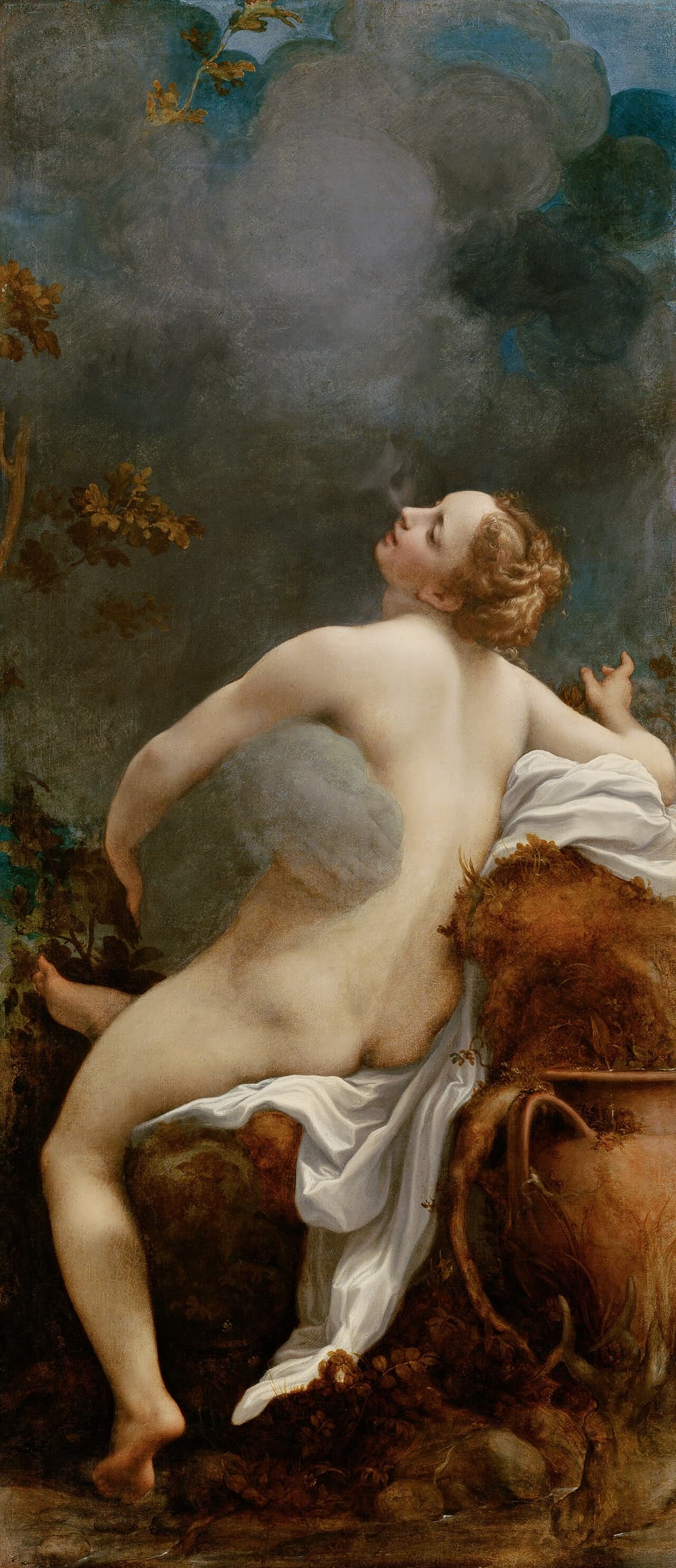
Set that against the seduction narratives, and the difference between Greek and Roman religion becomes concrete rather than rhetorical. Jupiter's stories in Ovid and Ennius are largely translated Greek property. His jurisdiction is not.
Triumph day
A victorious general processed through the city in a gilded chariot, wearing the purple-and-gold toga picta, and — Pliny the Elder says the practice was old and that the face of the terracotta cult statue was painted the same way — with his face reddened with minium, cinnabar. The route ended at the Capitoline temple with the sacrifice of white oxen and the deposit of laurel in Jupiter's lap.
Whether the triumphator was understood to be Jupiter for the day is genuinely disputed. The red face and the borrowed regalia support it; other scholars read the whole costume as the dress of the archaic king rather than a divine impersonation, and note that no Roman source says outright that the man is the god. The much-repeated detail of a slave in the chariot whispering a reminder of mortality appears only in late sources and should be treated with caution.
What Greece supplied, and what it did not
Jupiter absorbed Zeus's literature almost completely. Ennius, Virgil and Ovid write him with a Greek biography, and the Roman family tree marks those descents as imported for exactly that reason. What did not transfer in the other direction is everything above: the augural law, the fetial formula, the flamen's taboos, the Alban festival, the Capitoline triad. A page that says only "Jupiter is the Roman Zeus" has described the borrowed half and skipped the half Romans actually practised. The Greek and Roman pantheon comparison works the general case; the Roman tradition hub sets out how the whole system was administered.
The Etruscan route matters here too. Tinia, wielding the thunderbolt on engraved mirrors and painted tomb walls, reaches Rome independently of any Greek text, and haruspicy — the reading of lightning and livers — came to Rome as an acknowledged Etruscan import with Etruscan practitioners.
The name is still in the week and the sky
Dies Iovis, Jupiter's day, is French jeudi, Italian giovedì, Spanish jueves. English lost it to Thor's day, which is the same slot filled by the same Indo-European function through a different language. The planet keeps his name, its four largest moons keep the names of Jupiter's Greek-derived lovers, and "jovial" survives from the astrological doctrine that people born under that planet were cheerful — a genuinely Roman afterlife that Greek myth, whose gods never got the calendar or the planets, simply does not have. "By Jove" is the oblique stem still doing service as a mild oath, two thousand years after the flint knife.
Common questions about the Capitoline cult
Why does Jupiter have so few stories that are only his?
Because Rome recorded functions rather than narratives. The archaic Roman evidence for Jupiter consists overwhelmingly of calendar entries, priestly formulae, vows and temple dedications; there is no Latin equivalent of Hesiod. When Roman authors wanted a plot, they took a Greek one and changed the names, which is why the myths look derivative and the ritual does not.
Did ordinary Romans have anything to do with him?
Less than you would expect. State cult was funded and performed by magistrates and colleges on the people's behalf; the crowd watched processions and ate sacrificial meat at festivals. Private devotion attached far more to the household Lares, to Fortuna and to the personal Genius. The Ides of every month were sacred to Jupiter, and the white lamb sacrificed on them was a public act.
What is the Capitoline temple's connection to the geese?
The story belongs to the Gallic sack of about 390 BCE, and the geese were sacred to Juno, whose Arx shrine stood on the northern summit. Their alarm at night is credited with saving the citadel. Rome's later commemoration is one of the more peculiar rites on record: an annual procession in which geese were honoured and dogs were crucified, on the grounds that the dogs had failed to bark.
Does anything survive of the temple to see?
The podium does, in fragments, under and around the Palazzo Caffarelli on the Capitoline. Some of the massive tufa foundation blocks are visible inside the Capitoline Museums, and their scale is the best surviving argument that the sixth-century building was among the largest temples anywhere in the Mediterranean at the time it went up.