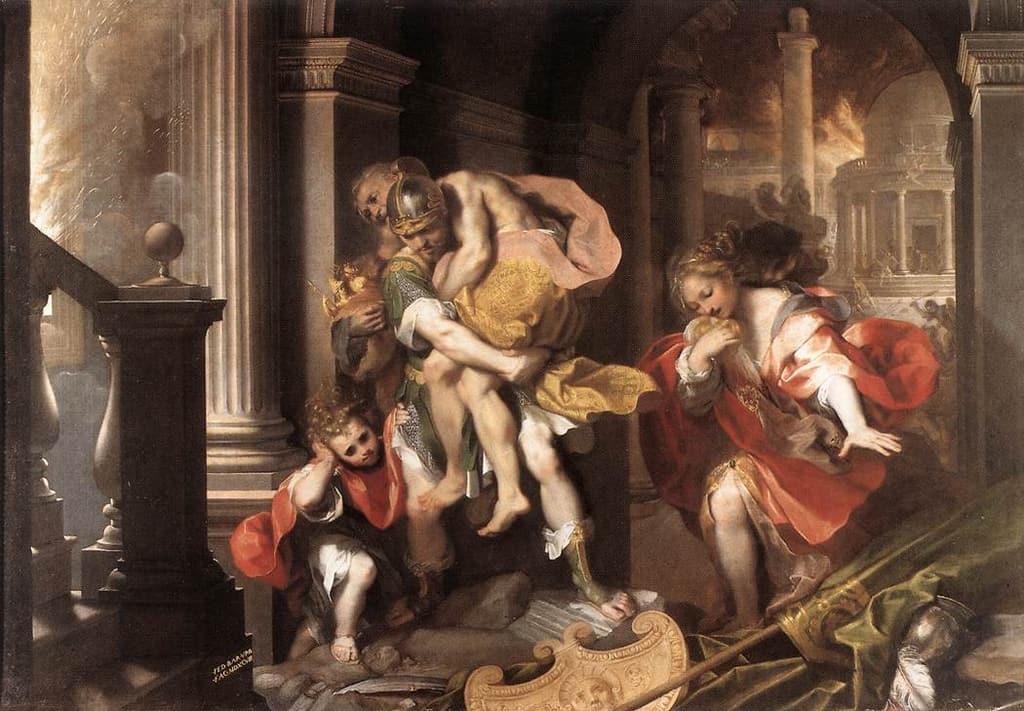
The most famous account of Troy's last night is not told by a Greek. It is told at a dinner party in Carthage, by a survivor, to a queen who has asked him to say what happened — and Virgil begins it with the narrator saying, in effect, that she is asking him to reopen a wound. Everything that follows in Aeneid 2 is a man's memory of the worst hours of his life, and Virgil never lets you forget the frame.
The city lets it in
The Greek fleet was gone from the bay. After ten years the plain was empty, the camp abandoned, the horse standing in it. Troy came out through its gates to walk around a beach it had not walked on in a decade, and argued about what to do with the thing the Greeks had left behind. The full story of the horse and the ruse belongs to its own account; what matters here is that the two Trojans who were right were both destroyed for it. The priest Laocoön drove a spear into its flank and warned against Greeks bearing gifts, and two sea-serpents came over the water from Tenedos and took him and both his sons. Cassandra said what she always said and was believed, as always, by nobody. The city hauled the horse through a breach in its own wall and spent the evening celebrating.
Aeneas was asleep when Hector came to him — not the Hector of the duels but the body as it had come back from Achilles' chariot, filthy, swollen, the thongs still cut into the ankles. In the dream he does not fight and he does not encourage. He tells Aeneas that Troy is finished, that there is nothing here to defend, and to take the household gods and go. It is one of the great refusals in ancient literature: the city's best soldier appearing specifically to say that heroism is now the wrong response.
Aeneas woke to the noise and did the opposite. He put on armour with no plan at all — he says so himself, that reason had no part in it — and went into the streets to die usefully.
The worst kind of street fighting
What he found was not a battle. It was a city being taken apart in the dark by men who knew where they were going. He collected a few others: Panthus the priest of Apollo carrying the sacred objects and his small grandson, Rhipeus, Dymas, a young man named Coroebus who had come to Troy to marry Cassandra and was, Virgil notes, not very bright.
They killed a Greek patrol and put on its armour, and Coroebus supplies the line about whether anyone asks an enemy for honesty. It works long enough to be lethal: they cut through the confusion until Cassandra is dragged out of Minerva's temple with her hands bound and her eyes turned upward — and Coroebus, seeing his bride hauled past, breaks cover to save her. The disguise then kills them all twice over, once from the Greeks and once from Trojans on the rooftops who see Greek helmets below and throw everything they have. Rhipeus dies here, and Virgil gives him the epitaph that the most just man in Troy died anyway, and the gods thought otherwise.
Priam at the altar
The survivors climb to the roof of Priam's palace and prise loose a tower to drop on the attackers, and it does nothing. Pyrrhus — Neoptolemus, Achilles' son, gleaming like a snake that has just shed — takes an axe to the door until the hinges give and the long interior of the palace is visible from the threshold, women clinging to the doorposts inside.
Priam is an old man who has put armour on shaking shoulders. His son Polites runs into the courtyard bleeding, with Pyrrhus behind him, and dies at his father's feet in front of him. Priam throws a spear that does not even penetrate the shield boss, tells Pyrrhus that Achilles at least treated a suppliant father properly, and is dragged through his son's blood to the altar and killed there. Virgil ends the scene with a sentence that stops the poem cold: a body on the shore, a head torn from the shoulders, a corpse without a name.
Then Aeneas sees Helen hiding by Vesta's shrine, and reaches for his sword — and here the text itself becomes disputed. The Helen episode, twenty-two lines of it, is missing from the best manuscripts and is known chiefly because the fourth-century commentator Servius says Virgil's literary executors cut it. Scholars have argued about it for four centuries and have not settled whether it is Virgil's, an interpolation, or a draft he had not finished. In the manuscripts that carry it, Venus stops her son's hand; in those that do not, she simply appears.
What she shows him is the thing that ends his resistance. She strips the mist from his eyes and lets him see the gods at work — Neptune levering the walls up from their foundations with his trident, Juno at the Scaean gate calling in more Greeks, Minerva blazing on the citadel, Jupiter behind all of it. Troy is not being lost. Troy is being demolished by the people who own it.
The road out, and the wife who is not on it
At home, Anchises refuses to move. He is old and lame, he has already seen the city sacked once by Heracles, and he intends to die where he is. Aeneas is arming again to go back out when two omens land: a tongue of flame plays around the hair of the boy Ascanius without burning it, and a star falls across the sky towards Ida with a trail of light. Anchises accepts and asks to be carried.
So they go out through a burning city in the arrangement that became the most reproduced image in Roman art: Aeneas with his father on his shoulders, the old man holding the household gods because his son's hands are bloody and may not touch them, the boy Ascanius half-running to keep up with a hand in his father's, and Creusa, Aeneas's wife, following behind. It is a picture of a household carried out intact — except that it is not intact. At the rendezvous by the ruined temple of Ceres, everyone is there but her.
He goes back. He runs through streets held by the enemy shouting her name, which is the only genuinely reckless thing he does all night and the only one Virgil lets him keep his dignity for. What meets him is her shade, larger than she was. She tells him that this was not permitted, that a long sea and a western land are waiting, a river called Tiber and a kingdom and a royal wife, and that she will not be a slave in a Greek house. He tries three times to hold her, and three times his arms close on nothing.
Seven years of getting it wrong
Aeneid 3 is the least-read book of the poem and the most human, because it is largely a record of misreadings. The refugees build a city in Thrace and abandon it when a shrub on a grave-mound bleeds and the voice of murdered Polydorus speaks from under it. At Delos, Apollo tells them to seek their ancient mother; Anchises confidently identifies Crete, they build there, and a plague nearly kills them before the household gods appear in the night to say the answer was Italy. The Harpies drive them off the Strophades and Celaeno curses them to eat their tables before they find rest. At Buthrotum in Epirus they find Andromache, now married to Helenus, keeping a scale model of Troy with a dry stream renamed Xanthus — the poem's quiet argument against nostalgia. They row past Scylla and Charybdis, pick up a man Ulysses left behind on the Cyclops' shore, and at Drepanum in Sicily Anchises dies, off-stage, in a single sentence. Then the storm takes them to Africa, and the story arrives at the queen who is listening to it.
Where the story comes from, and the version Romans didn't print
The escape is not Virgil's invention. Homer, Iliad 20, has Poseidon lift Aeneas bodily out of a fight he cannot win with Achilles and declare that his line will rule the Trojans hereafter — one of the very few Homeric prophecies about a future outside the poem, and the seed of everything Rome later grew from it. Vase painting and the carved Tabula Iliaca show Aeneas carrying Anchises out of the city centuries before Virgil.
But there was a rival tradition, and it is unflattering. Dionysius of Halicarnassus records the accusation that Aeneas was spared because he had come to terms with the Greeks and betrayed the city; the Little Iliad attributed to Lesches had him taken as Neoptolemus's prize; and the late antique forgeries passing as eyewitness accounts by "Dares the Phrygian" and "Dictys of Crete" — which medieval Europe took far more seriously than Homer — make the treachery explicit. Virgil is writing against this, and the insistent adjective he attaches to his hero, pius, is doing polemical work: it does not mean pious in the modern sense but dutiful, obligated, unable to put himself first.
Questions readers bring to this book
Why was Augustus so interested?
The Julian family claimed descent from Ascanius, whom Virgil pointedly also calls Iulus, making Augustus a descendant of Venus by way of a Trojan refugee. That is the political function of the poem and it is not hidden. It is worth being precise about what this does and does not explain: it accounts for why the subject was chosen and why Jupiter's prophecy in book 1 runs forward to Augustus by name, but it does not account for a poem whose emotional weight falls almost entirely on the losers, the abandoned and the dead.
Did Virgil really want it burned?
The ancient biographical tradition, principally Donatus drawing on Suetonius, says he did — that the poem was unfinished, that he asked for the manuscript to be destroyed, and that Augustus overrode the will and had Varius Rufus and Plotius Tucca edit it for publication with instructions to add nothing. There are around fifty-eight metrically incomplete lines in the text as we have it, which is consistent with the story, and the anecdote may still be a literary legend. He died at Brundisium in 19 BCE returning from Greece.
Is any of the fall of Troy archaeologically visible?
Troy VIIa, the settlement level most often matched to the traditional date, shows destruction by fire and unburied bodies in the streets in the late thirteenth or early twelfth century BCE. That is a real destruction of a real city at approximately the right time, and it is a very long way from confirming a narrative first written down five hundred years later, by a poet working another seven hundred years after that. The blog on how myth and archaeology actually relate sets out how thin the connective tissue is.
What became of the image of the man carrying his father?
It became Rome's shorthand for obligation. It is on Republican coinage, on the Ara Pacis, in wall paintings at Pompeii — including a satirical version with dog-headed figures — and it is the subject of Bernini's early marble group of 1618–19, in which Anchises is a bundle of ribs and Ascanius is a frightened child carrying the sacred flame. In the twentieth century it was repeatedly reused in refugee photography and war memorials, usually by people who had no idea they were quoting a Latin epic.