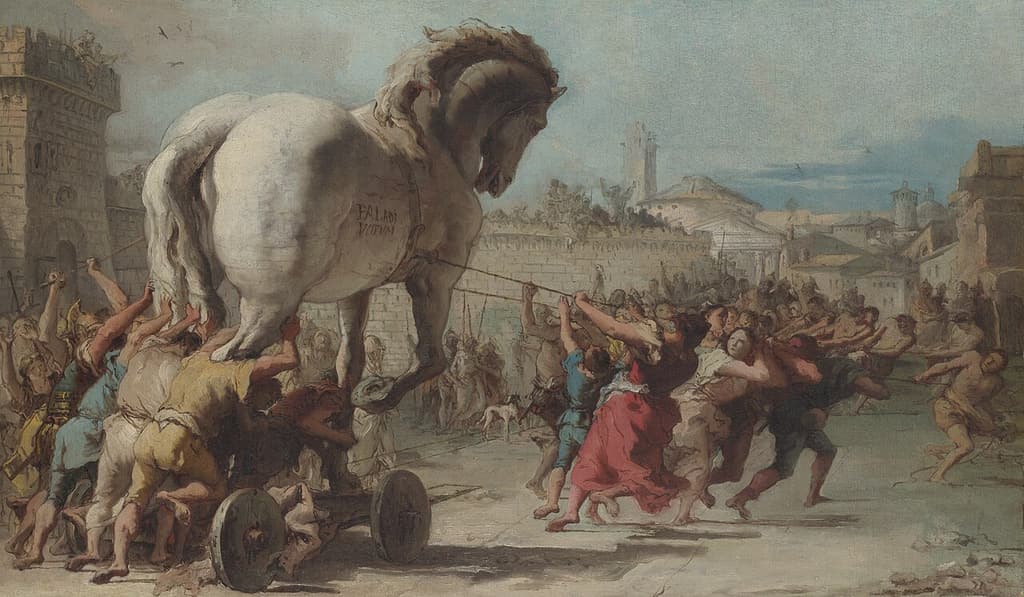
The single most famous episode of the Trojan War is not in the Iliad. Homer's poem ends with a funeral, weeks before the city falls, and it never mentions a horse. The Odyssey mentions one three times, always at a slant — once as a song performed at a banquet, once as an anecdote told by a woman at dinner, once as a boast made to a ghost. The full, blow-by-blow account of Troy's last night was written seven centuries later, in Latin, by a poet whose emperor claimed descent from the survivors.
What Homer actually gives you
In Odyssey 8, at the Phaeacian court, the blind singer Demodocus is asked for the story of the horse, and he sings a compressed version: the Greeks burning their camp and sailing away, the Trojans sitting in council around the thing they had dragged inside, arguing whether to split it open, throw it off the cliff, or let it stand as an offering. They chose wrong. Odysseus, listening, weeps into his cloak, and that is the point of the scene — Homer is interested in what the memory does to the man, not in the tactics.
Earlier, in Odyssey 4, Menelaus tells a stranger story still. Helen walked around the horse three times, he says, stroking its flanks and calling out to the men inside in the exact voices of each of their wives. One of them, Anticlus, opened his mouth to answer, and Odysseus clamped a hand over it and held on until the moment passed. Nobody in the Odyssey explains how Helen could do this or whose side she was on, and Menelaus tells the story in front of her.
The lost epics filled in the rest. The Little Iliad and the Iliou Persis — the "Sack of Troy", attributed to Arctinus of Miletus — covered the construction, the entry and the massacre, and both survive only as a few dozen quoted lines and a bare prose summary made by the grammarian Proclus. Everything we say about the archaic version of the fall of Troy rests on that summary.
The trick, as the tradition assembled it
Epeius built it, with Athena's help — a hollow horse of fir, with a concealed hatch and an inscription on the flank dedicating it to the goddess for a safe voyage home. The fleet burned its huts and sailed as far as the island of Tenedos, where it waited out of sight.
The number of men inside is one of the great unresolved trivia of Greek myth. Apollodorus reports fifty on the authority of the Little Iliad; the Byzantine scholar Tzetzes cites a figure of three thousand from the same poem, which is either a corruption or evidence that ancient readers were as confused as we are; Quintus of Smyrna and Triphiodorus, who list the men by name, arrive at about thirty. Stesichorus is said to have written a hundred.
One Greek stayed outside: Sinon, who let himself be captured, and whose entire function is to lie convincingly. In Virgil's telling he arrives bound and weeping, spins an elaborate account of having escaped being sacrificed by his own side, and explains that the horse was built enormous specifically so the Trojans could not fit it through their gates and take its protection for themselves. The Trojans tore down a section of their own wall.
Laocoön, a Trojan priest, was the one who said the obvious thing and threw a spear into the horse's side, where it stuck quivering. Then two enormous serpents came over the sea from the direction of Tenedos and killed him and his two sons in front of the crowd, and the crowd read that as a judgement on his impiety rather than as an assassination. Cassandra also warned them, because that is her entire condition. The marble group of Laocoön and his sons dug up on the Esquiline in 1506 — Pliny had described it as standing in the palace of Titus and named three Rhodian sculptors — reshaped Renaissance art within a decade of its discovery, which is a remarkable career for a minor character.
The night itself
Sinon opened the hatch. The fleet, seeing the signal fire, came back from Tenedos. What follows in Aeneid 2 is not a battle but a slaughter in the dark: houses burning, men killed in doorways, a city that has been drinking. Priam straps on armour he has not worn in decades, his wife Hecuba pulls him to the household altar, and Neoptolemus — Achilles' son — kills their boy Polites in front of them and then kills the old king on the altar steps. Ajax the Lesser drags Cassandra away from the statue of Athena she is clinging to.
That last act matters more than it looks. The Greeks won and then desecrated a temple, and the entire Nostoi tradition — the ruinous, storm-scattered homecomings, Agamemnon murdered in his bath, Odysseus's ten additional years — follows from the gods' anger at what was done during the sack. The Greek imagination did not treat the fall of Troy as a triumph. It treated it as the moment the victors ruined themselves.
Astyanax, Hector's infant son, was thrown from the walls. Polyxena was cut down on Achilles' tomb. The women were divided as property. Euripides built Trojan Women and Hecuba out of exactly this material for an Athenian audience that had recently done comparable things to Melos.
Why the fullest account is Roman
Virgil has Aeneas narrate the sack himself, at a dinner party in Carthage, to a queen he is about to abandon. Everything in Aeneid 2 is therefore doubly framed: it is the losing side's version, told by a survivor with reasons to present himself well, inside a poem written for Romans who traced their ancestry to Troy and their present empire to that ancestry.
This is why Sinon is so vivid, why the horse is described as a monster gliding into the city, and why the Greeks in book 2 are treacherous rather than clever. It is also why the phrase everyone knows — the warning against Greeks bringing gifts — is Latin. There is no Greek original of it.
Quintus of Smyrna's Posthomerica, probably third or fourth century CE, sets out to fill the gap between the Iliad and the Odyssey in Greek hexameters, and gives the fullest surviving Greek narrative of the horse. It is late, learned, and dependent on the same lost epics, and it is not an independent witness to anything archaic.
The ancient sceptics
Pausanias, touring Greece in the second century CE, looked at a bronze horse dedicated on the Athenian Acropolis and remarked drily that anyone who does not think the Trojans were complete fools must conclude the thing was really a siege engine. That rationalising reading has never gone away: the horse as a battering ram under a hide roof, or as a ship (Greek ships had horse-head prows, and the Greeks did arrive by sea), or as a siege tower, or — a nineteenth-century favourite — as an earthquake, Poseidon being both the god of horses and the earth-shaker who built Troy's walls in the first place.
None of these can be demonstrated, and the last one is more elegant than evidenced. What archaeology supplies is narrower and more interesting: the mound at Hisarlık in north-west Turkey has layered cities, and the level conventionally labelled Troy VIIa shows fire, hastily built storage jars sunk in floors, and unburied bodies in the streets, dated to roughly the late thirteenth century BCE. A fortified Bronze Age town on the Dardanelles was destroyed violently. That is the whole of what the spade says.
After the city
The story's downstream traffic is enormous. Aeneas carrying his father out of the burning city on his shoulders became the founding image of Roman pietas, reproduced on coins and on the Ara Pacis, and it leads directly to his voyage west and eventually to the founding of Rome. Medieval Europe piled on: the Franks, the Britons and half a dozen other peoples invented Trojan ancestors, on the reasonable logic that if Rome could do it so could they.
"Trojan horse" entered computing in the 1970s as the name for a program that is invited in, and is now the primary sense of the phrase for most people under forty. That the metaphor works perfectly, and that almost nobody using it could name the man who built the horse, is a fair description of how classical myth survives.
Points people get stuck on
Was the horse in the Iliad at all? No. The Iliad covers about fifty days in the tenth year of the war and ends with Hector's funeral. Achilles is still alive when it closes. Everything from Achilles' death onward is in other poems, most of them lost.
Why a horse specifically? No ancient source explains the choice, which is itself suspicious. Horses were sacred to Poseidon, one of Troy's builders and, in the Iliad, an enemy of the city; a dedicatory offering of a horse to a departing fleet's patron deity is plausible enough as a cover story. The connection to Athena, who is credited with the design, is less natural, and the sources simply assert it.
Who wrote the Little Iliad and the Iliou Persis? The attributions — Lesches of Mytilene and Arctinus of Miletus — are ancient guesses, not documented facts, and the poems of the Epic Cycle were already being reconstructed rather than read by the Hellenistic period. Treat every claim about their contents as a claim about Proclus's summary of them.
Did Helen betray the Greeks in the horse, or was she testing them? Homer offers no motive, and the ancient commentators split. Some read her circling of the horse as evidence she was still Trojan-hearted; some as a divine compulsion; Menelaus, telling the story, blames a god for putting her up to it. The refusal to resolve it is very much Homer's habit.
Read the cause at the judgement on Ida, or start from the Greek tradition as a whole.