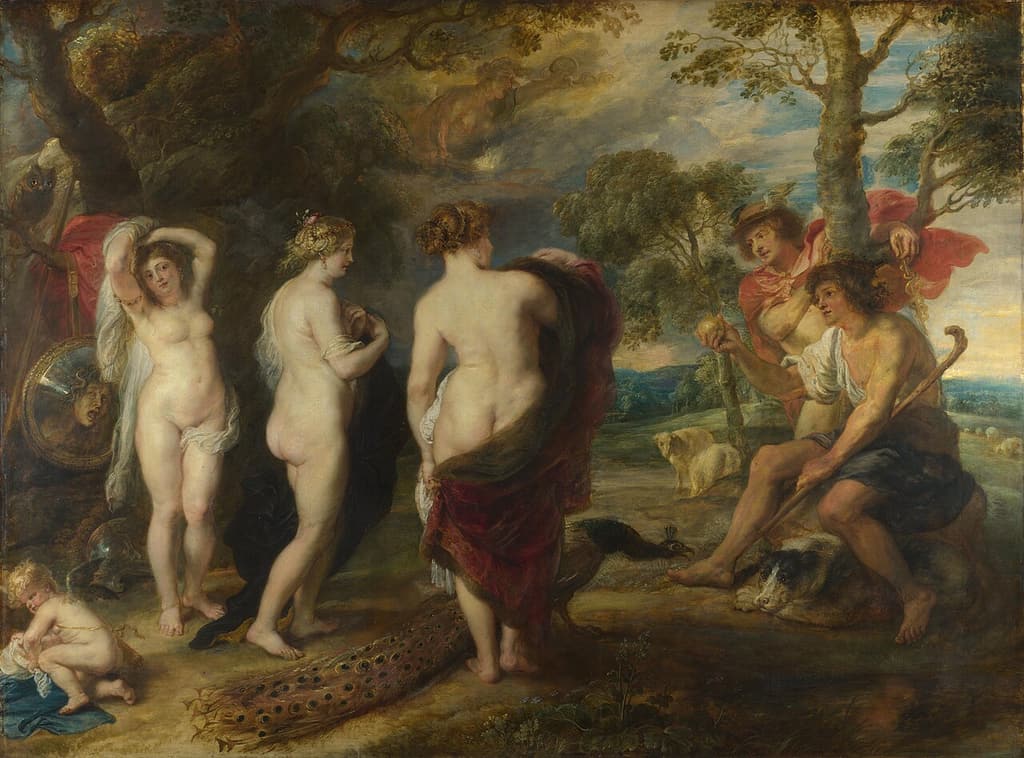
A ten-year war, a burned city and roughly half of surviving Greek literature descend from a decision made by a teenage cattle-herder on a Turkish hillside. The story is famous out of all proportion to its textual footprint: the Iliad, which is the reason any of it matters, mentions the judgement exactly once, in four lines near the very end, and even those lines have been suspected of being a later addition.
The wedding, the goddess who was not asked, and the apple that may be late
Peleus, a mortal, was marrying the sea-nymph Thetis, and every god was invited, because the marriage was itself a divine arrangement: Zeus had wanted Thetis and had been warned off by a prophecy that her son would surpass his father. Better a mortal father, then. The son was Achilles.
Eris, Strife, was not invited. She came anyway and put down a golden apple inscribed to the fairest, and Hera, Athena and Aphrodite all reached for it.
Here is where honesty is required. The Cypria, the lost epic that covered everything before the Iliad, survives only as a prose summary by Proclus and scattered quotations. That summary says the quarrel began at the wedding and that Zeus sent the three goddesses with Hermes to Alexandros on Ida to be judged. It does not mention an apple. The inscribed golden apple thrown by Eris appears in surviving literature much later — in Hyginus's Fabulae, in Lucian's satirical Judgement of the Goddesses, in the mythographic tradition of the Roman period. It may well be old and simply unattested; it may be a Hellenistic elaboration. What can be said is that the single most famous prop in the story is not securely archaic.
The Cypria does supply something else, which almost every retelling drops: a frame in which Zeus and Themis had already decided to bring on the Trojan War in order to relieve an overburdened Earth of her weight of people. In that frame the judgement is not the cause of the war. It is the mechanism.
Three offers on Mount Ida
Paris — the Greeks also call him Alexandros, and the two names sit side by side in Homer without explanation — was herding on Ida because he had been exposed at birth. His mother Hecuba had dreamt she gave birth to a torch that burned Troy; the child was left out to die and did not, and was raised by herdsmen, and was living with a mountain nymph named Oenone when three goddesses walked into his pasture.
Each of them offered him something outside the terms of the contest, and none of them saw anything improper in that.
- Hera offered rule: kingship over Asia, or over all men, depending on the source.
- Athena offered victory in every battle he fought, and in some versions wisdom or skill with it.
- Aphrodite offered the most beautiful woman in the world.
He took the third. The woman was already married, to Menelaus, king of Sparta.
It is worth registering how thin the divine promises are. Aphrodite is the only one of the three who delivers, and what she delivers destroys him. Hera and Athena spend the Iliad working steadily for Troy's annihilation, and the poem is quite clear that the grievance is personal.
The four lines Homer gives it
Near the opening of Iliad 24, explaining why Hera, Poseidon and Athena would not relent even over Hector's corpse, the poet says they had hated sacred Ilios ever since Alexandros insulted the goddesses when they came to his farmstead, and praised the one who offered him ruinous lust.
That is all of it. Four lines, referring to a story the audience obviously knew. The great Alexandrian scholar Aristarchus athetised them — marked them as not genuinely Homeric — and modern commentators have argued about it ever since, some holding that the passage's language is late, others that Aristarchus simply disliked the idea of Homer alluding to a beauty contest. There is no way to settle it. What the dispute demonstrates is that even the ancients found the judgement slightly embarrassing as a first cause.
Euripides made that embarrassment into drama. In Trojan Women, Helen defends herself by blaming the judgement, and Hecuba demolishes her: was Hera really so short of dignity that she would peddle Asia for a compliment? Was Athena? The old queen's argument is that the story is a lie told by a woman covering her own appetite. Euripides puts the sceptical reading of his own mythology into the mouth of its chief victim.
Ovid, in Heroides 16, has Paris write the whole scene to Helen in a seduction letter, which is a wonderfully cynical framing: the goddesses stripped, he says, and he judged, and now she owes him. The nudity is worth noting. Early Greek vase-painters show the three goddesses fully clothed and processing, with Hermes leading; the disrobing that every Renaissance painter takes for granted develops later and is largely a Roman and post-classical taste.
What it meant in a Greek city
Strip off the pin-up reading and the story is about hospitality and gifts, which is the same subject as the war it starts. Paris receives three guests and is asked to arbitrate; he accepts a bribe. He then travels to Sparta, is received as a guest by Menelaus, and leaves with his host's wife and a quantity of his host's property. Both acts are violations of xenia, the guest-host bond that Zeus personally guarantees, and the Iliad treats the second as the war's legal justification. Troy falls not because a man found a woman attractive but because a man twice took what was offered in trust.
There was also a schoolroom reading, current by late antiquity, that made the three offers into three ways of living — the political life, the active or military life, and the life of pleasure — with Paris choosing worst. That allegory is a philosopher's retrofit, but it is why the scene survived into Christian moralising art rather than being discarded as pagan smut.
What happened to the people in it
Oenone is the character the tradition remembers least and treats worst. She was a nymph of Ida with the gift of healing, Paris left her, and years later, dying of a poisoned arrow from Philoctetes, he was carried up the mountain to ask her for a cure. She refused. Then she changed her mind, arrived too late, and hanged herself. Apollodorus, Quintus of Smyrna and Parthenius all carry versions of this; Tennyson wrote two long poems on her.
Eris's apple became the phrase "apple of discord", used in English diplomatic prose since the seventeenth century for any prize that sets allies against each other. The Greek word on it, kallistēi, was adopted in the twentieth century as a slogan by the parodic religion of Discordianism, which is a genuinely odd afterlife for a wedding-present.
Painters could not leave it alone, because it is the one classical subject that requires three female nudes and a plausible excuse: Cranach dressed them as German court ladies, Rubens painted the scene at least three times and put his second wife into it, Watteau made it a rococo confection and Renoir a late, heavy, sun-warmed one. In every case the moment chosen is the offer, never the consequence.
Loose threads worth pulling
Why does Paris have two names? Homer uses Alexandros and Paris interchangeably, and Alexandros is the one that looks Greek — "defender of men". A Hittite diplomatic text of the thirteenth century BCE mentions a man called Alaksandu ruling Wilusa, a place widely identified with Ilios. Nobody can show that this is the same person or even the same tradition, and the coincidence has been both over-claimed and too quickly dismissed.
Did the Greeks think Helen went willingly? They disagreed violently, and it mattered to them. Homer's Helen is bitterly self-accusing. Stesichorus wrote a poem blaming her, went blind, and wrote a Palinode claiming she never went to Troy at all — only a phantom did, while the real woman sat out the war in Egypt. Herodotus took that Egyptian version seriously on the reasonable grounds that the Trojans would have handed her back if they had had her. Euripides dramatised it in Helen.
Is there any archaeology? Troy is a real multi-layered mound at Hisarlık, excavated since Schliemann in the 1870s and still under study; the level usually associated with the war, Troy VIIa, shows destruction by fire in the late Bronze Age. This tells us a fortified city burned. It says nothing whatever about a beauty contest, and the honest position is that the poem's world and the archaeological one touch only at the edges.
Which goddess would a Greek audience have expected him to pick? Almost certainly not Aphrodite, and that is the point of the scene's construction. Choosing power or valour would have made Paris a hero; choosing desire makes him the man whose brother Hector has to die for him.
Continue with the fall of the city, or read the participants themselves: Helen, Cassandra — who told Troy exactly what was coming and was believed by nobody — and the wider Greek tradition.