Every Roman schoolboy could tell you the date: the twenty-first of April, 753 BCE. It was a suspiciously precise figure for an event nobody could witness, and the Romans knew it — their own antiquarians offered at least half a dozen competing years, and the one that stuck did so largely because Varro said it in the first century BCE and Atticus and Cicero agreed. What nobody disputed was the shape of the story. It begins with a stolen throne, and it ends with a brother dead in a ditch.
A king's daughter and a locked door
At Alba Longa, the city the descendants of Aeneas had ruled for three centuries, the throne passed to a man named Numitor. His younger brother Amulius took it from him, and then did the arithmetic that usurpers do. He killed Numitor's sons. He could not decently kill Numitor's daughter, Rhea Silvia, so he made her a Vestal — a priestess of Vesta, sworn to thirty years of chastity, which amounted to sterilising the bloodline by legal means.
She bore twins anyway. Asked who the father was, she named Mars. Livy, writing under Augustus, reports this without endorsing it and adds a dry aside: either she believed it, or it was a more respectable story than the truth. Amulius had her imprisoned and the infants exposed — set out in a basket on the flooded Tiber, which was the legally tidy method, since the river did the killing.
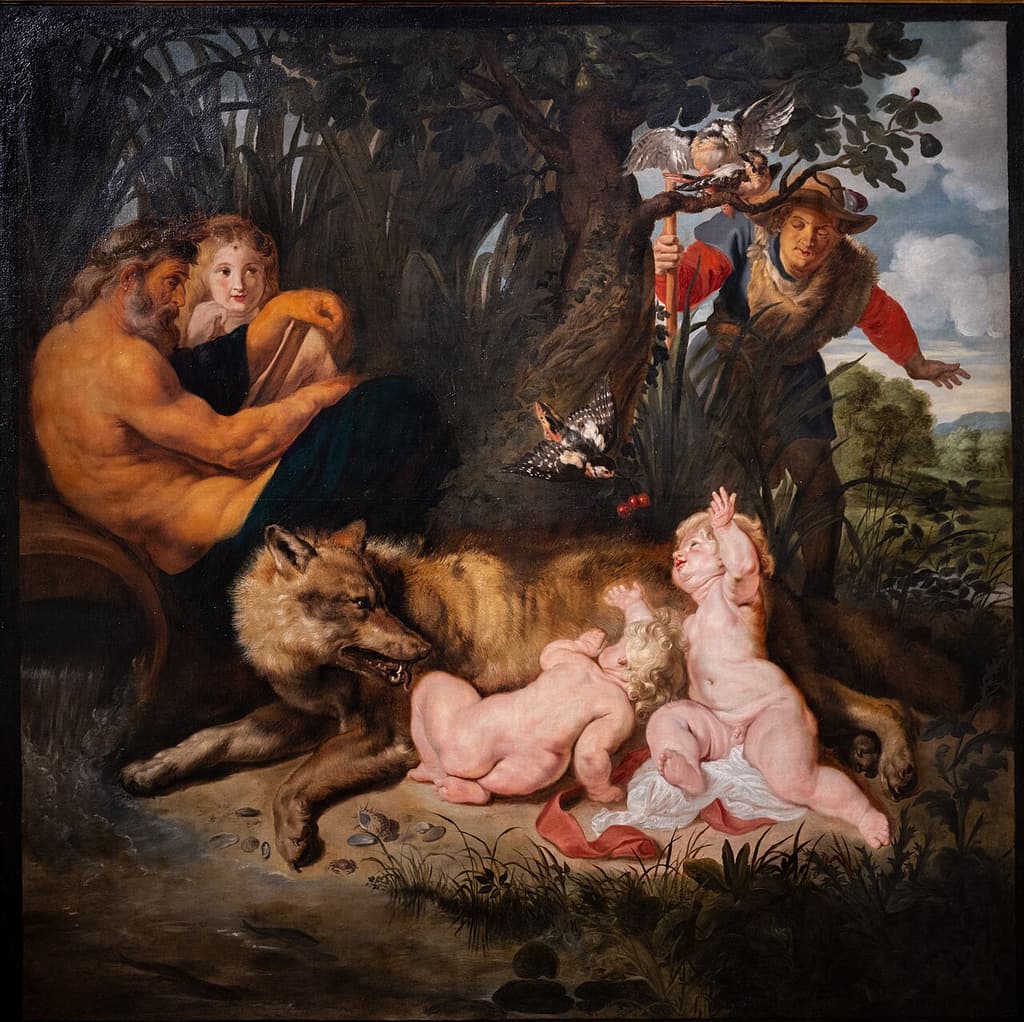
The flood receded. The basket grounded at the foot of the Palatine, under a wild fig tree the Romans still pointed to centuries later and called the Ficus Ruminalis. A she-wolf, drawn down from the hills to drink, found them and suckled them; a woodpecker brought food. Both animals were sacred to Mars, which is the story quietly confirming the paternity it had just left open. A royal herdsman named Faustulus took the children home to his wife, Acca Larentia, and raised them as shepherds.
Here the Romans themselves supplied the deflation. Livy passes on a version in which there was no wolf at all: lupa was also common slang for a prostitute, Acca Larentia was one, and the miracle is a euphemism that hardened into a legend. That the national foundation myth carried its own debunking, in the standard account, tells you something about how Roman historians worked.
Twelve birds against six
Grown, the twins fell into a quarrel with Numitor's herdsmen over pasture. Remus was captured and brought before Numitor, who looked at a young man of about the right age with a story about being found in a basket and did the arithmetic in the other direction. The brothers raised the shepherds, killed Amulius and restored their grandfather — and then, rather than inherit Alba Longa, decided to found a city of their own at the place where they had been left to drown.
They could not agree who should found it, or where, or what it should be called. So they took the auspices, which was the correct Roman procedure for a question no one could answer: each took a hill, Romulus the Palatine and Remus the Aventine, and waited for birds.
Remus saw six vultures. Romulus, shortly afterwards, saw twelve. Both claimed the kingship, and both were arguably right, because the augural rules did not settle whether priority or quantity carried the decision. This is the detail that makes the episode unmistakably Roman: the founding of the city turns on a procedural ambiguity in a religious ruling, and the constitutional deadlock is resolved with a weapon.
Romulus ploughed the boundary — a bronze ploughshare drawn by a white bull and a white cow, the furrow turned inward, the plough lifted where the gates would be, because a gate has to be ground the unclean can cross. That lifted stretch is why Latin has porta, from portare, to carry. What the plough cut was the pomerium, the sacred limit, and it was not a wall but a legal condition: inside it certain magistracies lapsed, armies could not march, the dead could not be buried.
Remus jumped over it, laughing.
Livy's Romulus kills him on the spot and says something about what happens to anyone else who leaps his walls. Ovid, in the Fasti, softens it considerably: Remus is struck down by an officer named Celer while the fortifications are being raised, Romulus swallows his grief in public and weeps at the funeral. Plutarch collects several variants and does not choose between them, noting the version in which Remus dies in a general brawl and the version in which Celer acts alone and flees to Etruria. The Roman tradition never quite decided whether its founder was a fratricide, and the discomfort is visible in every retelling.
What happened next, briefly
The city was a settlement of shepherds and needed people, so Romulus opened an asylum on the Capitoline for exiles, debtors and runaways — a detail Rome's enemies threw back at it for centuries. It needed wives, which produced the abduction at the festival of Consus and the war and reconciliation that followed. Romulus ruled thirty-seven years and then vanished during a storm on the Campus Martius; the official account was that he had been taken up and was now the god Quirinus, and Livy notes without comment the rumour that the senators had torn him apart and hidden the pieces under their togas.
Which sources say what
Nobody wrote any of this down for at least four hundred years. The earliest surviving continuous narratives are Livy, book 1, and Dionysius of Halicarnassus, both writing in the age of Augustus, both drawing on lost Roman annalists of the third and second centuries BCE — Fabius Pictor above all, who wrote in Greek. Plutarch's Life of Romulus is later still and is the most useful of the three for variants, because Plutarch's method is to list them.
Dionysius, writing for a Greek audience, preserves the rival traditions the standard version buried: that Rome was named for Rhome, a Trojan woman who burned the ships in the harbour to end the wandering; that it was founded by a son or grandson of Odysseus and Circe; that Romulus and Remus were the sons of Aeneas himself. The wolf-twins story appears to have been fixed no later than 296 BCE, when the Ogulnii brothers set up a statue group of the wolf and children by the Ficus Ruminalis — the earliest firm date for any part of it.
The statue is not what you were told
The bronze wolf in the Capitoline Museums, with two suckling infants beneath her, is the image on a thousand book covers. The wolf was long dated to the fifth century BCE and called Etruscan; the twins have always been known to be Renaissance additions, generally attributed to the workshop of Antonio del Pollaiuolo around 1471. Since 2006, radiocarbon and thermoluminescence work by Anna Maria Carruba and a University of Salento team has dated the wolf itself to the eleventh or twelfth century CE, and identified the casting technique as medieval rather than ancient. The finding is not universally accepted, but it is serious and it has not been refuted. The most reproduced object in Roman archaeology may be a medieval bronze.
Questions this story usually raises
Was there a real settlement on the Palatine in the eighth century BCE?
Yes, and this is the least contested part. Excavation has found Iron Age hut foundations on the Palatine consistent with occupation from around 750 BCE, and the tradition's date and place are broadly right even if its personnel are not. Andrea Carandini's claim from 1988 onwards to have found the actual pomerium wall of Romulus, dated to the mid-eighth century, is a much stronger claim and remains contested among archaeologists.
Why do the Romans count years from this event?
Ab urbe condita — "from the founding of the city" — was a literary and antiquarian dating system rather than an everyday one. Romans in daily life dated by the names of the two consuls in office. The AUC count mattered for anniversaries: Claudius celebrated Rome's eight-hundredth year in 47 CE, and Philip the Arab staged the millennium in 248 CE, with games nobody could afford.
Is the exposed-royal-infant plot borrowed?
It is one of the most widely distributed narrative patterns in the ancient world, and Rome is a late entry: Sargon of Akkad is set adrift in a reed basket in a text at least a millennium older, Moses in another, Cyrus is exposed on a mountain in Herodotus, and Oedipus is pinned by the ankles and left on Cithaeron. Whether these are borrowings or independent uses of an obvious plot is not resolvable, but the Roman version's distinguishing feature is the animal — the wolf is Rome's own contribution, and it stayed on the legionary standards and the coinage for a thousand years.
What survives on the ground?
The Lupercal, the cave where the wolf was said to have sheltered the twins, gave its name to the Lupercalia, the February festival at which young men ran the boundary striking bystanders with strips of goat hide. In 2007 a decorated vaulted chamber was found beneath the Domus Augustana on the Palatine and announced as the Lupercal; most archaeologists now think it a nymphaeum belonging to Augustus's house. The Ficus Ruminalis was still being replanted in the Forum in the imperial period whenever the old tree died.