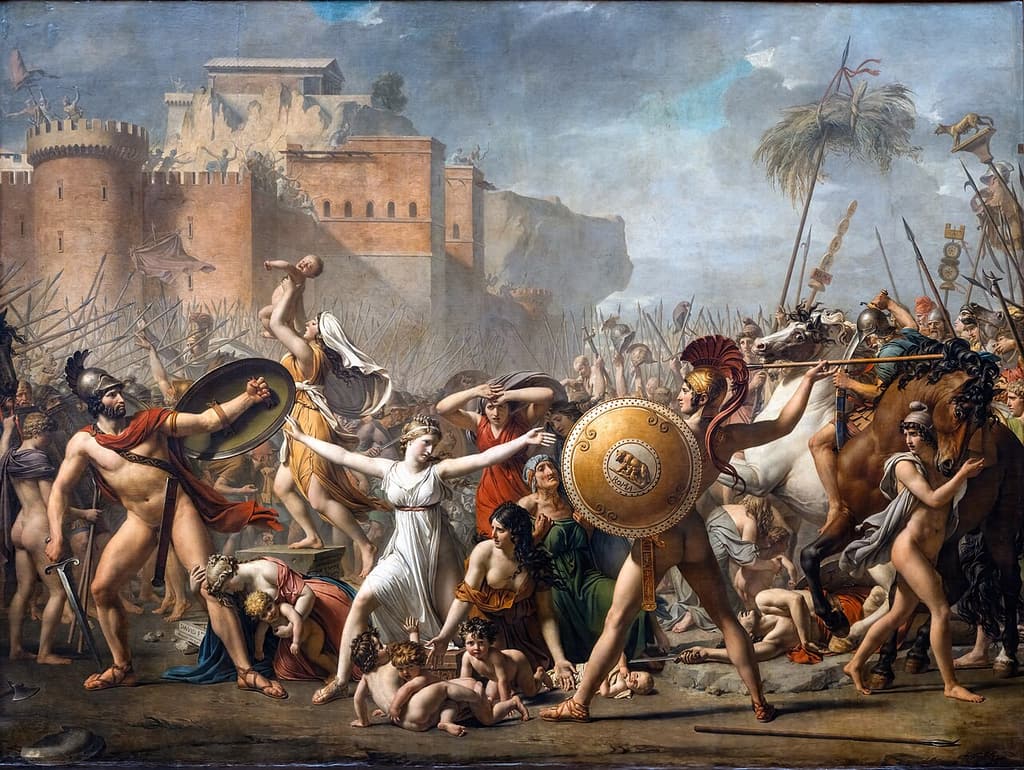
Rome's founding legend contains a mass abduction, and Rome did not hide it. Livy tells it in the ninth chapter of his first book, Ovid turned it into flirting advice, and for four centuries European sculptors and painters treated it as a prestige commission. What almost nobody remembers is that the story does not end with the abduction. It ends with the abducted women walking into the middle of a battle to stop it, and being listened to.
A city with no wives
The new settlement had walls, an influx of men from everywhere — runaways, the landless, the unwanted — and one structural problem. It had no next generation.
Romulus sent embassies to the neighbouring communities asking for the right of intermarriage. Every one of them refused, and several asked, with some point, whether Rome intended to open an asylum for women too, since that was evidently how it acquired everything else. Rome was a town of nobodies and the neighbours were not marrying into it.
Romulus kept his temper in public and made preparations. He announced solemn games in honour of a god of horses, and advertised them widely.
The neighbours came in numbers, partly out of curiosity about the new town. Whole families of Sabines arrived with their wives and children. They were shown round the walls and the buildings and made welcome, and then they sat down to watch the show.
At a prearranged signal the young men of Rome went into the crowd and carried off the unmarried women.
Livy records the practicalities without embarrassment. Most were taken by whoever reached them. The most beautiful had been marked out in advance for the leading senators and were carried to their houses by men detailed for the job. One outstanding girl was seized by the retinue of a man named Talassius, and everyone who asked was told whose she was — which, according to the tradition, is where the shout raised at Roman weddings comes from.
What happened next in the houses
The families fled, calling on the god whose festival had just been used as cover.
Romulus went round the women in person, and his argument is preserved. The fault, he said, was their fathers', for refusing the alliance that was asked for properly. They were not concubines; they would be wives, with legal marriage, a share in property, a share in citizenship, and children — and there is nothing people hold more dearly than that. He asked them to let their anger cool and give their affection to the men chance had given their bodies to.
The husbands, Livy adds drily, made the same case in their own way, pleading passion, which works on women better than argument.
The ancient authors are unanimous and insistent on one point: none of the women was sexually assaulted at the moment of seizure, none was taken as a slave, and every one was married in due form. Plutarch says all the captives were unmarried except one — Hersilia, taken by mistake, who became a central figure in what followed. He also notes that his sources cannot agree how many were taken, giving figures from thirty to nearly seven hundred.
Whether that unanimity is evidence or apologia is a fair question, and the answer is probably both. Roman writers were describing the origin of their own marriage law and had every reason to insist it began in legality. The English title of the episode does not help: the Latin word means seizure and carrying off, and "abduction" is the accurate translation. Calling it a rape imports a modern meaning the sources explicitly deny while describing something that is, on any reading, a violent crime against several hundred women.
The wars
The insulted communities attacked separately, which was their mistake. Rome dealt with them one at a time; Romulus killed the king of the first in single combat and carried his armour back on a frame, founding the rarest of Roman honours — the spoils stripped by a commander from an enemy commander, awarded only three times in a thousand years.
Then the Sabines came, under Titus Tatius, and they were a different proposition.
They took the citadel by treachery. A Roman girl named Tarpeia, daughter of the officer commanding it, went outside the walls for water and agreed to let them in for what they wore on their left arms — meaning their gold bracelets. When she opened the gate they gave her what was on their left arms, which was also their shields, and crushed her to death under them. The cliff from which traitors were afterwards thrown carries her name.
The fighting came down into the low ground between the hills, where the Forum would later be. The Romans broke and ran, and Romulus vowed a temple to Jupiter the Stayer on the spot if the line held, and it held, and the battle went on.
The women in the middle
Then the women came out of the town.
Livy's account of it is the best thing in his first book. They came with their hair torn loose and their clothes ripped, the terror of the situation having driven the timidity out of them, and they went straight into the space between the two armies with the weapons still flying — dividing the battle lines, going to fathers on one side and husbands on the other.
What they said is given as a speech, and it is an argument rather than a plea. They told both sides not to stain themselves with the blood of a relative by marriage, not to put the mark of parricide on the grandchildren the fight was ostensibly about — the fathers' grandsons, the husbands' sons. And if they hated the connection between them, then turn the anger where it belonged: on us. We are the reason for the war, we are the reason for these wounds and these deaths on both sides; we would rather die than live as widows or as orphans.
The armies stopped. There was silence, and then the commanders came forward and made not just a truce but a merger. The two peoples became one state. The kingship was shared between Romulus and Tatius. The city kept Romulus's name; the citizens took a formal title from Tatius's home town, which is why Romans in official language were called Quirites. And the thirty wards of the city were named after thirty of the women.
Where the story is told
- Livy, From the Founding of the City, book 1 — the fullest and best-told version, written under Augustus, and the source of the women's speech.
- Dionysius of Halicarnassus covers the same events in far greater detail and with more anxiety about the legality of everything.
- Plutarch, in his life of Romulus, gathers the variant traditions and the disagreements about numbers.
- Ovid treats it twice and both times outrageously: in the Art of Love as evidence that the theatre has always been a good place to pick up women, and in the Fasti in connection with the matrons' festival in March.
None of these authors was writing history. Rome under the first emperor was extremely interested in its own origins, and the whole first book of Livy is legend given the dignity of prose.
What the legend is doing
It explains wedding customs. The shout at Roman weddings; the carrying of the bride over the threshold; the parting of a bride's hair with a spear point. Every one of these was explained by Romans as a survival of the seizure, which is the standard shape of aetiology — the ritual came first and the story was fitted to it.
It explains what Rome thought Rome was. This is the important part. The founding population of the city is a gang of exiles who acquire wives by force from a neighbouring people, and then merge with that people, share the kingship, and take a second name from them. Rome's origin story is about absorbing outsiders and becoming something new. Athens told itself the opposite story — that Athenians had sprung from their own soil and married nobody. The difference shows up in the citizenship law of both cities for the next eight hundred years.
It gives women a decisive political act. The intervention is the only moment in Rome's regal legends where a group without any formal power stops a war by argument. Roman writers found it useful and slightly uncomfortable, and handled it by making the women's loyalty to their new husbands the point.
Marble, paint and MGM
The subject became a standard for artists who wanted to demonstrate that they could handle violent motion and multiple figures.
Giambologna carved a three-figure marble spiral of it for the Loggia dei Lanzi in Florence in 1583 — famously without any subject in mind at first, the title supplied afterwards. Poussin painted it twice, as a mass of colliding diagonals under a colonnade. Rubens took it as an opportunity for flesh and armour.
The most interesting is Jacques-Louis David's Intervention of the Sabine Women, finished in 1799. David painted the second half of the story, not the first: Hersilia with her arms out between Romulus and Tatius, children on the ground between the fighters, the whole composition arranged so that the women stop the picture. He began it in prison after the fall of Robespierre, and it was understood at the time as an argument about reconciliation after the Terror.
And in 1954 MGM adapted the story as a musical about seven backwoods brothers in Oregon, with a number that cheerfully names its source. Whether the material survives that treatment is a matter of taste.
Points worth being clear about
Did any of this happen? Almost certainly not as told. There is real archaeological evidence of Sabine presence in early Rome and of a genuinely mixed early population, which is probably what the legend encodes. Romulus, Tatius, Tarpeia and Hersilia are legendary figures, and Roman writers four hundred years later were working from oral tradition, family boasts and the need to explain existing rituals.
What happened to Tatius? He was killed a few years later in a dispute at Lavinium, and Romulus ruled alone and, according to the sources, did not investigate the killing very energetically.
Is Hersilia Romulus's wife? In most versions, yes; in some she is married to one of his companions. Her role is stable even where her marriage is not — she is the one who speaks for the women, first pleading for the captured relatives and later leading the intervention.
Why did the sources insist so hard on the marriages being legal? Because Roman marriage law descended, in their own account, from this event, and because a foundation resting on the mass rape of neighbours would have poisoned the legal fiction. The insistence is a tell about what Romans needed the story to be.
Continue with Romulus and Remus, the city's beginning at the founding of Rome, the king who came next at Numa and the nymph Egeria, and the Roman hub.