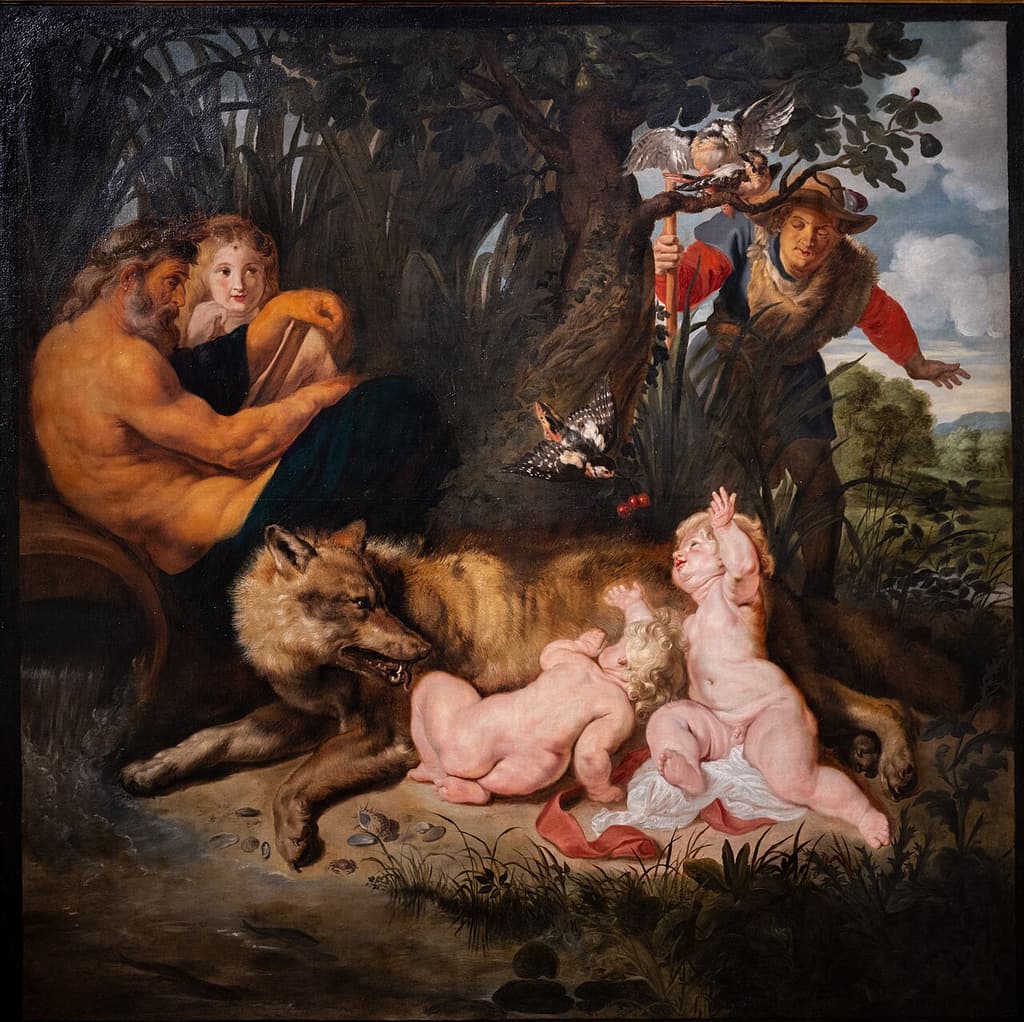
Rome's founding story ends with one brother killing the other, and Roman writers did not soften it. Livy sets the murder down in the first pages of his history and lets the reader sit with it; Horace, writing during the civil wars, treats the fratricide as a curse working itself out in Romans killing Romans a lifetime at a time. A nation whose origin myth is a crime against a twin has told itself something specific about its own character, and it kept telling it.
Alba Longa, and a Vestal with an unprovable excuse
The back-story is dynastic. At Alba Longa — the city founded, in the Roman scheme, by the son of Aeneas, which is how the Trojan strand and the Latin strand were welded together — King Numitor is deposed by his brother Amulius. To end the line, Amulius makes Numitor's daughter Rhea Silvia a Vestal, since a priestess bound to chastity for thirty years produces no claimants.
She bears twins anyway and names Mars as the father. Livy records the claim and then, in a single clause, records that she may have said it because no better explanation was available to a Vestal in her position — one of the earliest and coolest pieces of source-criticism in Latin prose. The twins are put in a basket and set on the flooded Tiber, which recedes and strands them at the foot of the Palatine by a wild fig, the ficus Ruminalis.
The wolf, and the ancient attempt to explain her away
A she-wolf suckles them; in the fuller versions a woodpecker, Mars's other bird, brings food too. The herdsman Faustulus takes them home to his wife Acca Larentia.
Livy then reports the rationalisation that some of his sources preferred: lupa in Latin means both she-wolf and prostitute, and on that reading Acca Larentia was called a lupa among the shepherds, and the miracle is a misunderstood nickname. He does not endorse it. What matters is that a demythologising version was already in circulation before the Augustan age — Romans were arguing about the historicity of their own founding legend two thousand years before anyone else got to it.
Acca Larentia was herself worshipped, at the Larentalia in December, with a tradition that she left the Roman people her property; the Roman calendar carried her long before any surviving literary account was written down.
Twelve vultures against six
Grown, the twins restore Numitor and set out to found a city of their own. The disagreement that kills Remus starts as a technical dispute in augury, which is the most Roman thing about the whole legend.
They take the auspices from separate hills, Romulus on the Palatine and Remus on the Aventine, and the birds give an ambiguous result: Remus sees six vultures first, Romulus sees twelve afterwards. Priority against quantity, with no agreed rule for breaking the tie. Every reader of Livy in the late Republic knew that contested auspices were a live constitutional weapon in their own politics, and here is the first one, unresolved, killing a man.
The killing itself has two forms in Livy, given side by side. In the commoner version Remus jumps over his brother's new wall in mockery and Romulus strikes him down with the line that becomes the city's boundary law: so perish anyone else who leaps my walls. In the other, plainer version the brothers' supporters brawl and Remus dies in the scrum. Ennius, the earliest Latin poet to treat it, has a version of his own. Roman writers preserved the alternatives instead of choosing, which is the usual pattern and a good reason to read the story as legend that grew rather than history that was recorded.
Drawing the boundary with a plough
The founding act was not building but ploughing. Romulus yoked a bull and a cow and cut a furrow around the Palatine, lifting the plough where the gates were to be so the ground there stayed unconsecrated — because things that must pass in and out, including corpses and armies, cannot cross a sacred line. That furrow is the pomerium, the religious boundary within which no army could be under arms, and which real Roman magistrates were still extending and arguing about a thousand years later.
The traditional date is 21 April 753 BCE, a figure worked out by the scholar Varro in the first century BCE and never agreed by everyone. The day was already the Parilia, the shepherds' festival of Pales, with bonfires jumped for purification of the flocks — so Rome's birthday was retrofitted onto an existing pastoral rite, and Romans continued to celebrate it as such. It is still marked in Rome each April.
Asylum, abduction and a shared throne
Romulus's next act, in Livy, is to open a sanctuary on the Capitoline for refugees, debtors and runaways — a founding population Roman writers described without embarrassment, and which their enemies used against them. The shortage of women that follows produces the seizure of the Sabine women at a festival of Consus, and then the war that ends when the women themselves intervene between their fathers and their husbands. The upshot is joint rule with the Sabine king Titus Tatius, and a merged people: the fuller version of that episode belongs to the Sabine women and the founding of Rome.
His disappearance is stranger than his birth. Reviewing the army at the Goat's Marsh, he is hidden by a sudden storm and is not there when it clears. Proculus Julius comes forward to swear he met Romulus on the road, now a god, instructing Rome to cultivate the military arts. Livy records the alternative that circulated quietly: that the senators standing around him tore him to pieces and carried the parts away under their togas. From that point Romulus is identified with Quirinus, a god who had a flamen and an ancient hill of his own, and whether that identification is archaic or a late tidying-up is one of the standing arguments in Roman religion.
How much of this is history
Almost none of it, in the form given, and yet the site is not empty. Excavation on the Palatine has found Iron Age huts of the right period, and the tradition's date sits within a plausible window for the settlement's coalescence. Beyond that the ground gets soft fast: Andrea Carandini's identification of an eighth-century wall on the Palatine slope as Romulus's own has not persuaded most of the field, and the Lapis Niger, an archaic shrine in the Comitium with the oldest surviving Latin inscription, was associated by Romans themselves with Romulus's grave or his father's without any way of testing it.
The strongest modern argument, made at length by T. P. Wiseman, is that Remus is a late addition: the twin appears in the record only from around the fourth century BCE, and his function — a second founder who is destroyed so the first can rule — maps suspiciously well onto the plebeian and patrician settlement of that same period. In 296 BCE the Ogulnii brothers, plebeian aediles, put up a statue group of the wolf and the twins by the fig tree, which is the first solid attestation of the image in Rome. Fabius Pictor, writing Rome's history in Greek about eighty years later, gives the legend the shape everyone afterwards inherited.
The bronze wolf, and a date nobody expected
The Capitoline Wolf was for centuries the emblem of that whole story: a bronze she-wolf, usually dated to the fifth century BCE and attributed to an Etruscan workshop, with the suckling twins added around 1471 and generally credited to Antonio del Pollaiuolo. Then metallurgical study by Anna Maria Carruba in the 2000s found single-pour casting techniques characteristic of the Middle Ages, and radiocarbon results pointed to a date around the eleventh to twelfth century CE. The finding is not universally accepted and the argument continues, but the safe statement is that the most famous object in Roman mythology may be a thousand years younger than the label used to say.
The twins in the modern world
The wolf and twins are the emblem of the city of Rome and the badge of one of its football clubs; Mussolini distributed copies to cities abroad as a statement about a revived empire, which is why the group stands in Chișinău, in Bucharest and, at one time, in several American cities. Rome's founding date remains a public celebration each 21 April. And the last emperor in the west, deposed in 476 CE, was named Romulus Augustulus — the founder's name and the first emperor's, in the diminutive, on the boy who ended it. No novelist would risk that; it happens to be true.
Frequently raised points about the twins
Why does Rome not celebrate Remus at all?
Because the version that survived needed a single founder and a single boundary. There is a trace of the alternative in the Roman institution of paired magistrates — two consuls, two censors — and in the persistent literary use of the fratricide as an explanation for civil war, which keeps Remus present as an accusation rather than a memory. No festival, temple or priesthood of Remus is attested.
Is there any connection to other twin-founder stories?
The pattern of exposed royal twins raised by animals or herdsmen is widespread, and comparisons are routinely drawn with Cyrus, with Moses, and with the Greek twins Amphion and Zethus who wall Thebes. Whether Rome borrowed the shape from Greek storytelling, inherited it from an Italic tradition, or arrived at it independently is not settleable from the evidence, and confident claims in either direction should be treated with suspicion.
What was the fig tree, and did it survive?
The ficus Ruminalis, at the foot of the Palatine near the Lupercal, was where the basket grounded. A fig tree in the Comitium was pointed out as it, or as a transplanted descendant of it, and Tacitus records official alarm when the tree withered in 58 CE and relief when it sprouted again — a good illustration of how physically Romans located their legends.
Was the Lupercal cave ever found?
A vaulted, richly decorated chamber under the Palatine, near the House of Augustus, was announced in 2007 as the Lupercal sanctuary. The identification is contested; several specialists read the space as a nymphaeum belonging to an imperial residence. The cave that gave its name to the Lupercalia certainly existed as a Roman cult site — whether this is it remains open.