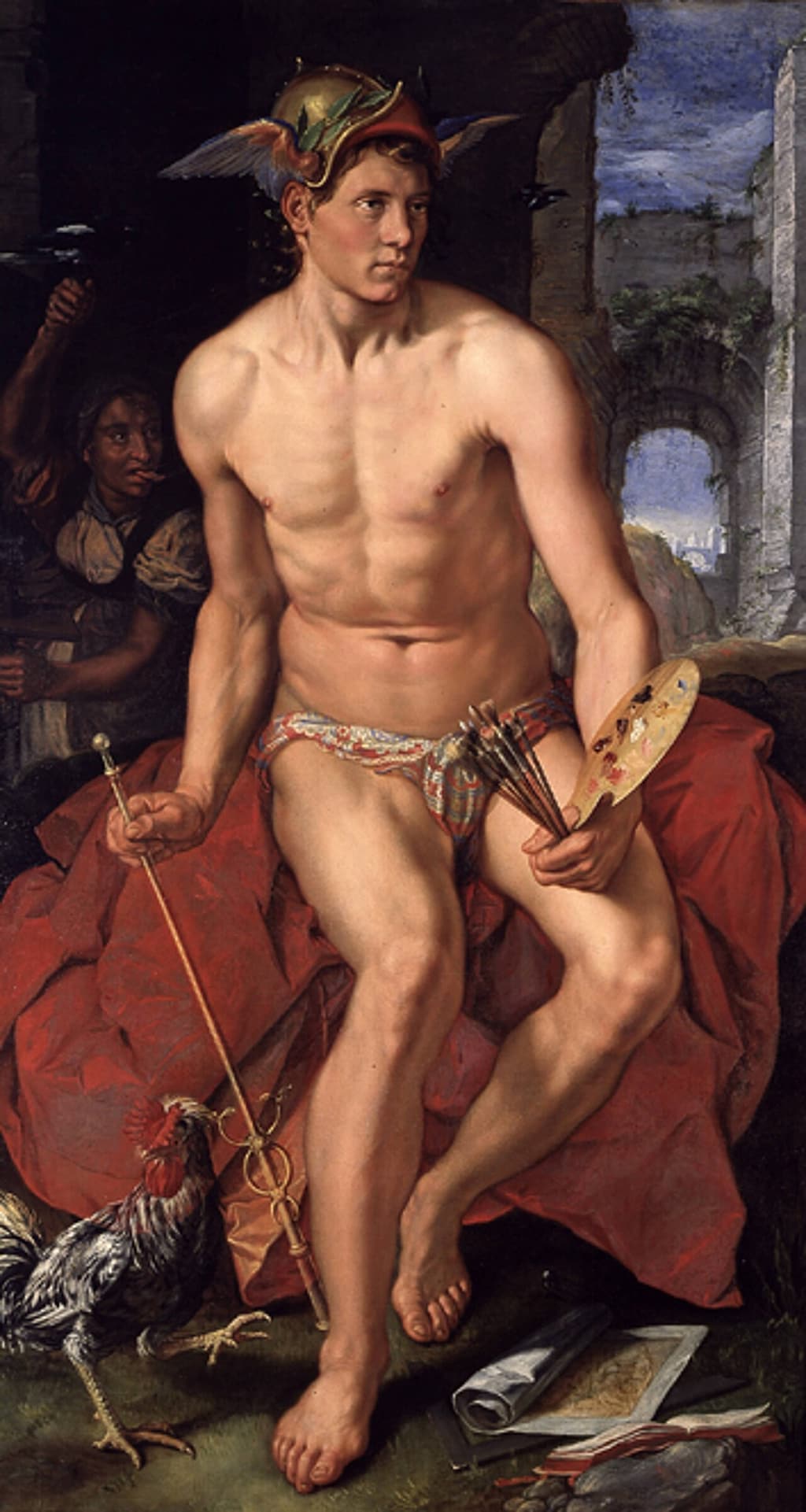
His name is a commercial term. Mercurius is built on merx, merchandise — the same root as mercari, to trade, and mercator, a merchant. No etymological ingenuity is required and none of the mystery of Greek Hermes's name applies. Rome named this god after the activity he was for.
The temple the Senate did not want
His temple went up on the Aventine slope by the Circus Maximus in 495 BCE, and Livy tells the story of its dedication as a political incident. The consuls both wanted the honour; the Senate referred the decision to the people, and the people gave it to a centurion, Marcus Laetorius. The Senate was reportedly furious. In the same year a guild of merchants was established in connection with the cult.
That is a founding worth registering. Mercury's Roman cult begins outside the sacred boundary, on the plebeian hill, dedicated by a soldier over the objections of the aristocracy, attached to a trade association. He is the god of the people who move goods.
The prayer for profitable lying
The best single passage on Roman Mercury is in Ovid's Fasti for 15 May, his festival day. Merchants went to a spring by the Porta Capena, filled a jar, sprinkled their goods and their own heads with the water, and prayed. Ovid reports the prayer in what reads as barely exaggerated form: wash away my past perjuries, wash away my past lies, let the gods not hear them, and grant me profit today from a good deception.
No Greek text does anything quite like this. It is not a myth about a trickster god; it is a piece of commercial religion in which a businessman asks for absolution and better results next quarter in the same breath, and the poet reporting it clearly finds the frankness funny. Roman religion permitted transactions of exactly this shape — do ut des, I give so that you give — and Mercury was the deity where the transactional logic got closest to the surface.
The purse
In Roman art he carries three things: the winged cap or petasus, the herald's staff, and a money-bag. The bag is the Roman addition. Greek Hermes has the staff and the boots and the traveller's hat, but the purse in the hand is a Roman iconographic invention and it is everywhere — bronzes, wall paintings, shop signs, gravestones — because it stated in one object what the god was for. His herald's staff, the caduceus with its twin snakes, is separately one of the most heavily reused emblems of antiquity, and is still routinely confused with the single-snake rod of Asclepius in medical branding.
His mother is Maia, an old Italic power of growth whose name the month of May carries, and to whom the flamen Volcanalis sacrificed on 1 May — an unexpectedly archaic link that suggests Maia was in the Roman calendar before her son was fitted to her as Hermes's mother. It also makes Maia a genuinely Roman name still in circulation.
Caesar's Gallic Mercury, and what interpretatio hides
In the sixth book of the Gallic War, Caesar writes that the god the Gauls worship most is Mercury, that they have the most images of him, that they consider him the inventor of all arts, the guide of roads and journeys, and the greatest power over money-making and trade.
That sentence is almost certainly not about the Roman Mercury at all. Caesar is applying interpretatio Romana, naming a foreign god by the nearest Roman equivalent, and the god behind it is generally identified with Lugus, whose name survives in Lyon (Lugdunum), Laon and Leiden. Gallo-Roman dedications repeatedly pair Mercury with the native goddess Rosmerta, who has no Roman counterpart and gives the game away.
The physical scale of that cult is worth stating: Pliny the Elder records a colossal bronze Mercury made for the Arverni by the sculptor Zenodorus, which took ten years and cost forty million sesterces — a statue of a "Roman" god commissioned by Gauls, larger than anything of the kind in Rome. The lesson generalises. Interpretatio is a translation convention, and it conceals at least as much as it conveys, on every frontier where Romans wrote down someone else's gods.
Where Hermes is richer, and where Mercury is
Hermes has a biography: born at dawn, stealing Apollo's cattle by evening, inventing the lyre from a tortoise before bedtime. He also has the herms, stone pillars marking boundaries and doorways whose mutilation in 415 BCE became an Athenian political scandal, and a serious role conducting souls to the dead.
Roman Mercury took the myths as literature — Ovid and Horace both write him well — but not the herms and not, in state cult, the psychopomp function. Rome had its own gods of the boundary and its own arrangements for the dead. What Mercury got instead was the empire's commerce, which is why his image outnumbers most Olympians' across the western provinces: he is the god of the people who kept the roads busy.
What kept his name
Wednesday is his: dies Mercurii gives mercredi, miércoles, mercoledì. The planet nearest the sun is named for the fastest-moving god, and the element mercury for the liquid metal alchemists connected with that planet — which is why quicksilver's symbol is Hg from Greek hydrargyrum but its name is Roman. From there: mercurial temperaments, the Mercury dime, NASA's Mercury programme, Mercury Records, and a singer who chose the surname. Florists' delivery networks and courier companies still use his winged sandals as a logo, which is about as close to the original job description as a modern brand ever gets.
Questions that come up about Mercury
Did he have a priest or a state festival beyond 15 May?
There is no flamen Mercurialis, but there was a body of mercuriales — an association attached to his cult, drawn from traders — which is an unusual arrangement and reinforces how much this cult belonged to an occupational group rather than to the state calendar. His day is the Ides of May, and the temple's dedication anniversary is the same date.
Was he worshipped at crossroads like the Lares?
Not in Rome, though the association shows up in the provinces, where Mercury frequently receives dedications at roadside shrines and passes. In the city the crossroads belonged to the Lares Compitales and their December festival. The overlap in the provinces probably comes from Mercury absorbing native road-and-boundary deities under interpretatio.
What is a "Mercury" in a Pompeian shop?
A very common painted or moulded figure by a doorway or on a counter, typically small, with purse and staff, sometimes beside a phallus for luck. These are the working-level evidence for his cult and are far more numerous than any temple record: a bar or a bakery announcing, in the ordinary idiom of the street, that money is expected to come in through this door.
Why do doctors use his staff?
They mostly should not. The caduceus with two snakes and wings is Mercury's, a herald's and trader's emblem; the single-snake staff of Asclepius is the medical one. The confusion appears to have spread through nineteenth-century printers' devices and was then entrenched when the US Army Medical Corps adopted the caduceus in 1902. Commercial healthcare branding in the United States still uses the trade god's staff far more often than the healing god's.