Start at the barbecue. The fire theft is famous and the meat is not, but in Hesiod — the only archaic source for either — the meat comes first, and the fire is the retaliation for it. Read in the right order, this is not a story about a benefactor stealing a gift for humanity. It is a story about a quarrel that escalates twice, and about who ends up paying for it.
Mecone: the division of the ox
At a place called Mecone, gods and men were still settling the terms of their relationship, and an ox had to be divided between them. Prometheus did the dividing. He made two portions. In one he put the meat and the rich inner parts, and covered them with the animal's stomach lining, which looks like offal and is repellent. In the other he laid out the bones, stripped white, and wrapped them in a layer of glistening white fat.
He invited Zeus to choose. Zeus took the fat.
Hesiod then does something peculiar which every reader trips over: he says Zeus saw through the trick and was angry, and chose the bones anyway knowingly, because he was already planning harm for mankind. This ruins the story's logic — a deceived god is the whole point — and it is generally understood as Hesiod refusing to let the king of the gods be outsmarted in his own poem. The awkwardness has never been smoothed out, and it sits there in the Theogony as a visible seam.
The scene exists to explain a real practice. At a Greek animal sacrifice, the thigh bones wrapped in fat were burned on the altar for the god and the meat was eaten by the people. Every festival dinner in Greece was, technically, this trick being re-performed. Hesiod is telling worshippers that the arrangement they participate in weekly began as a swindle that the victim allowed to stand.
The stalk of fennel
Zeus's response was to withhold fire from mortals. He would not give it, so they could not cook and could not work metal, and would live like animals with meat they could not use.
Prometheus stole it. Hesiod's detail is exact and physically plausible: he hid it in a hollow fennel stalk. Dried giant fennel has a pith that holds an ember and smoulders slowly along its length without the outer casing catching, and it was genuinely used in the Mediterranean to carry fire from one household to another. The most famous theft in mythology is committed with a piece of ordinary agricultural equipment.
Zeus, seeing the spark among men from a distance, was — Hesiod says — cut to the heart.
Two punishments, and only one of them lands on the thief
The second escalation is the one people forget. Zeus did not punish humanity by taking the fire back. He punished them with a gift.
Hephaestus moulded a woman from earth and water; Athena taught her weaving and dressed her; Aphrodite gave her allure; Hermes put in a shameless mind and a thief's tongue. Every god contributed something, which is what her name records. She was delivered to Prometheus's slower brother Epimetheus, who had been warned to accept nothing from Olympus and accepted her anyway, and what she brought with her is a separate and even bleaker story.
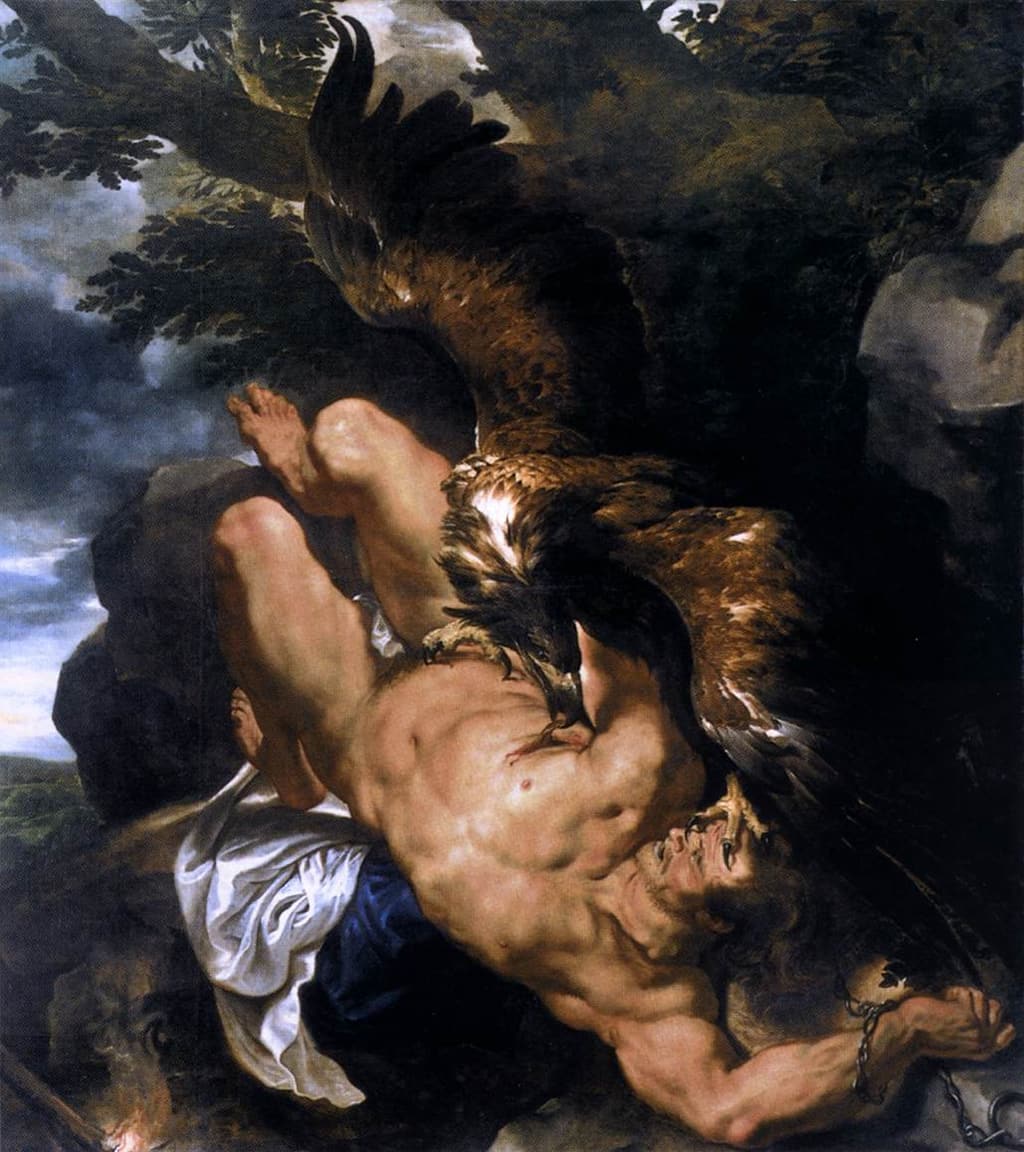
Prometheus himself was taken east and pinned to a rock in the mountains with an unbreakable shaft driven through him, and an eagle came each day to eat his liver, which grew back each night. Hesiod adds that Heracles eventually shot the eagle and freed him — and that Zeus permitted it, because he wanted his son to have the glory. So even the rescue is a favour.
Aeschylus rebuilds him
The Prometheus of Prometheus Bound is a different character altogether. Where Hesiod's is a clever schemer, the tragedian's is a civilising god who gave humanity everything: he lists numbers, writing, yoked animals, ships with sails, medicine, the reading of omens, the working of metals under the earth. And one gift more, which is the strangest line in the play — he took away from humans the ability to foresee their own deaths, and planted blind hopes in them instead. Fire, he says almost as an afterthought, came on top of that.
He is also, in this version, in possession of a secret: he knows which marriage would produce a son greater than his father, and he will not say. Zeus will fall unless he is told. Hermes arrives to demand it and gets nothing, and the play ends with the whole rock face driven down into the earth with the god still shouting from it.
Two cautions belong on that play. First, it was the opening piece of a trilogy, and the reconciliation almost certainly came in the lost Prometheus Unbound — so the defiant, unbroken Prometheus that the Romantics adored is a fragment torn from a resolved sequence. Second, whether Aeschylus wrote it at all is a genuine and long-running scholarly dispute, on grounds of metre, vocabulary and the extraordinary staging demands; a substantial body of specialists assigns it to a later fifth-century hand, and the question is not settled.
What the Greeks were arguing about
Underneath the plot is an argument about whether human civilisation is a gift or a theft — whether technology arrived with divine approval or against divine intention. Hesiod's answer is grim: everything good in human life is a compensation for something worse, and labour, women, disease and hunger are all in the same package as fire. Aeschylus's answer inverts it and makes the god who defied Zeus the reason humans are more than animals.
That disagreement is why the story stayed alive. Plato has Protagoras retell it in his own idiom, with Prometheus stealing technical skill from Hephaestus and Athena and Zeus later supplying the political sense to use it without mutual slaughter. Every version is an argument about what humanity got and what it still lacks.
Cult, by contrast, was thin. Prometheus had an altar in the Academy at Athens and a torch race in his honour — appropriately, a relay in which the flame had to arrive still burning — and he shared it with Hephaestus and Athena, the other patrons of craft. He was a god of the workshop rather than a god of rebellion. The rebellion is a literary career.
Who takes his place
There is a footnote most retellings drop. Prometheus's release required someone to go to death in his stead, and the volunteer was Chiron, the centaur — immortal, and incurably wounded years earlier by one of Heracles' own poisoned arrows. He was in permanent agony and could not die of it. Giving up his immortality solved both problems at once. That transaction is the quiet, adult centre of the whole cycle: two impossible situations cancelling each other.
The modern Prometheus
No classical figure has been more thoroughly repurposed. Goethe's 1770s ode has him addressing Zeus with contempt and taking sole credit for making humans in his own image. Beethoven wrote a ballet about him and reused its finale theme in the Eroica. Shelley wrote Prometheus Unbound explicitly to replace the reconciliation he assumed Aeschylus had written, because he refused to let the rebel shake hands with the tyrant. Mary Shelley gave Frankenstein the subtitle The Modern Prometheus, which fixed the association between stolen fire and dangerous knowledge for good.
The Soviet Union liked him for obvious reasons; so did nineteenth-century industrialists, for the opposite ones. Element 61, discovered in reactor fission products and named in 1945, is promethium — named with the atomic bomb explicitly in mind by the chemists who found it. Ridley Scott's Prometheus borrowed the name and the theme of makers punished by their creations.
The image that persists is not Hesiod's. It is the rock and the eagle, which Rubens and Moreau and a hundred others painted, and which appears on a Laconian cup of about 560 BCE — Prometheus bound with the bird at his liver, and Atlas beside him under the sky, two brothers serving the same sentence in different postures.
Questions this story raises
Was Prometheus a Titan? Yes, by descent — his father was Iapetus, one of the children of Gaia and Uranus — but he did not fight against the Olympians in the Titanomachy. Hesiod has him on Zeus's side in that war, which makes the later quarrel a falling-out among allies rather than a continuation of an old one. Atlas is his brother, and Atlas did fight.
Did he make human beings? Not in Hesiod, where humans already exist at Mecone and nobody explains where they came from. The idea that Prometheus moulded the first people out of clay is later — Aesopic fable, Ovid's suggestion in the Metamorphoses, Pausanias reporting that lumps of leftover clay smelling of human flesh were still shown to tourists at Panopeus. It is a real ancient tradition, but it is not the archaic one.
Why the liver specifically? It was the organ read for omens in Greek and Etruscan divination, and it was popularly held to be the seat of the passions. It is also the only major human organ that genuinely regenerates, which the Greeks may or may not have known from wounds; the coincidence is remarked on regularly and cannot be proven either way.
How much of the eagle punishment is in the earliest source? All of it. The chained god, the daily bird and the regrowing liver are in Hesiod's Theogony, which is the oldest text we have on the subject. The Caucasus as the specific location comes with Aeschylus.
Related: what came out of the jar, the Greek tradition as a whole, and the family tree that places the Titans against the Olympians.