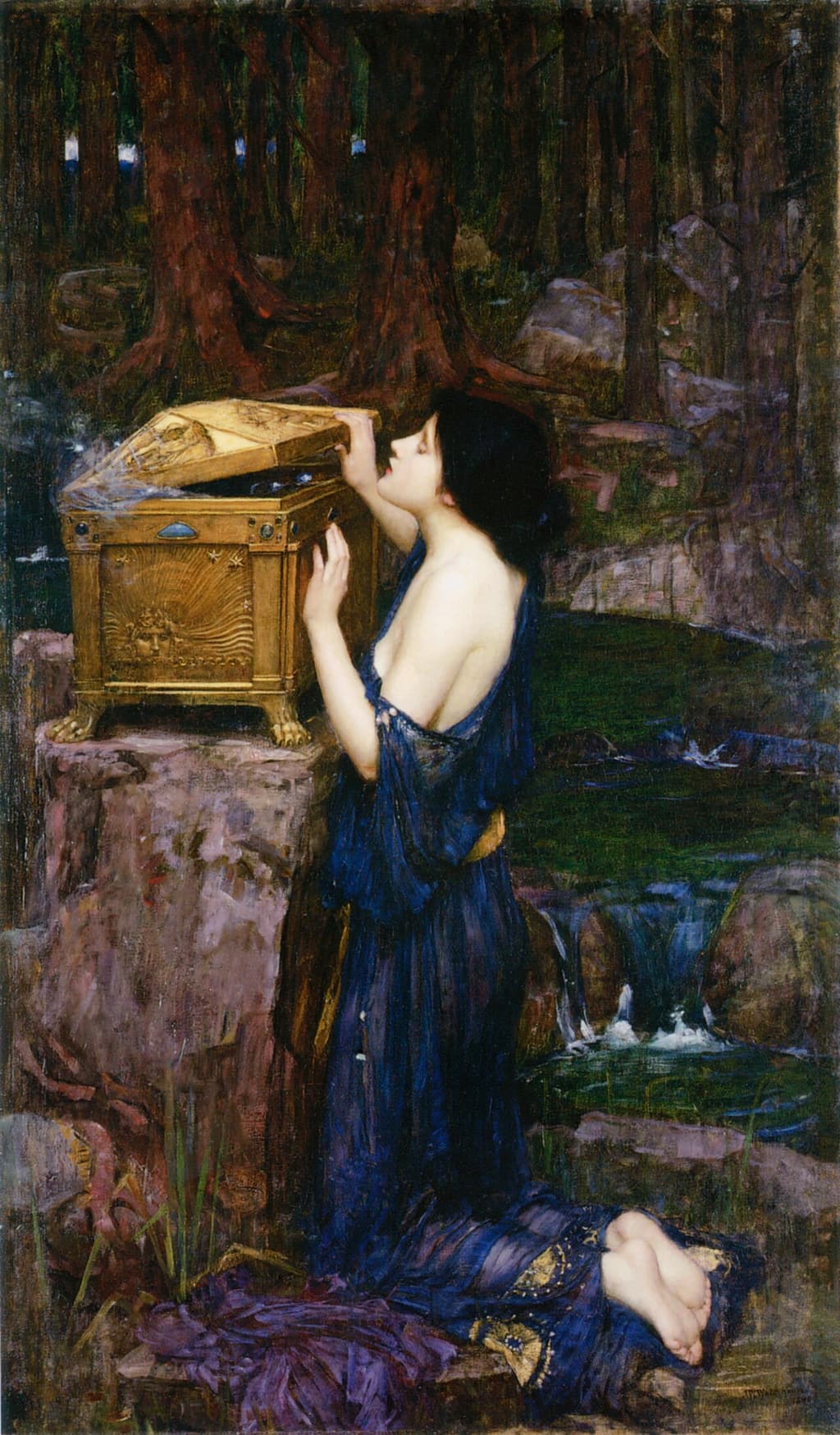
There is no box. There is a large ceramic storage jar, of the kind Greek households kept oil and grain and wine in, and sometimes buried their dead in. The mistranslation is traceable: Erasmus, rendering Hesiod into Latin in the early sixteenth century, turned the Greek pithos into pyxis, a small lidded casket, and every European language followed him. Five hundred years later the phrase "Pandora's box" is in every newspaper and the object it names never existed.
The story it belongs to is shorter than people think, survives in two versions by the same poet that contradict each other, and ends on a sentence nobody has ever satisfactorily explained.
Why Zeus made her
She is a reprisal. Prometheus had cheated Zeus over the division of a sacrificial ox and then stolen fire back for humanity in a fennel stalk, and Zeus decided that the correct response was not to take the fire away again but to give people something else.
Hephaestus mixed earth and water and moulded a body, with a voice and strength in it, in the likeness of the goddesses. Athena taught her weaving and dressed her, and put a worked veil and a golden crown on her. The Graces and Persuasion hung gold necklaces on her; the Seasons crowned her with spring flowers; Hermes, last, put into her a shameless mind and a deceitful nature and gave her speech, and lies with it.
Her name is the accounting. Pandora — because all the Olympians gave her a gift, or, on the other reading of the same compound, because she is the one who gives everything. Hesiod chooses the first sense explicitly, but the second is the older-sounding one, and there is a real possibility that the name belonged originally to an earth-goddess, an all-giver, and that Hesiod has taken it over and inverted it.
She was delivered to Prometheus's brother Epimetheus — the name means something like "afterthought" — who had been warned never to accept anything from Zeus and accepted her without hesitating.
Four lines that carry everything
Then, in the Works and Days, the passage everything else hangs on:
The woman took the great lid off the jar with her hands and scattered what was in it, and made grief for humankind. Before that, people had lived free of hard work, free of painful sickness and of the harsh labours that bring death. Now the earth is full of evils and the sea is full of them, and diseases come to people by day and by night, silent, because Zeus took the voice out of them.
Only Hope stayed inside, under the rim, and did not fly out, because the woman put the lid back on first.
Notice what Hesiod does not say. He does not say whose jar it was, or where it came from, or how it got into the house. He does not say Pandora was forbidden to open it. He does not even, strictly, say she was curious — the word is not there. And he says nothing whatever about what it means that Hope stayed in.
What is Hope doing inside the jar?
This is one of the genuine unsolved cruxes of Greek literature, and it is unsolved because the text is short, not because scholars are lazy.
The difficulty is structural. The jar holds evils. If Hope is in the jar with the evils, then either Hope is itself an evil, or the jar contains something that does not belong to the category. And if the jar's contents were released to humanity, then the thing kept inside was kept from us — so leaving Hope in the jar means humanity does not have it.
The main readings, none of which commands agreement:
- Hope remained with us as consolation. The comforting version, and the one most retellings assume. It requires the jar to be a storehouse rather than a prison — she keeps the one good thing safe.
- Hope was withheld. We got the diseases and lost the expectation. Bleak, and consistent with the mechanics of the jar.
- Hope is one of the evils, and the worst of them. Nietzsche took this view flatly: Zeus left it precisely so that people would go on tormenting themselves. Some scholars think the Greek elpis — closer to "anticipation of what is coming" than to English "hope", and usable of dread as well as of expectation — supports this.
- Hesiod is being deliberately unresolved. The Works and Days is a poem of hard practical advice to a brother who has cheated him, and its whole tone is that life is grim, work is necessary and comfort is not offered. An ending that refuses to say whether we have hope suits it.
Anyone who tells you confidently which one is right is telling you which one they prefer.
Hesiod contradicts himself
He told the story twice, and the versions do not match. In the Theogony there is no name and no jar at all. There is simply a beautiful evil made and given to men as the price of fire — and then a long, sour passage comparing women to drones in a hive who eat what the workers gather. The point there is not a single catastrophic act. It is that the existence of women is the punishment.
The Works and Days softens this into narrative and adds the name, the jar and Hope. Whether the jar was part of the tradition Hesiod inherited or something he grafted on cannot be determined from two poems by the same author.
There is also a straightforwardly different ancient version, and it is worth knowing about because it makes the fable coherent. In the fabulist Babrius, and in a related passage of Theognis, the jar contains good things, not evils; a man opens it out of curiosity, the blessings escape upward to the gods and are lost, and hope alone is caught under the lid — which is why hope is the only good thing still living with human beings. That version has no woman in it at all.
The uncomfortable part
Hesiod's Pandora is not a curious girl who made a mistake. She is a manufactured object, designed as a weapon, given a lying mind by a god as part of her specification, and delivered as a punishment to the entire male half of the species. The poem is explicit about this, repeatedly, and in terms that are not made better by context.
Later Greeks did not adopt this as doctrine — there was no Greek dogma of a fall, no doctrine of inherited guilt, and Pandora is not blamed in Greek religion the way she is in the poem. But the passage sat in the school curriculum for two thousand years and did work.
The comparison with Eve is inevitable and needs care. There is no evidence of one tradition borrowing from the other; both belong to a wide eastern Mediterranean pattern in which the first woman, curiosity or disobedience, and the loss of an easier life are linked. What the comparison does illuminate is how differently the two cultures used it: Genesis makes it the start of a theological argument about sin, while Hesiod makes it an explanation of why farming is hard.
Her afterlife in art and idiom
Greek vase painters were much more interested in her making than her opening. Several fifth-century pots show a woman rising out of the ground surrounded by gods, sometimes labelled Anesidora — "she who sends up gifts" — which is an earth-goddess title, and this is the strongest visual argument that something older stands behind Hesiod's account. Pausanias saw her birth carved on the base of Pheidias's great statue of Athena in the Parthenon.
After Erasmus, the box took over. Rossetti painted her holding a casket with smoke escaping; Klee made a strange small etching of a vessel that is unmistakably not a box; a hundred cartoons a year use the lid as shorthand for an irreversible decision. The phrase now attaches to nuclear weapons, gene editing, social media and any legislative amendment somebody dislikes.
Recent retellings have gone back to correct the record — Natalie Haynes titled a book Pandora's Jar precisely to make the point that the container has been wrong for five centuries and that the woman blamed for everything acts, in the original, in four lines.
Frequently asked, rarely answered
Whose jar was it? Hesiod never says. Later authorities guessed: some make it a wedding gift from Zeus that came with her, some say it stood already in Epimetheus's house, and one late tradition has Prometheus himself bottling the evils and storing them there — which would make his brother's household the safest place on earth until it was married into.
Was Pandora the first woman? In Hesiod, yes, and men existed before her. Other Greek accounts of human origins do not agree with this at all — some have humans grown from the earth, some from stones thrown after a flood, some made by Prometheus from clay — and Greek mythology never harmonised them.
Did she have any cult? Not under that name, and this is telling. She has no temple, no festival, no priesthood. She is a figure of poetry, not of worship, which is unusual for a character this famous and supports the view that her name was taken from somewhere else.
Does the phrase "opening Pandora's box" fit the story? Only loosely. In Hesiod the harm is permanent and general, and the lid does get put back on — successfully, and with something still inside. The modern idiom, which implies total irreversibility, drops the one detail the poem spends its last line on.
Read the first half of the quarrel at the theft of fire, meet the woman herself, or go up to the Greek tradition. The name is in modern use as a given name, with a history worth reading at a site that tracks them.