The labours are usually presented as a list, which is exactly what ruins them. A list of twelve monsters is a bestiary. What actually holds the sequence together is an argument between two men about the terms of a contract — one of them the strongest creature alive, the other a coward with a legal mind and the authority of Delphi behind him. Eurystheus cheats on the paperwork twice, and the paperwork wins.
Why he was there at all
Heracles went to Delphi as a murderer. Hera had sent madness on him and he had killed his own children — his wife Megara too, in some tellings — and the Pythia's instruction was that he go to Tiryns, put himself under his cousin Eurystheus for ten years, and perform whatever tasks that man set. Do it, and he would be made immortal.
Note the number. Ten. Twelve is what he ended up doing, and the two extra tasks exist because Eurystheus disallowed two of the first ten. Sources disagree on where the madness belongs: Apollodorus puts the killings before the servitude, which makes the labours a penance. Euripides, in his Heracles, puts them after — the hero comes home in triumph and then destroys his family, which makes the whole heroic career worthless in a single scene. That relocation is deliberate and devastating, and it is one of the sharpest things any Greek playwright did to inherited material.
Eurystheus never came out to meet him. He communicated through a herald named Copreus, and when anything genuinely alarming arrived at Tiryns he climbed into a large bronze storage jar sunk in the ground and gave orders from inside it. Vase painters loved this. There are pots on which you can see nothing of the king but a bald head and two hands over the rim.
The first ten, and the two that were struck out
The lion of Nemea could not be cut. Arrows came off it. He shut it in its own cave, blocked one mouth, and strangled it, then found that the only thing that would skin it was its own claws. He wore the hide afterwards, and that pelt is how you identify him in art for the next thousand years.
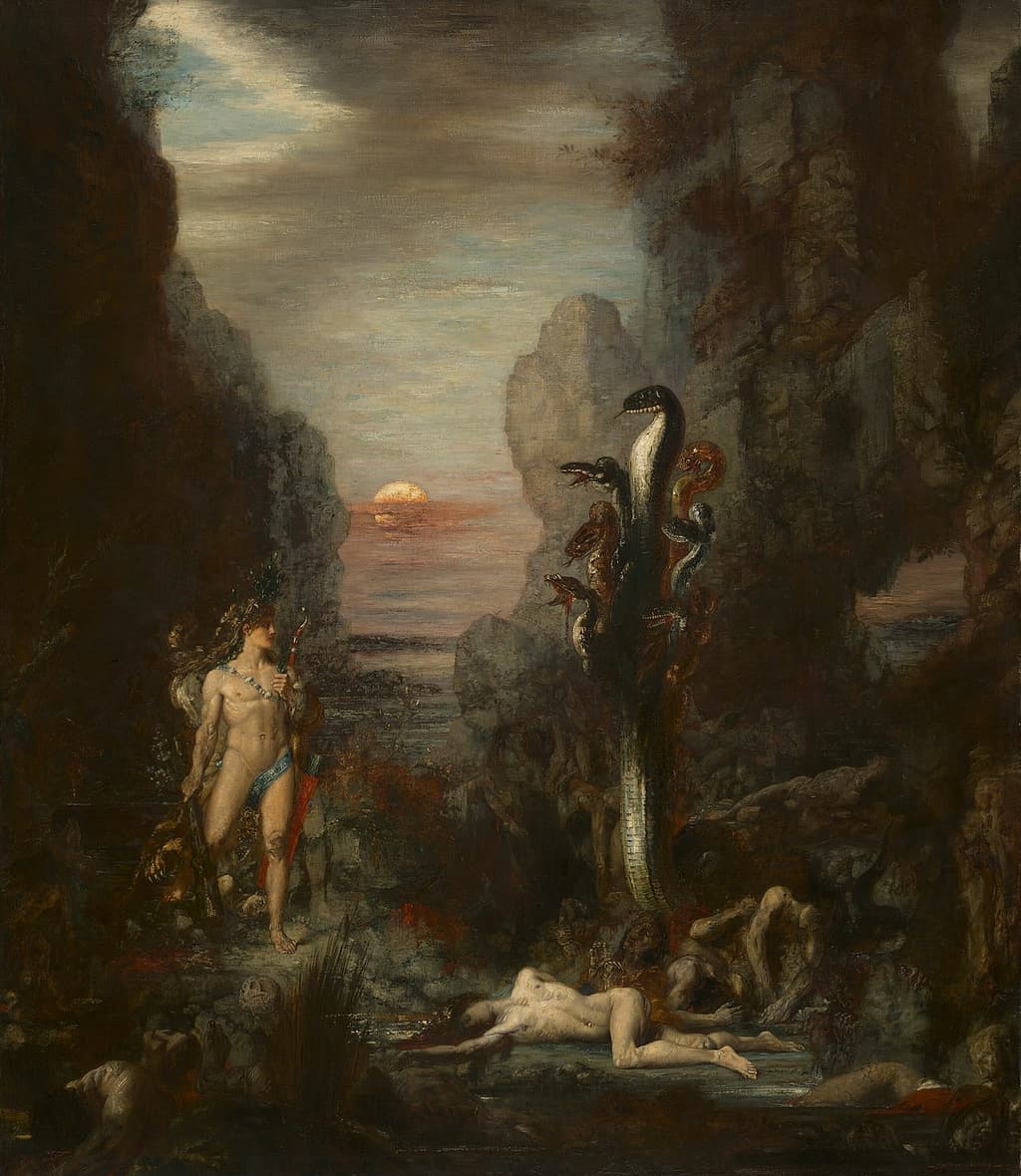
The Hydra of Lerna grew two heads for each one cut. He brought his nephew Iolaus, who ran in with a firebrand and cauterised each stump as it opened, and the immortal head went under a boulder. He dipped his arrows in the creature's blood, which was a practical decision that eventually killed Chiron, the centaur Nessus, and Heracles himself. Eurystheus disallowed it: he had help.
The hind of Ceryneia was sacred to Artemis and had golden antlers, and the problem was not killing it but not killing it. Apollodorus gives him a year of pursuit and a diplomatic apology to the goddess at the end.
The Erymanthian boar he ran into snowdrifts until it foundered and carried it back alive over his shoulders — this is the jar episode. On the way he stopped with the centaur Pholus, opened a jar of wine that belonged to all centaurs collectively, and started a brawl that ended with Chiron accidentally shot by one of the Hydra-poisoned arrows, incurably wounded and immortal, a problem resolved only much later.
The stables of Augeas held three thousand cattle and had never been cleaned. He diverted two rivers, the Alpheus and the Peneus, through the yard. Eurystheus disallowed this one too — Heracles had negotiated a fee of a tenth of the herd from Augeas beforehand, which made it paid work rather than a labour. The argument is petty and completely characteristic.
The Stymphalian birds were flushed out of a marsh with bronze castanets made by Hephaestus and shot as they rose. The Cretan bull he wrestled and shipped home; released, it wandered to Marathon and became someone else's problem. The mares of Diomedes in Thrace ate men, and he stopped them by feeding them their owner, but not before they had eaten his companion Abderus, for whom he founded a city. The belt of Hippolyta would have been handed over willingly if Hera had not gone through the Amazon camp in disguise starting a rumour, after which it had to be taken off a corpse. The cattle of Geryon were on an island past the western edge of everything, guarded by a two-headed dog and a herdsman, and owned by a man with three bodies joined at the waist; Heracles borrowed the golden cup that Helios sails in overnight to get there, having first threatened the sun with an arrow for making him too hot.
That is ten. Two are void. Eurystheus adds two more, and both of them are qualitatively different from anything that came before: they are not in the world.
The two replacement tasks, which are not the same kind of task
The apples of the Hesperides required first finding out where they were. He wrestled the shape-shifting sea-god Nereus until he answered, crossed Libya and killed the wrestler Antaeus by holding him off the ground where his mother could not feed him strength, and on some route or other freed Prometheus from his rock. Then he reached Atlas and made the offer everyone remembers: I will hold this, you fetch those. Atlas came back with the apples and no intention of taking the sky again, and Heracles agreed pleasantly, asked him to take it for one moment while he padded his shoulders, and walked off. In the other version he simply picks the apples himself after killing the serpent Ladon, and Atlas does not appear.
Cerberus had to be brought up alive and unarmed, which is the only labour where the condition is harder than the deed. He went down, asked Hades directly, and was told he could take the dog if he could subdue it without weapons. He did. He brought it to Tiryns. Eurystheus took one look and sent it straight back, and the servitude was over.
Twelve is a late number, and the sets do not match
There is no early text that gives twelve labours in a fixed order. The earliest place the number is actually materialised is architectural: the twelve metopes of the Temple of Zeus at Olympia, carved around 460 BCE, six over the front porch and six over the back. That is a fifth-century Elean committee's canon, made of stone, and it is not identical to the canon in Apollodorus three or four centuries later. The Olympia sequence puts the Augean stables in a position of honour, which is unsurprising given that Augeas was a local king and Heracles was held to have founded the Olympic Games on that occasion.
Diodorus Siculus, writing in the first century BCE, gives the fullest continuous narrative and orders things differently again. Earlier still, the sixth-century poet Pisander of Camirus wrote a Heraclea that is largely lost, and Panyassis another. What survives from the archaic period is a mass of episodes — Heracles fighting the sea-god, Heracles wounding gods at Pylos, Heracles and the Cercopes — with no evidence that anyone had yet fixed which ones counted.
The parerga, the "side-works", are the giveaway. Antaeus, Busiris, the freeing of Prometheus, the rescue of Alcestis, the Argonautic voyage, the sack of Troy a generation before the famous one: these attach loosely to the itinerary and drop off it again depending on who is telling it. The twelve is a frame imposed on a career, not the shape the career originally had.
What the Greeks were doing with him
He was the panhellenic hero, claimed everywhere, and that is why the geography of the labours sprawls from Thrace to Spain to Libya. Dorian aristocracies traced descent from him; Sparta's two royal houses did; Alexander's family did, and Alexander wore the lion skin on his coinage. He is also the only major hero who becomes a god at the end, with a divided cult — sacrificed to as a hero at some altars and as an Olympian at others, sometimes at the same sanctuary on the same day, which ancient writers themselves found notable.
The moral reading came later and is Stoic in flavour: labour freely undertaken, endurance, the choice of virtue over ease. Prodicus's parable of Heracles at the crossroads, summarised by Xenophon, made him a schoolroom figure. The Romans, who called him Hercules and swore by him constantly, took the endurance and left most of the ambiguity behind.
Where the sequence went next
The twelve became a structural template long after anyone believed in them: any ordeal-list narrative — the labours of a video-game hero, the trials in a quest fantasy — is working in this shape. Disney's 1997 animation removed the infanticide, the servitude and Eurystheus altogether, which is a defensible children's-film decision and leaves almost nothing of the plot. Steve Reeves and a long line of Italian peplum films fixed the muscleman image; the God of War series borrows the lion pelt for a character who is otherwise unrecognisable.
The lion itself has an afterlife of a different kind: the Nemean beast is one of the standard identifications for the constellation Leo, which is why the zodiac's origin stories keep circling back to this cycle.
Things readers ask about the sequence
Why does the order vary so much between books? Because no ancient source had authority over the others. Apollodorus is a handbook compiler of perhaps the first or second century CE working from many earlier texts; Diodorus is writing universal history with a rationalising bent; Olympia's sculptors were making a building. Modern lists usually follow Apollodorus because he is tidy, not because he is early.
Was Iolaus really disqualifying? The rule appears only as Eurystheus's ruling, and it is not applied consistently — Athena helps with the Stymphalian birds in several accounts and nobody objects. The two disallowances read less like a code than like an employer looking for grounds.
Did the servitude last ten years or twelve? Apollodorus says the Pythia set eight years and a month, though the text is disputed here, and the round "twelve years" appears elsewhere. The mismatch between the number of years and the number of labours is old and unresolved.
Is there anything historical underneath? No specific event, but the distribution of his cult is informative: Heracles sanctuaries cluster at boundaries, gates, gymnasia and hot springs, and he is repeatedly the hero invoked at the edge of settled territory. Whatever he was before he acquired a biography, he was a figure of thresholds.
More on the tradition at the Greek hub and the family tree; for the cycle's inheritors see the Argonauts, on which Heracles briefly served and was left behind.