The sanctuary sits on a shelf of Mount Parnassus above a ravine, facing a sea of olive trees running down to the Gulf of Corinth. It is not a comfortable place. Two enormous cliffs, the Phaidriades or "shining rocks", rise directly behind it, and the Castalian spring runs out of the gorge between them. Whatever one concludes about the oracle, the site was chosen by people who understood that a place can do a great deal of the work.
The navel
Delphi called itself the omphalos, the navel of the world. The aetiology, reported by several authors, is that Zeus released two eagles from opposite ends of the earth and they met here. A carved stone omphalos stood in the temple — a rounded conical block covered in a net-like pattern of woollen fillets — and the Roman-era copy found on site is one of the most photographed objects in Greek archaeology. Next to it, Pausanias says, stood the stone that Cronus swallowed instead of the infant Zeus, which was anointed with oil daily.
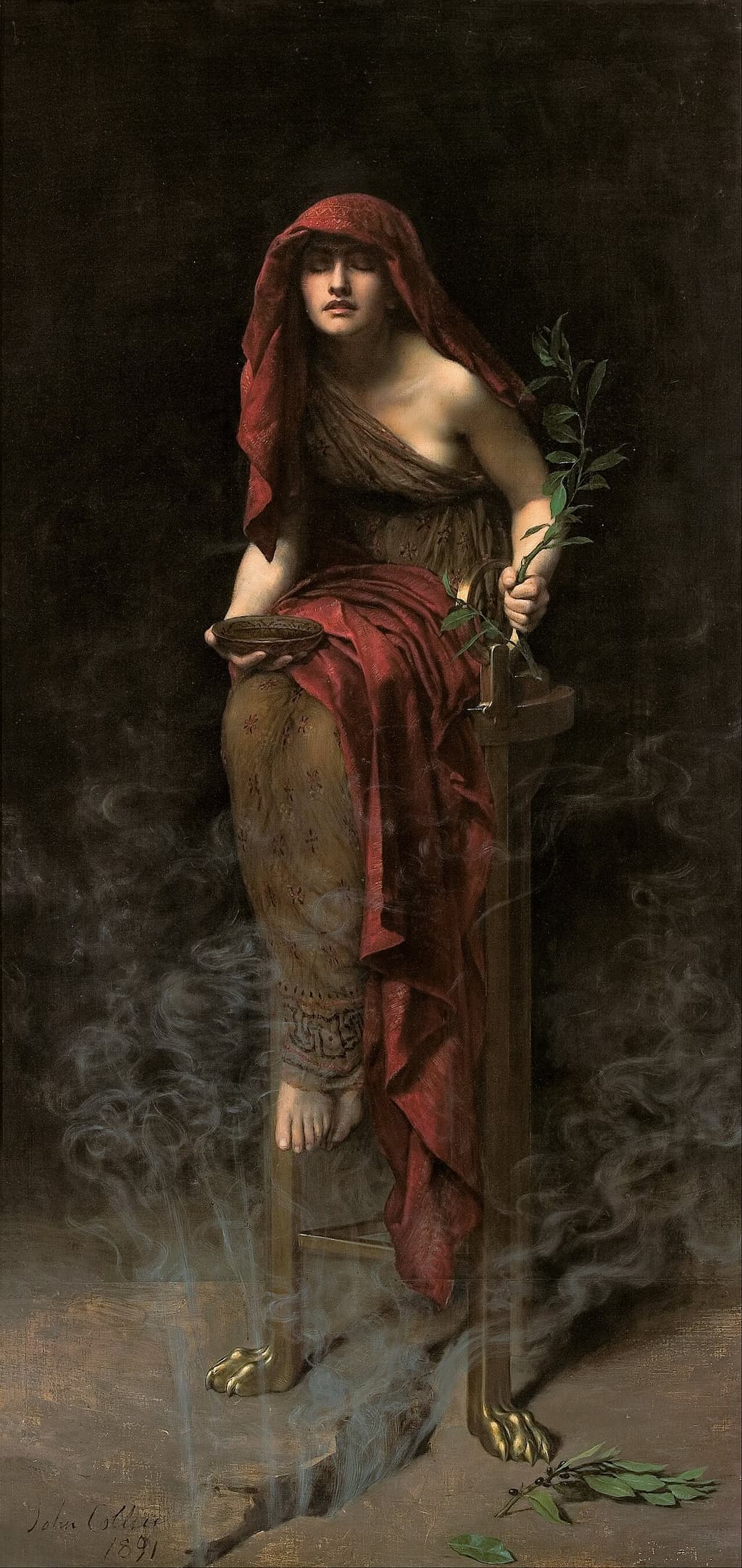
The other object was the tripod: a bronze three-legged stand with a bowl, which is what the Pythia sat on and which became the sanctuary's emblem, appearing on coins and in art wherever Delphi is meant.
Who ran it
Not Apollo alone, in practical terms. Delphi was administered by an Amphictyonic League — a religious confederation of twelve peoples of central Greece and Thessaly, each with two votes, which met twice a year, administered the sanctuary's finances and land, and had the authority to declare a Sacred War against anyone who violated it.
That authority was used, and it made Delphi a piece of international machinery rather than a shrine. Four Sacred Wars are counted, the first over the neighbouring town of Crisa levying tolls on pilgrims in the early sixth century BCE, the third over Phocian seizure of the sanctuary in the 350s, which gave Philip II of Macedon his opening into central Greek politics and, ultimately, into Greece. The Phocians melted down dedications to pay mercenaries; the accountants' records of what was taken survive on stone.
Cities dedicated treasuries along the Sacred Way — small marble buildings holding their offerings, functioning as permanent advertisements. The Athenian Treasury, rebuilt in the twentieth century, was paid for from the spoils of Marathon according to its inscription. The Siphnian Treasury's frieze is among the finest archaic sculpture in existence. Sparta, Thebes, Syracuse, Corinth and dozens of others competed here architecturally, and the whole terraced slope is a record of Greek inter-city rivalry conducted in stone.
The Pythian Games
Second only to Olympia among the four panhellenic festivals, and different in kind: the Pythian Games began as a musical contest, a competition in singing to the kithara a hymn about the god's killing of the serpent, and added athletics and chariot racing later. The prize was a laurel wreath. The stadium sits at the very top of the site, above the theatre, above the temple — the highest point anyone climbs.
The maxims
Carved at the temple were short sayings attributed to the Seven Sages, of which two are famous: gnōthi seauton, know yourself, and mēden agan, nothing in excess. A third, more cryptic, was the letter E, about which Plutarch wrote an entire essay canvassing explanations without settling on one.
These made Delphi a moral authority as well as a predictive one, and their afterlife is enormous — "know thyself" runs through Socrates, Cicero, Montaigne, Pope, Emerson and every self-help shelf since, generally without anyone noting that its original context was a warning to remember you are mortal and not a god, delivered on the doorstep of an oracle.
The vapours question
Ancient authors, including Strabo and Plutarch, describe a pneuma or exhalation rising in the inner chamber. Plutarch, who served as a priest at Delphi in the late first century CE, discusses it as a genuine physical phenomenon and speculates about why it had weakened — his essays On the E at Delphi and On the Obsolescence of Oracles are the best inside account of any ancient sanctuary.
French excavators from 1892 onward found no fissure and no gas, and the vapour story was dismissed for most of the twentieth century as a literary invention. Then a multidisciplinary team — a geologist, an archaeologist, a chemist and a toxicologist — published work from 2001 onward identifying two intersecting faults beneath the temple, bituminous limestone that releases light hydrocarbons when heated by fault friction, and traces of methane, ethane and ethylene in the spring water and travertine deposits near the site. Ethylene is a sweet-smelling gas that was used as an anaesthetic in the twentieth century and produces, in light doses, a euphoric trance.
The hypothesis has been contested — critics argue the measured concentrations are far too low, and that the geology does not demonstrate delivery into the adyton in the classical period. It is not settled. What changed is that the ancient reports can no longer simply be dismissed as fiction, and that is a fair summary of the current state of the question.
The village on top of it
The most striking fact about the modern site is that a village was living in it. Kastri sat directly on the sanctuary, its houses built over the temple terraces, until the French School at Athens negotiated the removal and relocation of the entire settlement in 1891–92 so that the "Great Excavation" could begin. It ran from 1892 to 1903 and produced the site as it is now seen, along with the Charioteer of Delphi — a life-size bronze from about 470 BCE, found in 1896 with its inlaid eyes intact, one of the very few large Greek bronzes to survive.
The last responses date to the fourth century CE. The traditional final oracle, reported in a much later source as delivered to the emperor Julian — that the hall has fallen, Apollo has no house, the laurel has withered, the speaking spring is silent — is of doubtful authenticity but has served as the epitaph ever since. The sanctuary closed under Theodosius' anti-pagan legislation in the 390s CE.
What a consultation cost, and what the sanctuary did with the money
Who could consult the oracle, and what did it cost?
In principle any free person or state, subject to sacrificing a pelanos — a fee paid in cash or in kind, whose rate is recorded for some cities on surviving inscriptions, with states paying far more than individuals — and to the preliminary goat sacrifice indicating the god's willingness. Certain cities held promanteia, the right to consult ahead of the queue, granted as an honour. The oracle was open only nine months a year and originally only one day a month.
What did people actually ask?
The surviving corpus is dominated by practical and religious questions: whether to found a colony and where, which god to sacrifice to in order to end a plague, whether to accept a proposed alliance, whether to adopt a cult. Herodotus preserves the most famous political consultations, including the "wooden wall" response to Athens before the Persian invasion, which Themistocles interpreted as the fleet. Delphi's function was less to see the future than to underwrite a decision that the questioner had already narrowed down.
Is the theatre the one still used today?
The ancient theatre at Delphi seats about 4,500 and has been used for occasional performances since the Delphic Festivals staged by the poet Angelos Sikelianos and Eva Palmer in 1927 and 1930, but it is not in regular use like the theatre at Epidaurus. Conservation concerns have restricted access in recent years.
Was Delphi wealthy?
Extremely, and it functioned as a kind of international deposit institution: gold and silver dedications from Lydian kings, Sicilian tyrants and Greek cities accumulated there under sanctuary protection, catalogued by weight in inventories inscribed on stone. Croesus of Lydia's dedications, itemised by Herodotus, included gold ingots and a lion of refined gold. That concentration of portable wealth is precisely why the sanctuary was worth going to war over, and why the Phocian seizure was so shocking.