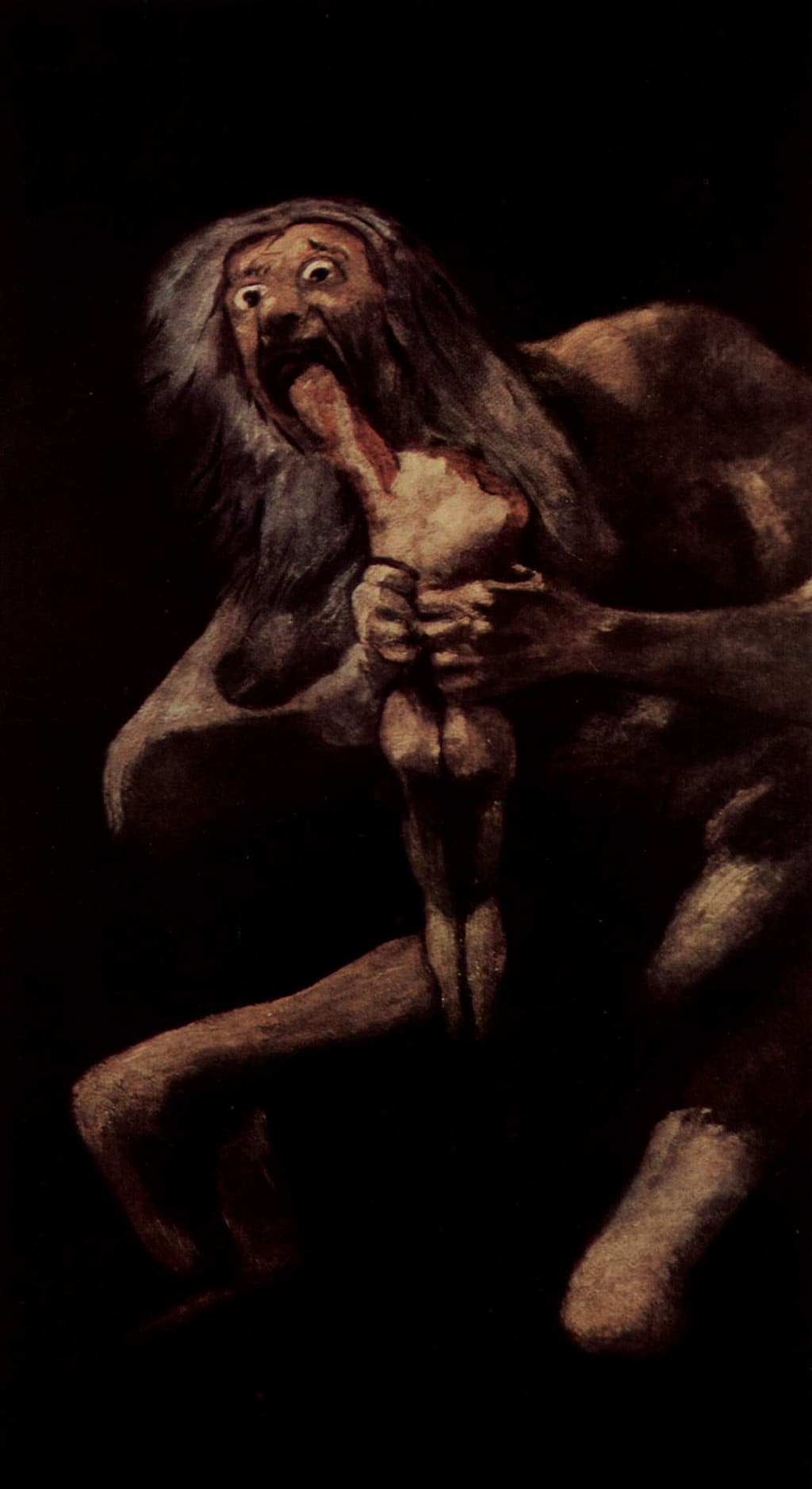
Two things were said about Cronus in the same culture at the same time. He is the father who ate his children as they were born, one after another, and had to be tricked with a stone. He is also the king under whom men lived like gods, without labour, sorrow or old age, when the earth gave its fruit without being asked. Hesiod says both, within a few hundred lines of each other, in the Theogony and the Works and Days, and does not appear to feel any tension. Greek religion was not required to be consistent, and the festival Athens held for him — the Kronia, in midsummer at harvest — celebrated the golden-age king, not the cannibal.
The castration of the sky
The Theogony's succession myth begins with Ouranos, the sky, lying over Gaia, the earth, and pushing each of their children back inside her as they are conceived. Gaia, in pain, makes a sickle of grey adamant and asks her sons to act. Only Cronus, the youngest, agrees. He waits, seizes his father, and cuts. The severed parts fall into the sea and produce Aphrodite; the drops of blood on the earth produce the Erinyes, the Giants and the Meliae, the ash-tree nymphs. Ouranos names the sons Titans, "strainers", and predicts vengeance.
The structural parallel with the Hurrian-Hittite Song of Kumarbi, recovered from Hattusa in the twentieth century, is close enough that borrowing is now widely accepted: there too a sky-god is unmanned by his successor — by biting, in that version — who then becomes pregnant from swallowing what he has taken, and is in turn displaced by a storm-god. Hesiod's succession sequence is not a purely Greek invention, and identifying its Near Eastern source is one of the field's real achievements.
Swallowing, and the stone at Delphi
Warned by Gaia and Ouranos that his own child would overthrow him, Cronus took each infant from Rhea as it was born and swallowed it whole. Five went down intact: Hestia, then Demeter, Hera, Hades and Poseidon. Expecting a sixth, Rhea went to Crete on her parents' advice, bore Zeus in secret, and gave her husband a stone wrapped in swaddling clothes, which he swallowed without inspecting.
Grown, Zeus forced him to disgorge them — by an emetic given by Metis in Apollodorus, without explanation in Hesiod — and the stone came up first. It was set at Delphi beneath Parnassus, and Pausanias, writing in the second century CE, says he saw it: a stone of no great size, anointed with oil every day, with unspun wool laid on it at festivals. Eight centuries after Hesiod, someone was still oiling it.
The Titanomachy that followed lasted ten years and turned when Zeus released the Hundred-Handers, Kottos, Briareos and Gyges, from beneath the earth. The defeated Titans were shut in Tartarus behind a bronze gate with the Hundred-Handers as guards.
And yet: the golden age
Hesiod's Works and Days gives the five races of men, and the first, the golden race, lived "when Cronus was king in heaven". They did not age, they died as if falling asleep, and the grain-giving earth bore of its own accord. Pindar's second Olympian places the blessed dead on the Isle of the Blessed, ruled by Cronus. Others say Zeus released him after a time and set him to rule that place, or that the Romans located him in Italy after his fall, where he taught agriculture.
The Kronia at Athens, in the month Hekatombaion at the grain harvest, involved masters and slaves eating together, and in some accounts slaves being served. It is the model for the Roman Saturnalia in December, with its gift-giving, its licence, its mock king, and its suspension of ordinary rank. A festival of temporary equality attached to a deposed god makes a certain kind of sense: the golden age is by definition the order that no longer applies, so it is honoured by suspending the present order for a day.
Not the god of time
Kρόνος (Kronos) and χρόνος (chronos, "time") are different words with different first letters and no established etymological connection. Hellenistic allegorists — the Stoics prominent among them — merged them deliberately, reading the swallowing of children as time consuming what it produces. Cicero records the interpretation; Neoplatonists elaborated it; Renaissance mythographers inherited it. The sickle, originally a harvest implement and the instrument of the castration, became the scythe of Time, and from there Father Time with his hourglass and scythe walked into every New Year cartoon in Europe.
This is a genuine and productive misreading, not a modern error, and it is worth being clear which parts of "Cronus, god of time" belong to Hesiod (none) and which to two thousand years of allegory (all of it). The name's actual origin is unknown, and may not be Greek.
Saturn is a different god with a different job
The Roman Saturn was an old Italian deity of sowing — his name is usually connected to satus, sown — with a temple at the foot of the Capitoline that housed the state treasury, the aerarium. His statue was said to be bound with woollen fetters all year, released only at his festival. The Saturnalia, running from 17 December and expanded to several days, was the most popular festival in the Roman calendar: courts closed, gambling was permitted, gifts were exchanged, a Saturnalicius princeps was appointed to give absurd orders, and slaves dined ahead of their masters.
His identification with Cronus imported the Greek myths wholesale, and the golden-age association fitted an Italian agricultural god comfortably. The astrological Saturn — cold, slow, heavy, malefic, the outermost visible planet and therefore the slowest-moving — descends from Babylonian astronomy through Hellenistic Greek astrology and gives English saturnine and Saturday, the one weekday in English still named for a Roman god.
Goya's kitchen wall
The image nearly everyone carries is Goya's Saturn Devouring His Son, painted directly onto the plaster of his house near Madrid around 1820–23 and never intended for exhibition; it was transferred to canvas after his death and hangs in the Prado. It shows a wild-eyed giant tearing into an already headless adult body — not the swaddled infant of Hesiod. Rubens' earlier version, which Goya knew, is closer to the text.
Neither is what a Greek would have pictured. The archaic tradition has Cronus swallow the babies whole and undamaged, which is the necessary premise: they have to come back out alive. Goya's cannibal is Roman-named, Baroque-descended and psychologically modern, and it has almost entirely replaced the original in the popular imagination.
Cronus now
He turns up as a background threat in fantasy and games — the Percy Jackson sequence rebuilds its entire arc around his attempted return, which is a reasonable extrapolation from the Titanomachy — and as a byword for devouring parental power in psychoanalytic writing. The planet, the day, the words saturnine and saturnalia, and Father Time himself are all his in one guise or another. The golden age, meanwhile, has become secularised: every political appeal to a lost era of simplicity descends, through Virgil's fourth Eclogue and Ovid's account of the ages in Metamorphoses 1, from Hesiod's few lines about the race that lived when Cronus was king.
Titan, god or neither — and what the Giants have to do with it
Was he ever actually worshipped?
Sparsely, but yes. The hill above the sanctuary at Olympia is the Kronion, and Pausanias records that priests called the Basilai sacrificed to Cronus there at the spring equinox. Athens had the Kronia and a joint temple of Cronus and Rhea near the Olympieion. Cult of a deposed god is unusual and the evidence is thin compared to any Olympian, but it is not absent.
Why is he a Titan rather than a god?
The categories are less firm than modern usage suggests. Hesiod calls the Titans gods; the distinction is generational and political — they are the ruling family Zeus overthrew, not a different order of being. Several Titans keep their honours under the new regime, notably Hecate and Helios, and Prometheus is a Titan's son who deals with Olympus directly. The clean modern division into "Titans" and "gods" as opposing species is a tidy-up.
Does he have any children besides the six Olympians?
The centaur Chiron is his, by the Oceanid Philyra, whom he approached in the form of a horse and left when Rhea appeared — which is the standard explanation of why Chiron is half horse and, unlike other centaurs, immortal and wise. Some sources also give him the Corybantes, and Roman tradition gives Saturn a son Picus in Italy.
What is the difference between the Titans and the Giants?
Different beings, different wars, different origins, and constantly conflated. The Titans are the children of Ouranos and Gaia and are defeated in the Titanomachy. The Gigantes are born from the blood of the castrated Ouranos falling on the earth, and they attack Olympus later, in the Gigantomachy, which required a mortal — Heracles — to win. The Gigantomachy is the more common subject in Greek art, including the great Pergamon altar frieze.