The eight surviving columns at the western end of the Forum belong to Saturn, and the building they held up was not primarily a place of worship. It was the aerarium, Rome's state treasury: the public money, the bronze law tablets and the military standards were kept in and under it for most of the Republic. The architrave still carries the inscription recording that the Senate and People of Rome restored what fire had destroyed, cut in the fourth century CE.
A god of sowing whose temple is the exchequer is a specifically Roman construction, and Roman writers were content to explain it by saying that money was safe where the golden age was remembered.
The statue in wool
Inside stood a cult image which, according to Macrobius, was hollow, filled with oil, and had its feet bound with woollen fetters for the whole year. The bonds were untied for the days of the Saturnalia in December and tied again afterwards.
Nobody in antiquity could agree what the binding meant. Suggestions ranged from a memory of the god's own imprisonment to a device for keeping his beneficial presence in the city. What is not in doubt is the annual rhythm it enacted: a god held in check for eleven months and let loose for one, at the moment when Roman society itself was let loose.
His temple's rite was also conducted Graeco ritu — the Greek way, with the head uncovered, where nearly all Roman sacrifice was performed with the toga drawn over the head. Roman priests knew this was anomalous and recorded it as such.
Saturnalia
From 17 December, and by the imperial period for anything from three to seven days, the ordinary rules were suspended.
- Courts and schools closed; formal business stopped.
- Men swapped the toga for informal dinner clothes and put on the pilleus, the felt cap worn by freed slaves — the whole city dressed as ex-slaves for the week.
- Households inverted: slaves were served by their masters, or dined first, or were permitted to speak with a freedom the rest of the year did not allow.
- Gambling with dice, illegal at other times, was tolerated in public.
- Gifts were exchanged: wax candles (cerei) and small pottery figurines (sigillaria), which had their own market days at the end of the festival.
- A Saturnalicius princeps, a mock king, was chosen by lot at dinner parties to issue absurd orders. Tacitus records the young Nero being picked at one such gathering and using the role to humiliate Britannicus.
- The greeting was io Saturnalia, shouted in the street.
How free the freedom was is a real argument rather than a rhetorical one. Roman writers themselves disagree: Seneca complains about the city going mad and advises a philosopher to join in moderately rather than abstain conspicuously; Pliny the Younger had a soundproofed room built so he could work through it; Lucian's satire treats the licence as genuine but strictly time-limited. One scholarly reading takes the reversal as a safety valve that reinforced the hierarchy by suspending it under supervision; another takes seriously the possibility that slaves experienced it as real relief. The sources support both, which is usually a sign that both were true for different households.
The god who was hidden in Latium
The Roman narrative about him is not the Greek succession myth, though Rome accepted that too once Jupiter was equated with Zeus. The Latin story is that Saturn, driven out of his kingdom, was received in Italy by Janus, taught the inhabitants agriculture and law, and reigned over a golden age in which there was no property, no slavery and no war — and that Latium takes its name from his hiding there, latere.
Virgil uses that tradition in the Aeneid to give Italy an indigenous prehistory rather than a Greek-derived one, and the Saturnalia's reversals were understood as an annual replay of the age when nobody owned anybody. Whether the golden-age material is old Italic or a literary construction from Hesiod's races of men is disputed; the calendar and the treasury are the parts that are certainly Roman.
His name's origin is unsettled. Varro derived it from satus, sowing, which fits his sickle and his December date; modern linguists are more inclined to connect him with the Etruscan Satre, a deity who appears in the region of the sky mapped out on the bronze liver from Piacenza.
Cronus, Chronos, and a confusion that produced Father Time
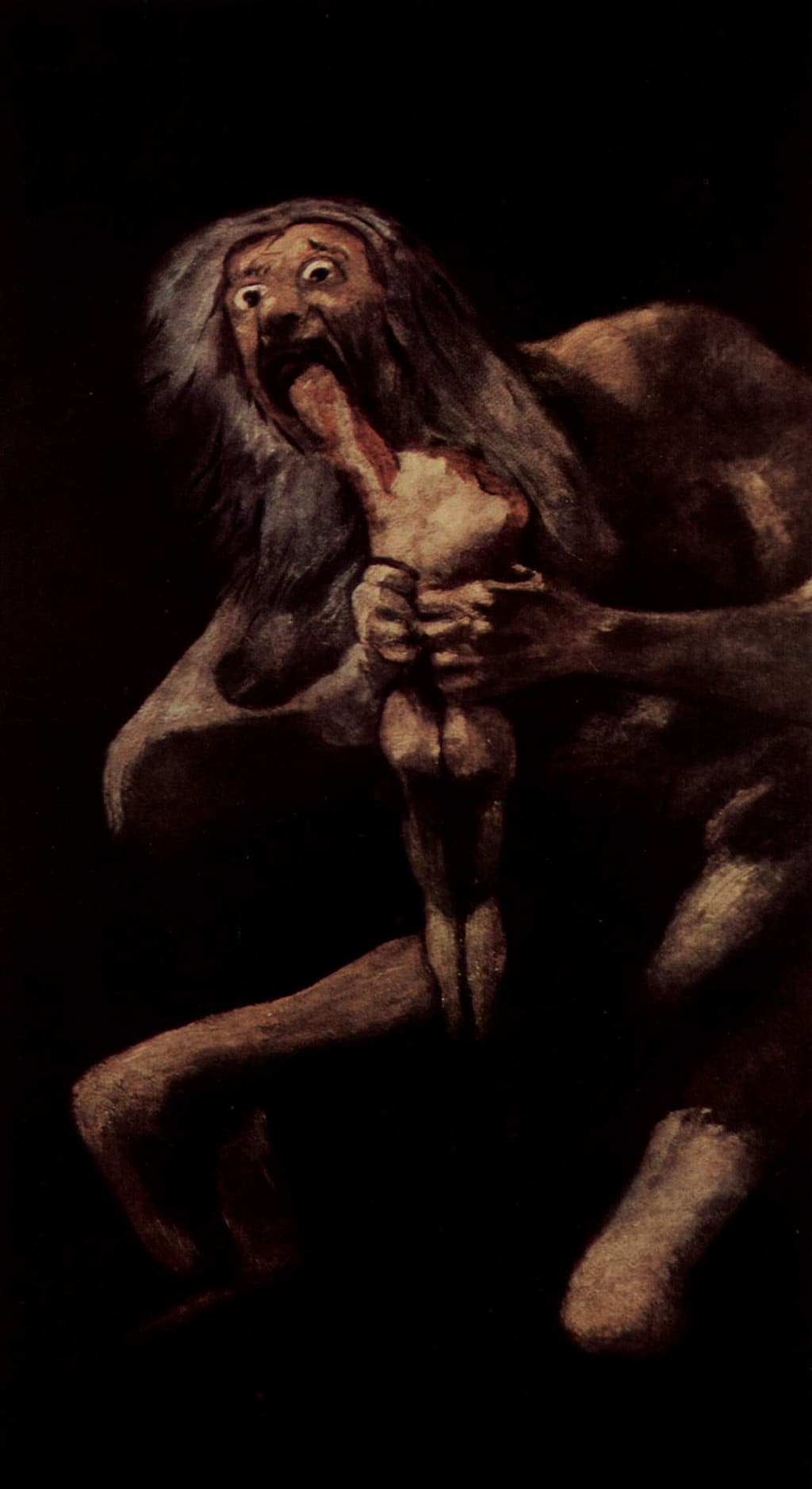
Greek Cronus supplied the swallowing of children and the castration of the sky, and Rome took the plot. Then a second, separate mix-up did more damage: Kronos the Titan and chronos, the Greek word for time, are unrelated but sound alike, and late antique and medieval writers merged them. Saturn accordingly acquired time's scythe and hourglass, aged into a bearded old man, and became Father Time — the figure who still appears every New Year's Eve alongside the infant year. The sickle in his hand began as a harvesting tool for a sowing-god and ended as the reaper's blade.
Saturday, saturnine, Saturn V
He owns the only day of the English week still named for a Roman god; the others were replaced by Germanic equivalents, and dies Saturni survived because there was no Norse Saturn to swap in. Astrology made him the slowest and coldest planet and the ruler of melancholy, which gives English saturnine; medicine gave lead to Saturn, so chronic lead poisoning was long called saturnism. The planet's rings, first properly interpreted by Huygens in 1655, made it the most recognisable object in the solar system, and NASA put his name on the rocket that reached the Moon. Goya's black painting of him devouring his son is probably the single most reproduced image of any Roman god.
Things worth settling about Saturn
Is Christmas descended from the Saturnalia?
The parallels are real and the descent is not proven. Candles, gift-giving, feasting, holiday closure and a mock king who resurfaces in the medieval Lord of Misrule all line up suggestively, and midwinter festivity in Rome ran from 17 December through to the January Kalends. But 25 December is not a Saturnalia date, the early Christian arguments for that date turn on other reasoning, and the claim that it was chosen to displace the festival of Sol Invictus is itself contested by specialists. The honest statement is that a Roman December of licence and presents shaped the texture of European midwinter custom, and that direct institutional descent is an assumption rather than a finding.
Why did the treasury need a temple?
Because a temple was the securest building type available and because deposit under a god's protection carried a sanction that a strongroom did not. The same logic put documents in Ceres's temple and wills with the Vestals. Roman public finance and Roman religion shared premises for entirely practical reasons, and the tabularium built above the Forum in 78 BCE continued the pattern.
Did slaves really give orders to their masters?
The sources describe masters waiting on slaves at dinner, slaves being allowed to criticise freely, and the household discipline being relaxed — not a transfer of authority. Nothing suggests legal status changed for the week, and Roman law made no provision for it. The felt cap of the freedman worn by everyone is the sharpest image of what the festival did: it staged emancipation as costume.
What is left of his temple?
The eight granite columns and the architrave, visible from every photograph of the Forum, belong to the late-antique rebuilding; the podium beneath contains earlier phases going back to the Republic. The vaulted chamber that held the treasury is partly accessible in the substructure. It remains one of the oldest continuously rebuilt sacred sites in Rome, with a foundation date traditionally in the first years of the Republic.