Callimachus opens his hymn with the goddess as a small child on her father's knee, asking for presents: eternal virginity, many names, a bow, a short tunic to the knee, sixty ocean nymphs for a chorus, twenty more to mind her boots and hounds, and all the mountains in the world — any city he likes, she says, since she will rarely go down into one. It is charming and it is a very precise piece of theology. Artemis is defined by refusal: of marriage, of the city, of adulthood as Greek society defined it for women. And the goddess who protects girls is also the goddess who demands them.
Potnia Theron, the mistress of animals
Her oldest visual form is not the slim huntress of classical statuary. On seventh-century BCE vases and metalwork she appears frontally, winged, gripping two animals by the throat or the hind legs — lions, birds, deer. Scholars call the type Potnia Theron, "Mistress of Animals", a phrase the Iliad actually applies to her, and the same iconography runs back through Minoan and Near Eastern art. This is not a goddess of cuddly wildlife. She holds the animals; she has power over their lives; and the hunter's relationship to her is one of permitted killing under conditions that can be violated.
Agamemnon violates them. In the story behind the Trojan expedition, he offends her — by boasting after killing a deer, in one version, or by an unpaid vow — and she stops the wind at Aulis until his daughter is offered. Aeschylus in the Agamemnon makes the sacrifice horrifyingly literal: the girl lifted over the altar like a kid, her mouth gagged to stop a curse. Euripides in Iphigenia at Aulis has Artemis substitute a deer at the last instant and carry the girl to the Tauric Chersonese, where in Iphigenia among the Taurians she is a priestess of a barbarian Artemis whose rite is human sacrifice. The two versions are irreconcilable and both are canonical. Which one a reader is given usually determines whether they think the story is about a father's crime or a goddess's mercy.
Brauron: the bears, and what girls actually did
At Brauron on the east coast of Attica, girls somewhere between about five and ten served the goddess as arktoi, "she-bears", in a rite called the Arkteia. Fragments of small krateriskoi from the site show girls running, sometimes naked, sometimes in a saffron garment, near an altar and a palm. Aristophanes' Lysistrata lists "I was a bear at Brauron" as one of the stages of an Athenian woman's civic life alongside carrying the basket and grinding the grain.
The aetiology given is that a tame bear at the sanctuary was killed after it scratched a girl, and the goddess sent plague until the Athenians agreed to give their daughters to her. Whatever its origin, the function is legible: the wild goddess takes girls out of the household for a period, and returns them ready to become wives — which is precisely the transition Artemis herself refuses. Brauron also received the clothing of women who died in childbirth, dedicated in inventories that survive on stone. She is not a fertility goddess, but she stands at the door of the most dangerous moment in a Greek woman's life, and Greek women called her Lochia when they were in labour.
At Sparta, her sanctuary of Artemis Orthia hosted an ordeal in which boys were whipped while stealing cheeses from the altar; by the Roman period this had become a tourist spectacle with tiered seating, and Plutarch says boys died under the lash. Sparta's Artemis, like Brauron's, is about the making of citizens through controlled violence.
The punishments
Her myths are short and end badly for the offender.
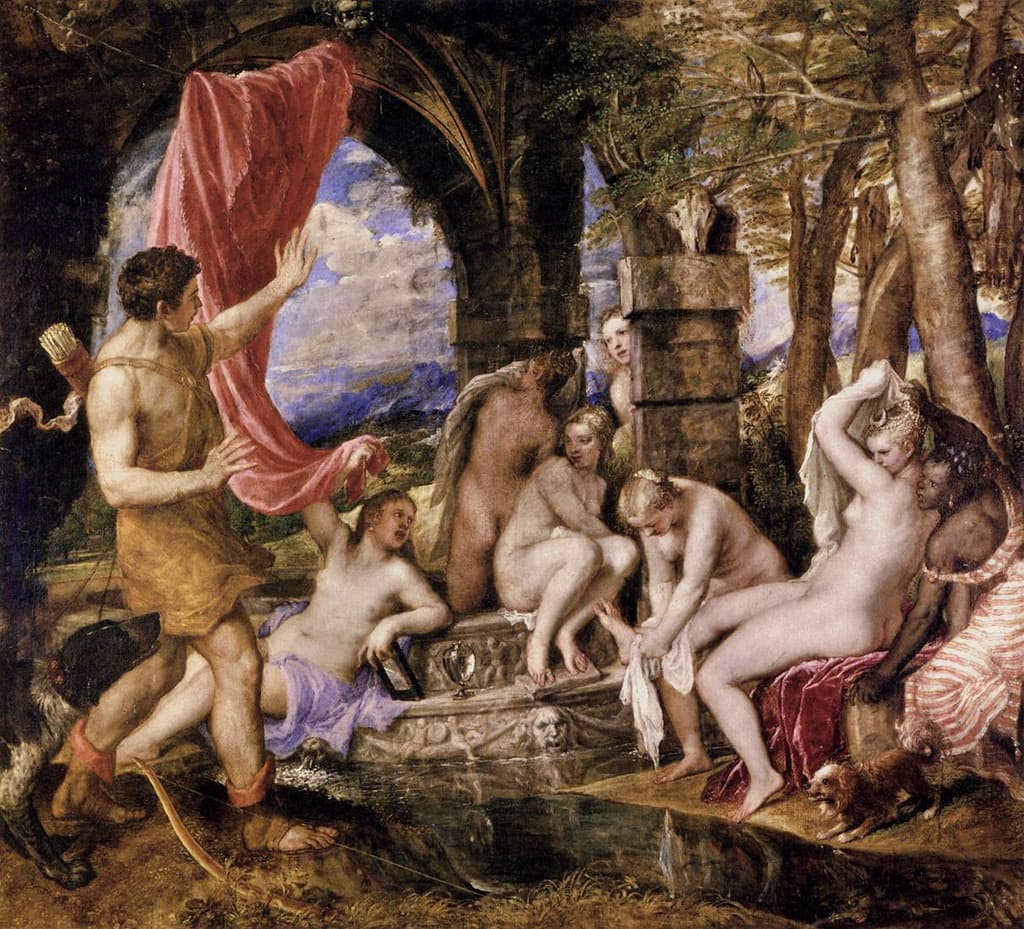
- Actaeon, a hunter who saw her bathing — or, in the older version reported by earlier sources, who boasted of surpassing her at hunting — is turned into a stag and torn apart by his own fifty hounds, who do not recognise him.
- Niobe boasts of having many children where Leto has two. Artemis kills the daughters and Apollo the sons, in a single afternoon; Niobe weeps until she becomes a weeping rock on Mount Sipylus, which Pausanias says he went and looked at.
- Callisto, one of her nymphs, is made pregnant by Zeus. Discovered while bathing, she is expelled, turned into a bear, and eventually placed among the stars as the Great Bear — though whether Artemis, Hera or Zeus works each transformation varies by source.
- Orion dies by her arrow or a scorpion, in versions that disagree about whether he assaulted her, challenged her, or was tricked into being shot by a jealous Apollo.
The one figure she protects is Hippolytus, in Euripides, and she cannot save him: she can only promise revenge on Aphrodite and admit that gods do not weep and may not watch a favourite die. It is one of the coldest and most honest depictions of a Greek deity anywhere in the tragedians.
The Ephesian problem
The Artemision at Ephesus was one of the seven wonders — a colossal Ionic temple, rebuilt after an arsonist burned it in 356 BCE, funded by an international asset-managing sanctuary that operated something like a bank. Its cult statue is nothing like the Attic huntress: a rigid figure with a tapering, sheath-like lower body covered in registers of animals, a high crown, and a chest covered in dozens of ovoid protuberances. Those objects have been read as breasts, eggs, bee's eggs, dates, gourds and — in an influential proposal — bull testicles from sacrifice. There is no consensus.
The honest position is that the Ephesian goddess is an Anatolian deity whose Greek name is a label applied by settlers. Her staff included eunuch priests called Megabyzoi and a hierarchy without Greek parallel; bees were her emblem and appear on Ephesian coinage. The Acts of the Apostles preserves a first-century snapshot of the cult's economic scale, in the riot of the silversmiths whose trade in shrines was threatened. Treating Ephesian Artemis and Brauronian Artemis as the same goddess with local variations is a convenience of ancient nomenclature, not a fact about religion.
Selene, Diana, and the moon that came later
Homer's Artemis has nothing to do with the moon; that is Selene, a separate Titan-descended goddess who drives it. The identification is Hellenistic, tidied further by the Romans, and produces the triple goddess — Diana above, Artemis on earth, Hecate below — that Renaissance mythographers systematised and that most modern readers absorb as ancient. The Roman Diana had her own long-standing cult at the Aventine and at Lake Nemi, where the priesthood, the rex Nemorensis, was held by a runaway slave who won it by killing his predecessor in single combat. That startling detail launched James Frazer's The Golden Bough and, through it, a century of comparative mythology, much of it now discredited.
Rockets, Hunters, and the rereading of her virginity
She is currently in the strongest cultural position of any Greek goddess apart from Athena. The moon-and-bow independent huntress is a stock character across young-adult fiction and games; NASA's Artemis programme, named as Apollo's sister in 2019, put her on rockets. Rick Riordan's Hunters of Artemis have made her a figure of chosen sisterhood for a generation of readers. Feminist and queer readings of her virginity as autonomy rather than deprivation are now the default in criticism.
What almost never survives the transfer is the childbirth patronage, the bear-girls, and the fact that she required death. A goddess whose sanctuaries collected the garments of women who died in labour, whose Spartan cult flogged children bloody, and who stopped a fleet until a girl was killed is a harder figure than the archer on the film poster.
The virgin midwife, the Cretan doubles, and a burnt temple
Is her name Greek?
Probably not, or at least not demonstrably. A-te-mi-to and a-ti-mi-te appear on Linear B tablets, so the name is Bronze Age, but no convincing Greek etymology has emerged; proposed links to artemes ("safe and sound") or to a bear word are speculative. A pre-Greek Anatolian origin is widely suspected and not proven, which sits well with the strength of her cult in Asia Minor.
Why is she a virgin goddess but invoked in labour?
Greek cult did not require a goddess to have experienced what she governs. The relevant idea is that she stands at thresholds — between wild and settled, girl and woman, life and death — and childbirth is the sharpest of those. She is credited in some accounts with assisting at the birth of her own brother moments after being born, which makes the patronage a matter of function rather than biography.
What is the relationship between her and Britomartis or Diktynna?
Both are Cretan goddesses assimilated to her. Diktynna, "she of the nets", was said to have leapt from a cliff into fishermen's nets to escape King Minos; Britomartis is her local name and is glossed in antiquity as "sweet maiden". They keep independent sanctuaries in Crete and western Greece while being addressed as aspects of Artemis, which is how Greek polytheism usually handled a strong regional deity.
What happened to the Temple of Ephesus?
It was damaged in a Gothic raid in 262 CE and never fully restored; the site declined with the silting of the harbour and the rise of Christianity in the city, and its stone was quarried for later buildings, some of it reportedly for Hagia Sophia. The site was located in 1869 by John Turtle Wood after years of searching, and today a single reassembled column stands in a marsh.