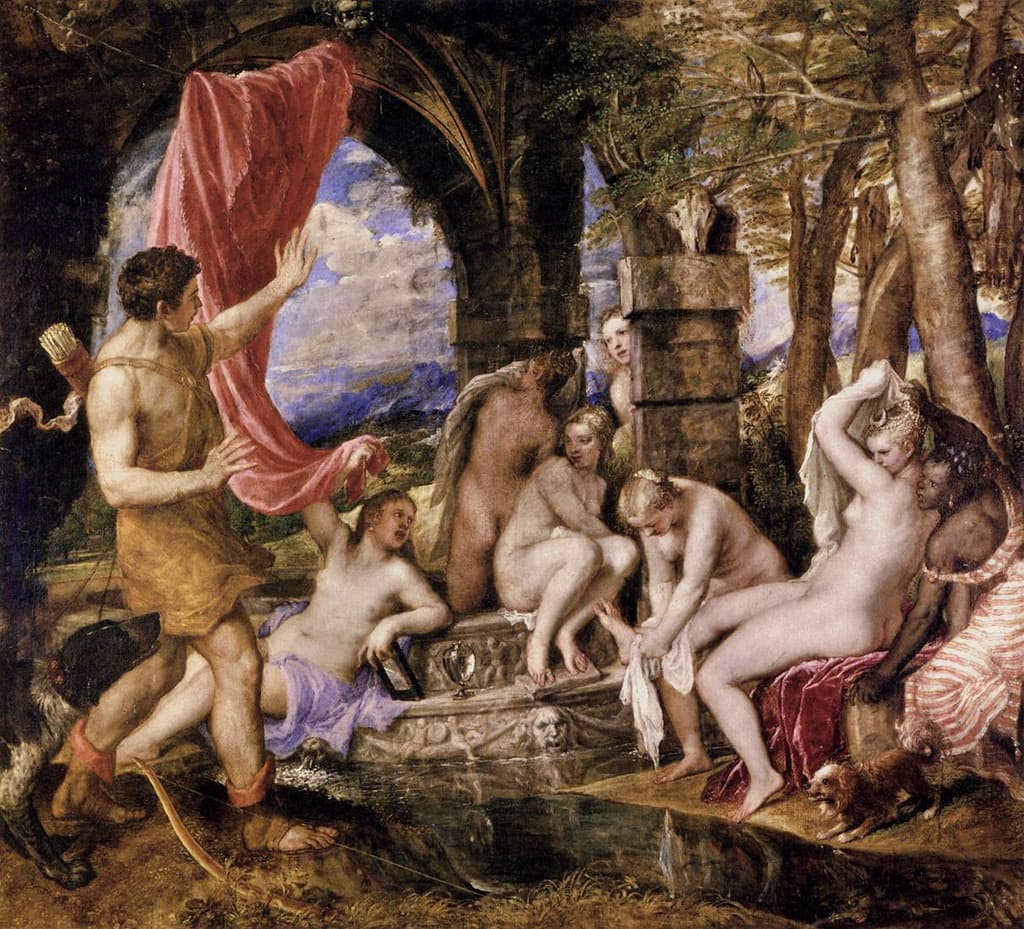
In the woods above Lake Nemi, sixteen miles from Rome, there was a priesthood held by a runaway slave. The holder was called the rex nemorensis, king of the grove. To take the office a fugitive had to break a branch from a particular tree in the sanctuary and then kill the man currently holding it; he then held it himself until someone else did the same to him. Strabo describes the arrangement as a barbarous survival, and Suetonius records that Caligula, thinking one incumbent had lasted too long, hired a stronger man to go and challenge him.
This is not folklore recovered by later antiquarians. It is a functioning religious office in central Italy, within a day's travel of the capital, described by contemporaries.
Nemi was a real place with real finds
The sanctuary sat on a terrace above the crater lake the Romans called speculum Dianae, Diana's mirror. It was a federal cult shared by the Latin communities before Rome dominated them, and its excavated votive deposits show what people actually wanted from her: terracotta models of wombs, of babies, of breasts, alongside models of eyes and limbs. Whatever the poets say about a virgin huntress, the women who paid for those offerings were asking for children and safe deliveries.
Two other figures shared the grove. Egeria, the spring nymph who advised Numa Pompilius, and Virbius, whom Roman writers identified with the Greek Hippolytus, brought back from the dead and hidden in Italy — which is why horses were banned from the precinct, Hippolytus having been killed by his own.
Her festival on 13 August, the Nemoralia, filled the lake shore with torches and garlands; hunting dogs were crowned and hunting was suspended for the day. In Rome the same date was the anniversary of her Aventine temple and a recognised holiday for slaves.
Frazer built a world on that priesthood, and most of it fell down
James Frazer opened The Golden Bough — twelve volumes that shaped a century of thinking about religion, and Eliot, Yeats, Freud and Campbell with it — by asking why a man should have to kill a priest to become one at Nemi. His answer, an evolutionary scheme of dying-and-reviving vegetation kings that supposedly underlies all religion, is not now accepted by specialists in any of the fields it drew on.
The rite itself is not in question; the theory built on it is. That distinction is worth holding onto, because the Nemi priesthood is regularly presented in popular writing either as proof of Frazer's system or as a Frazerian invention, and it is neither.
A Latin name and a plebeian cult
Unlike Artemis, whose name has no accepted Greek etymology, Diana is transparently Italic: from the same root as dies and deus, the bright sky, giving something like "the shining one". She belongs to the layer of Latin religion that predates Greek contact.
Her Aventine temple, credited by tradition to King Servius Tullius, was a joint sanctuary of Rome and the Latins — and the Aventine was the plebeian hill, outside the sacred boundary. The bronze inscription of the temple's charter was still legible in the late Republic and was used as a model for other cult regulations. That combination of associations, slaves and freedmen and the Latin allies rather than the Roman aristocracy, is her Roman social profile, and it does not come from Greece.
Trivia, and the moon
As Diana Trivia she belongs to the crossroads where three ways meet, and Latin poetry fuses her far more readily than Greek does with the moon and with Hecate: Virgil's commentators explain the triple form as Luna in heaven, Diana on earth, Hecate below. Catullus's thirty-fourth poem, a choral hymn sung by boys and girls, calls her mistress of mountains, green woods, hidden glades and sounding rivers, and then names her as Luna outright.
The Roman moon-goddess Luna had her own Aventine temple and remained nominally distinct, but the literary merger is complete by the Augustan age, and it is the reason Diana rather than Artemis became the standard European emblem of the moon.
Diana afterwards
Her afterlife is unusually strange. Because Latin was the language of the western church, "Diana" became the name for the pagan goddess women were accused of following: the ninth-century canon Episcopi condemns the belief that women ride out at night with Diana, and that text underpinned centuries of witchcraft literature, resurfacing in Charles Leland's Aradia in 1899 and from there in modern Wicca. She also gets a New Testament appearance by translation accident — the shout at Ephesus, "Great is Diana of the Ephesians", puts a Latin name on a many-breasted Anatolian goddess who has almost nothing to do with either Diana or Artemis.
In art she is the huntress of Fontainebleau, of the Diana of Versailles, of Houdon and Saint-Gaudens. As a given name she has been continuously popular in English for two centuries and is one of the most successful ancient names in modern use — carried by a Princess of Wales, and by Wonder Woman, whose civilian identity is Diana Prince.
Some specifics about Diana
Was the grove priest really always a slave?
The sources say so consistently, which is itself the oddity — Roman priesthoods were otherwise the property of the elite. Some scholars read the Nemi office as a deliberately inverted priesthood attached to a sanctuary of the marginal: slaves, foreigners, women seeking children. Others suspect the tradition preserves an archaic Latin succession-by-combat that had lost its original context. There is no ancient explanation, only ancient description.
Did she have a formal role in the Roman state calendar?
Less than her fame suggests. The Ides of August is her day, and there are minor entries elsewhere, but she has no flamen and no place in the great civic sacrifices. Her importance was regional, popular and personal rather than governmental, which is exactly the opposite of Jupiter's profile and a good illustration of how uneven Roman religion was.
What is her connection with childbirth if she is a virgin?
The two are only in tension if you start from the literary character. In cult, she is a goddess of thresholds and wild margins, and birth is the threshold that women asked about; the Nemi anatomical votives and her identification with the birth-helper Lucina — a title she shares with Juno — show the function plainly. The virginity is a Greek narrative attribute that Roman worshippers were evidently able to ignore.
Is there anything left at Nemi to see?
The sanctuary terrace has been excavated repeatedly since the eighteenth century and the finds are scattered across European museums, including a substantial group in Nottingham and Copenhagen. The lake also held two enormous pleasure barges built under Caligula, raised in the 1930s by draining part of the lake, housed in a purpose-built museum, and destroyed by fire in 1944 — an unusually complete cycle of discovery and loss for one small crater lake.