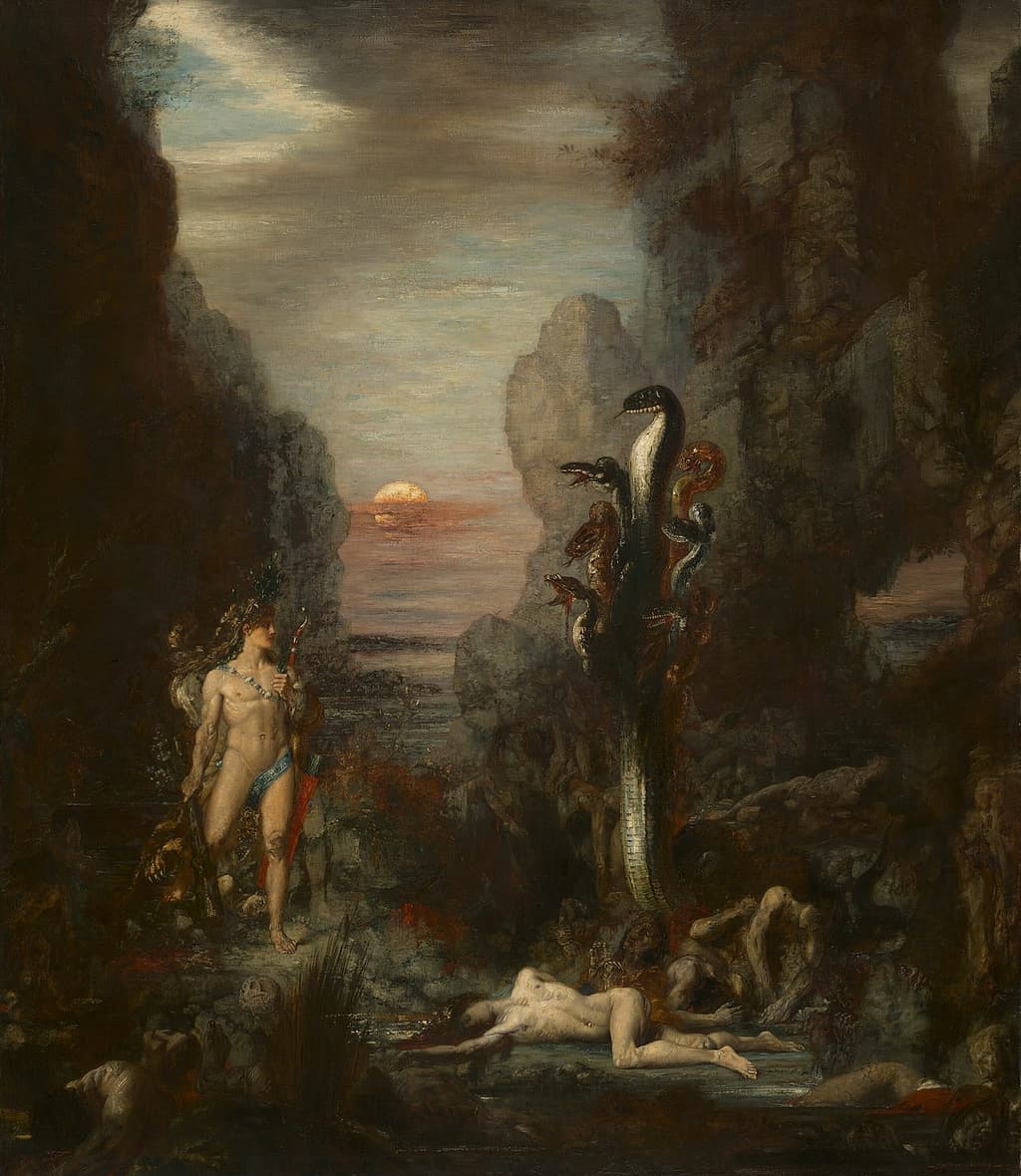
The best detail in the story is administrative. Eurystheus refused to count the labour, on the grounds that Heracles had not killed the Hydra alone — his nephew Iolaus had helped with the torch. He also disallowed the Augean stables because Heracles took a fee. Two of the twelve labours were rejected on technicalities, which is why replacements were added, and it is the reason the canonical number is twelve rather than ten.
A hero doing supernatural work under a king who audits the paperwork is one of the more quietly funny structures in Greek myth, and it is in the sources rather than a modern joke.
The creature
Hesiod gives her a family: child of Typhon and Echidna, sister of Cerberus, Orthrus and the Chimera, reared by Hera specifically as a grudge against Heracles. He calls her the Lernaean Hydra, whom the white-armed goddess nourished, insatiably angry at the mighty Heracles.
Head counts vary wildly, as they do with her brother. Hesiod does not give a number. Apollodorus says nine. Simonides says fifty. Diodorus reports a hundred. Later authors run to the hundreds. The middle head, in Apollodorus, is immortal. Her breath and even her scent were lethal; Pausanias, characteristically sceptical, suggests she was simply a very large water-snake with one head and that Peisander of Camirus gave her the extra heads to make her more frightening in a poem.
The fight
The account in Apollodorus is the fullest and is oddly procedural.
Heracles found her in the swamp at Lerna, near the source of the river Amymone, and drove her out of her lair with burning arrows. She wound herself around his leg. Every head he crushed with the club produced two in its place. Hera sent a giant crab to bite his foot as well, which he crushed and which Hera placed in the sky as Cancer.
He called Iolaus, who set fire to part of the neighbouring wood and used the brands to cauterise each neck as Heracles cut it, preventing regrowth. The immortal head he cut off and buried under a heavy rock beside the road to Elaeus. He then slit the body open and dipped his arrows in the gall.
That last act is the most consequential thing in his entire career.
The poison, which kills everyone eventually
The Hydra's venom on Heracles' arrows becomes the mechanism of an extraordinary number of later deaths, and the chain is worth laying out because it is one of the few places where Greek myth is genuinely systematic about cause and effect:
- Chiron, the immortal centaur, is accidentally struck and suffers a wound that cannot heal and cannot kill him, so he gives up his immortality to Prometheus in order to die.
- Nessus, the centaur, is shot while carrying Deianeira, and as he dies persuades her to keep his poisoned blood as a love charm.
- Heracles himself, when she uses it years later on the robe.
- Philoctetes is wounded by a fallen arrow and is abandoned on Lemnos for ten years, festering, in the situation Sophocles' play begins from — and the Greeks then have to fetch him back, because Troy cannot fall without the bow.
- Paris is killed by one of those arrows.
The whole back half of the Trojan cycle runs on poison from a swamp monster killed a generation earlier. That is a longer causal chain than Greek myth usually attempts.
Lerna was a real place
The site is on the coast of the Argolid, a genuine marsh fed by springs, and it was excavated in the 1950s: the House of the Tiles, an Early Helladic administrative building destroyed by fire around 2200 BCE, is one of the most important Bronze Age structures in mainland Greece. The Alcyonian Lake nearby was said by Pausanias to be bottomless — Nero reportedly had a sounding line of many stades let down without finding the floor — and to be an entrance to the underworld, through which Dionysus descended to fetch Semele. Annual secret rites were held there.
So the labour is set at a real marsh with a real reputation as a mouth of the underworld, next to a real Bronze Age ruin. The obvious rationalisation — that draining a many-sourced swamp is the underlying reality, since blocking one spring makes another break out — was already being offered in antiquity and is still sometimes proposed. It is neat, unprovable, and does not explain the poison.
What the word does now
Hydra as a metaphor for a problem that multiplies when attacked is one of the most-used classical figures in political and journalistic English, applied to insurgencies, corruption, spam, drug cartels and organised crime with equal facility. The image is doing real work: the specific idea is that direct force is counterproductive, which is exactly the point Iolaus' torch solves.
Elsewhere the name has spread widely. Hydra the genus of freshwater cnidarians, named by Linnaeus, is one of the few animals with genuinely remarkable regenerative powers and shows negligible senescence, which makes the naming unusually apt. The Hydra constellation is the largest in the sky. Pluto has a moon called Hydra, discovered in 2005. And Marvel's HYDRA organisation, with its "cut off one head, two more shall take its place", has probably introduced the myth to more people in the last two decades than any classical text.
The crab, the buried head, and the head-count problem
Is the crab really Cancer?
That is the standard aetiology: Hera set it among the stars in gratitude for its service, despite its complete failure. Some accounts have her place it there simply out of spite for Heracles. It is one of a small group of zodiac signs given Heraclean origins — the Nemean lion becomes Leo by the same logic — and both belong to the Hellenistic period, when Greek writers were systematically attaching myths to a constellation scheme inherited from Babylon.
Why does the immortal head get buried rather than destroyed?
Because it cannot be destroyed. Apollodorus is precise: it is cut off and buried on the roadside under a heavy stone. That is the standard Greek solution to an indestructible thing — containment rather than destruction, exactly as with the Titans in Tartarus. It also leaves a marked spot on a road, which is the sort of detail that suggests a local landmark being explained.
Did Heracles cheat?
Eurystheus thought so, and there is a real argument in the tradition about what counts as a hero's own achievement. Heracles is also assisted by Athena repeatedly, by Iolaus in several exploits, and by divine equipment throughout. The Hydra is singled out because the assistance was decisive and visible. It is worth noticing that the disqualified labours are the two where he used intelligence — a helper with a torch and a diverted river — rather than strength.
How many heads should a picture show?
Greek vase painters generally chose somewhere between six and nine, arranged symmetrically, which is a compositional decision rather than a textual one; a famous Corinthian vessel shows six. Roman and later art often shows seven. The nine-headed figure is Apollodorus' and is the one most modern references cite, but no count can claim to be canonical, and an illustration with fifty would be following Simonides.