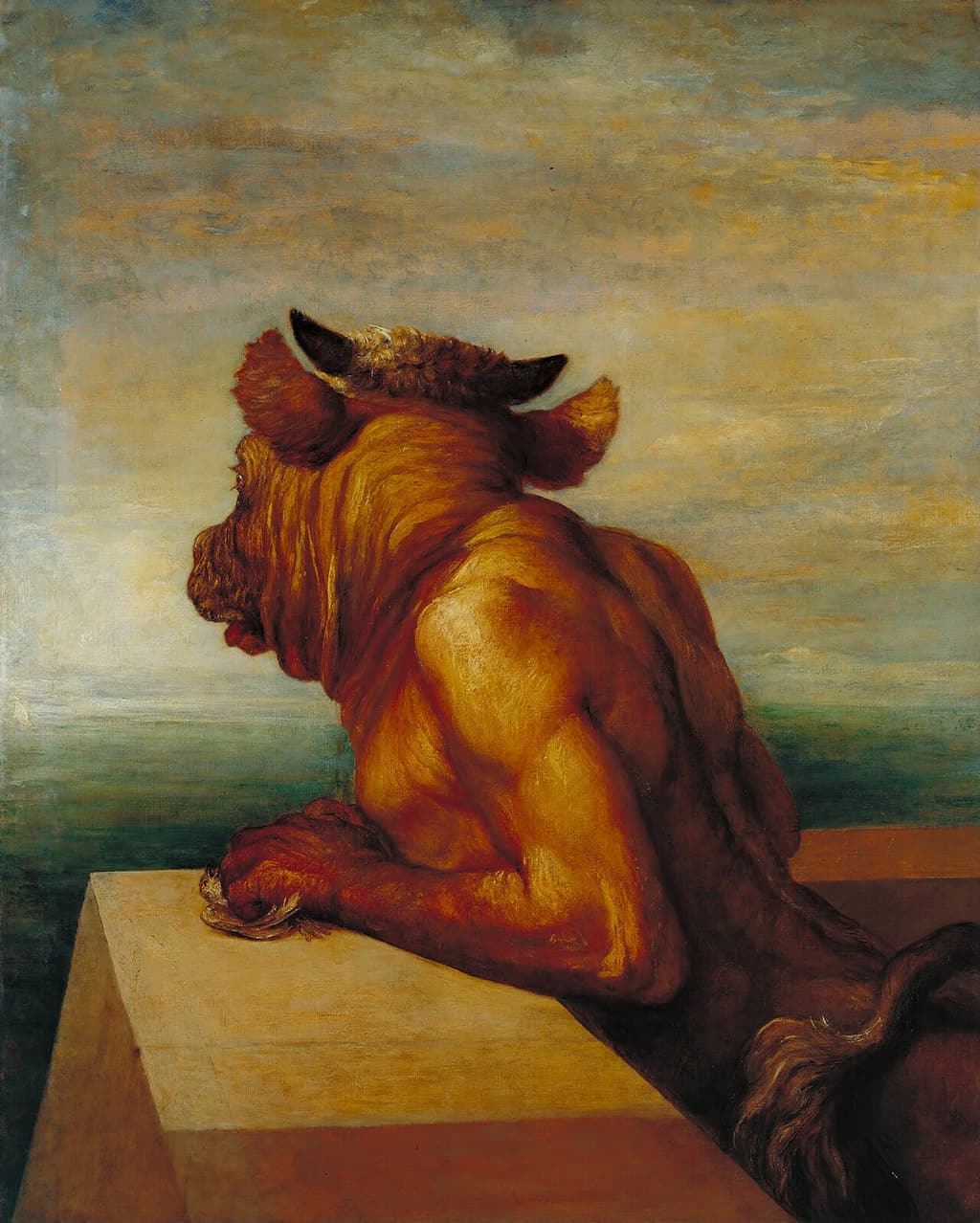
His name is Asterion — or Asterios, "starry one" — and Apollodorus records it without comment, as if it were an ordinary fact about an ordinary prince. It is the same name as Minos' own stepfather, the Cretan king who raised him. Somewhere behind the monster in the maze there is a royal Cretan name attached to a bull, and the story we have is what happened to it.
The word Minotaur is not a name at all. It is a description: Minos plus tauros, the bull of Minos. Whoever he was, the tradition remembers him as a possession.
The bull that was too good to kill
The chain of events is a punishment for greed, and it begins with Poseidon. Minos, contesting the throne of Crete, prayed for a sign — a bull from the sea, which he would sacrifice back. The bull came, white and magnificent. Minos took the throne, and then kept the animal for his herd and sacrificed an inferior one.
The god's revenge is aimed sideways, at the wife. Pasiphaë, daughter of Helios, was made to desire the bull. She went to Daedalus, the Athenian craftsman in exile at the Cretan court, who built her a hollow wooden cow covered in hide, on wheels, which she got inside. The child was born with a man's body and a bull's head — or, in some descriptions, the reverse.
It is worth noticing how the responsibility is distributed. Minos commits the sacrilege; his wife carries the punishment; the craftsman enables it and is later imprisoned for it; and the child, who did nothing at all, is shut underground and fed on human beings. There is no innocent party in the story except the monster.
The labyrinth, the palace and the double axe
Daedalus built the labyrinth to contain him, and the word is one of the most interesting in Greek. Labyrinthos is not Greek in formation; the -nth- suffix marks it as pre-Greek, of the same stratum as Korinthos and hyakinthos. It has long been connected to labrys, a word for the double-headed axe — attested as Lydian by the ancient lexicographer Hesychius, and therefore not certainly Cretan — which would make the labyrinth "the place of the double axe".
That matters because the double axe is everywhere at Knossos: incised on pillars, held by figures, deposited in caves, one of the most persistent Minoan cult symbols. Arthur Evans, excavating from 1900, found a palace complex of extraordinary complexity — hundreds of rooms on multiple storeys around a central court, storage magazines, light wells, corridors that double back — and he had no hesitation in identifying it as the labyrinth of legend. He also found frescoes and figurines of bull-leaping: young men and women vaulting over the horns of a charging bull.
None of this proves the myth. What it establishes is that Bronze Age Crete had a palace a Greek visitor could reasonably describe as a maze, a ritual involving bulls and young people in real danger, a sacred double axe, and a name for the building that Greek could not parse. The myth is not a memory of a monster, but it is plausibly a memory of Knossos.
The labyrinth as a design has its own separate history: the classical seven-course labyrinth — a single winding path with no branches, not a puzzle at all — appears on Cretan coins from the fifth century BCE and in rock carvings across Europe. A unicursal path you cannot get lost in is a strange thing to imprison a monster in, and the maze of branching dead ends that everyone now pictures is a much later development, mostly medieval and Renaissance.
The tribute
Minos' son Androgeos was killed in Attica — by the Marathonian bull, or by jealous rivals after athletic victories, depending on the source. Minos made war, and Athens agreed to a tribute: seven youths and seven maidens, every nine years in Plutarch's account, sent into the labyrinth. Theseus volunteered among them, was helped by Ariadne with the thread — supplied, Apollodorus says, on Daedalus' advice — and killed the Minotaur, with his bare hands in some versions and with a sword in others. The full sequence is set out in the account of the labyrinth.
Athenian art is unambiguous about how much this mattered: Theseus killing the Minotaur is among the most frequently painted scenes on Attic vases, and it appears on the metopes of the Hephaisteion and on the Athenian treasury at Delphi. A city that had once paid tribute to Crete made the killing of the Cretan monster into its founding image.
Ancient people already thought it was nonsense
Rationalising versions were circulating in antiquity, which is a useful corrective to the idea that ancient audiences believed everything they were told. Plutarch preserves the account of Philochorus, drawn from Cretan sources: there was no monster, but a brutal Cretan general named Tauros who won the funeral games for Androgeos and treated the Athenian youths sent as prizes with cruelty, and whom Theseus defeated in wrestling before the queen. Others made the labyrinth a prison rather than a maze, and the tribute an ordinary hostage arrangement of the kind Greek states made all the time.
The Cretans, Plutarch adds, complained that the Athenians told the story their way. It is one of very few places where we hear a myth's losing side objecting to the version that survived.
Ovid, Virgil and the sympathetic monster
Ovid's Metamorphoses 8 gives the fullest Latin account and coins the phrase that fixed him for European literature: semibovemque virum semivirumque bovem — half-bull man and half-man bull. Virgil puts the whole story on the doors of the temple at Cumae in Aeneid 6, carved by Daedalus, who could not bring himself to complete the panel showing his own son's fall. Dante places the Minotaur at the entrance to the seventh circle of the Inferno, guarding the violent, biting himself in rage.
The modern turn is toward pity. Borges' short story "The House of Asterion" (1947) is told by the Minotaur himself, who does not know he is a monster, believes his house has infinite doors, waits for a redeemer, and dies without resisting — the last line is Theseus remarking that the beast barely defended itself. Picasso spent years on the Minotauromachy etchings and the Minotaure magazine covers, using the figure for his own appetites and rage. Mary Renault, Steven Sherrill's The Minotaur Takes a Cigarette Break, and a long line of fantasy novels have followed the same line: the creature as victim.
Games and fantasy went the other way and made minotaur a species — a horned humanoid race, standard from Dungeons & Dragons onward, appearing in dozens of games as a labyrinth encounter. That pluralisation would have been unintelligible to any Greek. There is exactly one Minotaur.
Which half is bull, and what Crete actually depicts
Which way round is he — bull head or bull body?
Overwhelmingly a man's body with a bull's head, in both Greek art and the standard descriptions. Vase paintings from the sixth century BCE onward show a human physique, sometimes with hooves and a tail, and a bull's head; Ovid's chiastic phrase deliberately refuses to settle it. The inverted form, a bull's body with a human head, is essentially a modern variant and is closer to Assyrian and Mesopotamian hybrid guardians than to anything Cretan.
What happened to Pasiphaë and Daedalus afterwards?
Pasiphaë continues in the tradition as a sorceress — she is credited with a spell that made Minos' infidelities lethal to his partners, cured by Procris. Daedalus was imprisoned in the labyrinth with his son for helping Ariadne, and escaped by making wings. He fled to Sicily, where Minos pursued him and was killed in a bath by the daughters of King Cocalus, pouring boiling water through a pipe.
Is there any Minoan depiction of the Minotaur?
No convincing one. Minoan art has bulls everywhere — the bull-leaping frescoes, rhyta in the shape of bulls' heads, horns of consecration as an architectural motif — but no man-bull hybrid of the Greek type has been identified from Bronze Age Crete. Some seals show masked figures which have been argued about. The Minotaur as a figure appears in Greek art, several centuries after the palaces fell.
Why is he fed human beings specifically?
Because he cannot eat anything else, according to Apollodorus, having no natural food. The detail turns the labyrinth into a permanent obligation rather than a one-off imprisonment, which is what generates the tribute and therefore the plot. It also sets up the horror precisely: the animals whose sacrifice sustains Greek religion have been inverted, and a man-shaped creature is now consuming the offerings.