The abandonment on Naxos is the image European art chose, and it is not the ending.
Ariadne, daughter of Minos and Pasiphaë, helped Theseus out of the labyrinth and sailed with him, and he left her on an island while she slept. Catullus' poem 64 gives the scene its definitive form — she wakes, runs to the shore, sees the sails already small, stands in the surf with her clothes fallen, and delivers a curse that Jupiter hears and that costs Theseus his father. Ovid's Heroides 10 is her letter to him, written from the beach. Titian, Tintoretto, de Chirico, Strauss and Handel all worked from that moment.
But in the tradition she is then found by Dionysus, and married, and made immortal, and her bridal crown is set among the stars as Corona Borealis. She ends as a goddess with a constellation. The painted moment is the low point of a story that goes up.
The thread, and whose idea it was
Apollodorus is specific about the source of the plan: Ariadne, in love with Theseus, asked Daedalus how one could get out of the labyrinth, and on his instruction gave Theseus a ball of thread — tied at the entrance, unwound going in, followed back out. Some versions substitute a luminous crown given by Dionysus to light the way, which is a considerably older-looking motif and connects her to the god before Theseus ever appears.
The thread is one of the most durable images in Western culture. "Ariadne's thread" is a standard term for a systematic method of working through a problem by exhaustive tracing, used in logic, computing and maze theory; the phrase appears in discussions of graph traversal and of debugging. It has entirely detached from her.
Homer's version, which nobody uses
Odyssey 11 gives four lines that are almost incomprehensible on their own terms: Odysseus sees Ariadne among the dead, daughter of destructive Minos, whom Theseus was bringing from Crete to Athens, and he did not have the enjoyment of her, for Artemis killed her on Dia, on the testimony of Dionysus.
Nobody has explained this satisfactorily. Dionysus accuses her of something; Artemis executes her. Some readings take it as a punishment for having married in a sacred place, others as the trace of a lost story in which she was already the god's and Theseus took her. Hesiod, meanwhile, says the opposite: Dionysus made her his wife and Zeus made her immortal and ageless.
Two early sources, one killing her and one deifying her, and both were current. The Athenian versions in which Theseus is instructed by a god to leave her — and therefore not to blame — arrive later and are conspicuously convenient.
Naxos, Crete, and a goddess older than the story
Her name is probably not Greek. The elements have been read as containing an intensifier and hagne, "holy" — "utterly pure" — which would make it a title rather than a personal name, and the -ne ending is characteristic of the pre-Greek layer. She is also called Aridela, "the very clear one".
Cretan Ariadne looks like a goddess who was demoted to a princess. Plutarch reports that on Naxos there were two Ariadnes with two separate rites, one joyful for the wife of Dionysus and one mournful; on Cyprus, at Amathus, he says there was a grove of Ariadne Aphrodite, where a festival included a young man lying down and imitating the cries of a woman in labour, in memory of Ariadne having died in childbirth there after being left behind by Theseus. That is an unusual and specific ritual, and it is not the kind of thing invented to decorate a love story.
The labyrinth's own name, from a pre-Greek root, points the same way: something Cretan and old lies under the Athenian narrative.
The crane dance on Delos, which Plutarch says Theseus and the rescued youths performed with winding and doubling movements imitating the passages of the labyrinth, was still danced in his day.
The wedding, and the sky
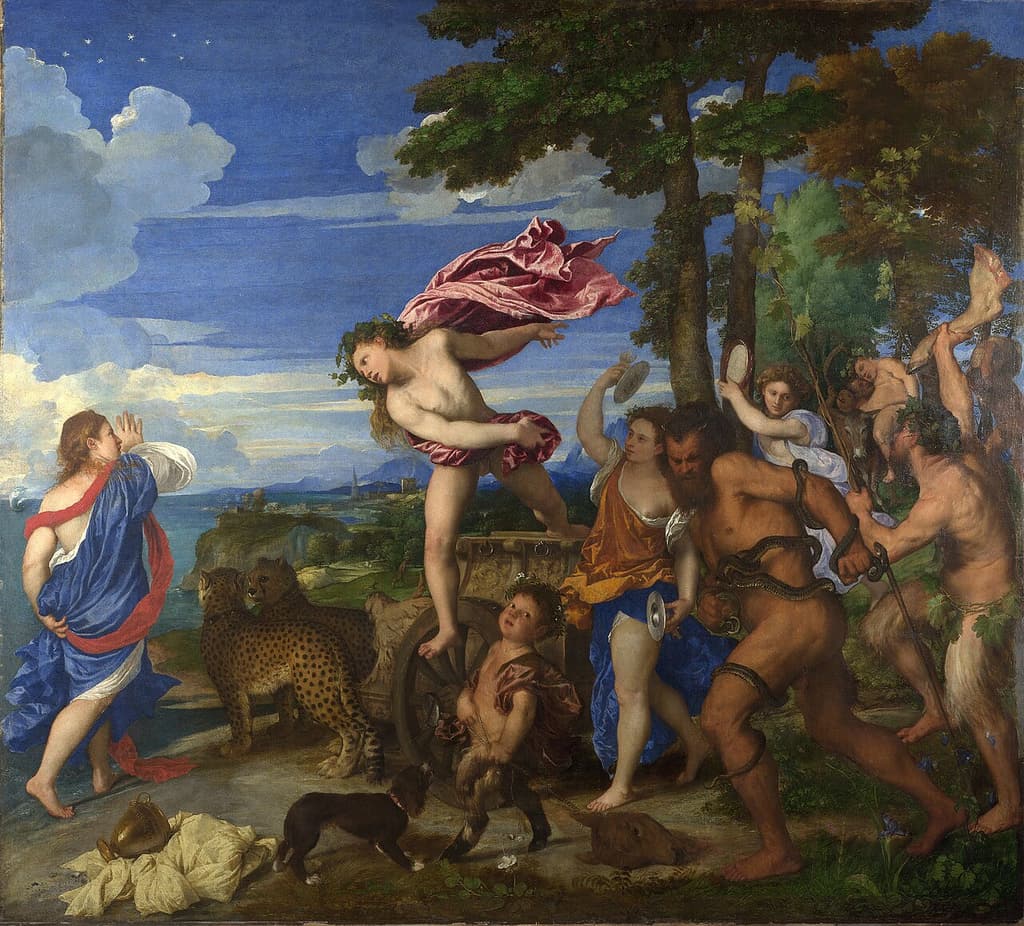
Dionysus finding Ariadne asleep on Naxos is one of the most-painted subjects in Western art, and Titian's version of 1523 — the god leaping from his chariot in mid-air, the leopards, the girl turning — is the most famous of them. Above her head Titian paints the crown of stars, which is the correct astronomical detail: the wedding gift, made by Hephaestus and set in the sky as Corona Borealis, a neat semicircle of stars visible on northern spring evenings with the bright Alphecca at its centre.
She bore Dionysus several children in the tradition, including Oenopion ("wine-face") and Staphylus ("grape-cluster"), which is about as unsubtle as Greek genealogy gets.
From Monteverdi to modern retellings
Monteverdi's lost opera L'Arianna of 1608 survives only in its "Lamento d'Arianna", which was the most famous piece of vocal music in seventeenth-century Europe and circulated in dozens of arrangements. Handel, Haydn, Benda and many others set the lament. Richard Strauss and Hofmannsthal's Ariadne auf Naxos (1912, revised 1916) makes it into an argument about art: a serious opera about the abandoned Ariadne is forced to be performed simultaneously with a comic troupe, and the question of whether she is waiting for death or for a new god is the work's actual subject.
Modern fiction has been more interested in the Cretan half. Mary Renault's The King Must Die gives her the bull-court and the politics; Jennifer Saint's Ariadne (2021) retells the whole thing from her and her sister Phaedra's perspective, part of the wave of first-person retellings that also produced Circe and The Silence of the Girls. Borges' labyrinth stories use her thread as a symbol without her.
A sister, a thread, and a crown of stars
What happened to her sister?
Phaedra married Theseus later, and her destruction is the subject of Euripides' Hippolytus — she falls in love with her stepson, is rejected, and leaves a letter accusing him, which kills him. Two Cretan sisters, both entangled with the same Athenian king, both destroyed by it, is a pattern the tradition never comments on but which any reader notices.
Is the labyrinth thread a real technique?
It is a genuine and sound method for exploring a maze — the modern name is Trémaux's algorithm, formalised in the nineteenth century, which involves marking passages as you traverse them. A thread solves the simpler problem of finding the way back rather than of exploring exhaustively. The classical Cretan labyrinth on coins is unicursal, a single path with no branches, in which no thread would be needed at all.
Did Ariadne have a cult of her own?
Yes, in several places and in ways that do not fit a mortal princess: the double rite on Naxos, the Amathus grove and childbirth ritual on Cyprus, and possible Cretan cult. Plutarch is the main source for this and he collected local customs carefully. Her position is the classic case of a figure who is a goddess in cult and a heroine in narrative, which happens whenever an older local deity is absorbed into an incoming people's stories.
Which star cluster is her crown?
Corona Borealis, the Northern Crown, a small arc of seven stars between Boötes and Hercules. Its brightest star, Alphecca or Gemma, is a variable binary. The Greek tradition also assigns the same crown to the one Amphitrite gave Theseus underwater in Bacchylides' version, which is a small tangle the sources do not resolve.