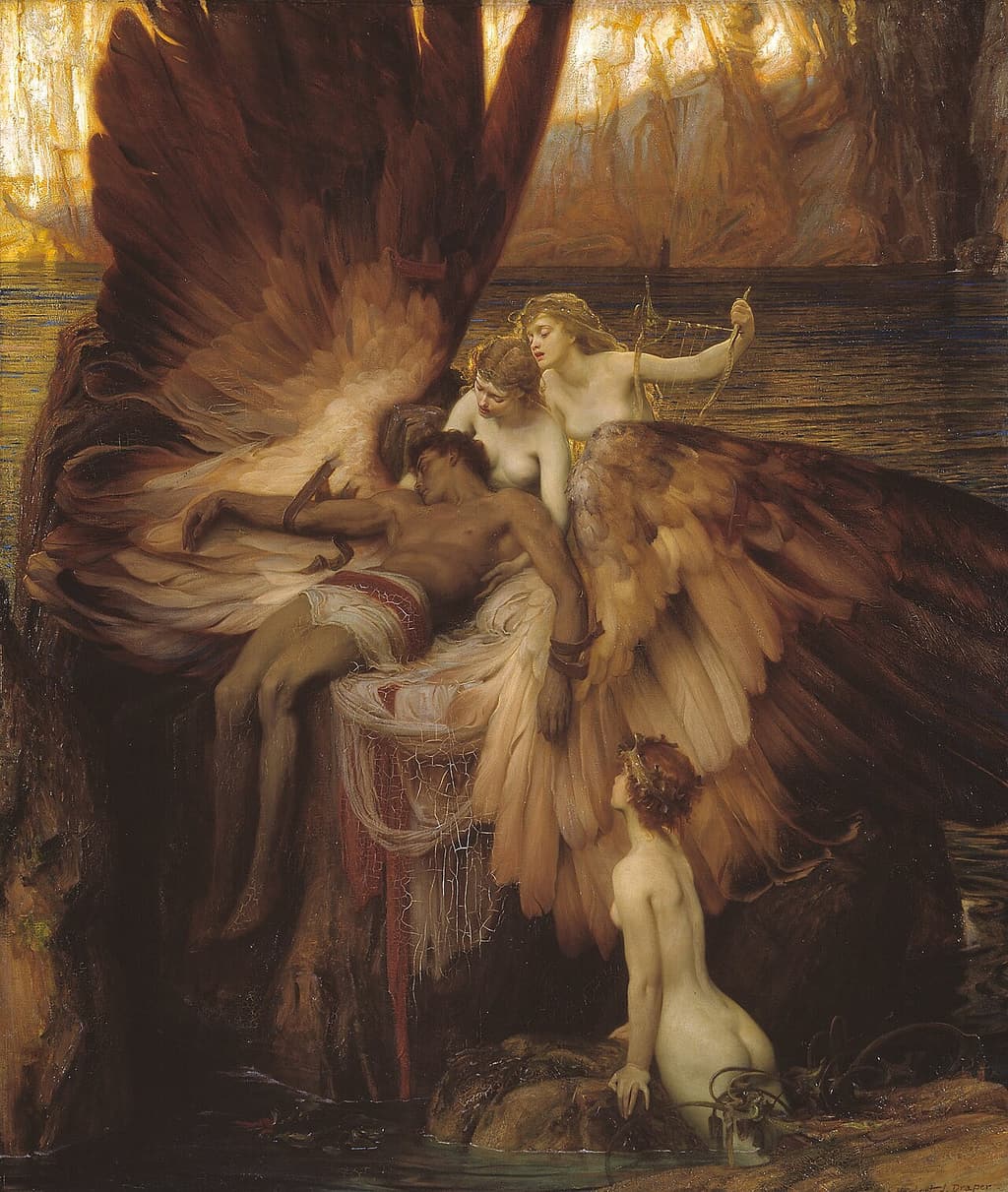
The escape only makes sense if you know why they were on Crete. Told cold, it is a father and son with feathered wings and a boy who does not listen. Told from the beginning, it is the story of a man whose skill keeps producing catastrophes for other people, until it finally produces one for him.
The murder in Athens
Daedalus was Athenian, of a good family, and the best craftsman anyone had heard of. He took on his sister's son as an apprentice — the boy is called Perdix, or Talos, or Calos, depending on the source — and the boy was better.
He looked at the spine of a fish, or the jaw of a snake, and cut teeth into a strip of iron, and invented the saw. He fixed two metal arms at a pivot so that one could hold still while the other turned, and invented the compass. He was twelve.
Daedalus took him up onto the Acropolis and pushed him off. Athena caught the falling boy and turned him into a partridge, which is why partridges nest on the ground and will not fly high — the bird remembers. The Areopagus tried Daedalus for murder and he ran before the verdict.
The Cretan employment
Minos of Crete took him on, and the commissions there are the reason everyone knows his name.
His first was the worst. Minos had failed to sacrifice a bull that Poseidon sent him, and the god arranged for the king's wife Pasiphaë to desire the animal. She could not act on it, and she went to the engineer. Daedalus built her a hollow wooden cow on wheels, upholstered in hide, and she got inside it.
His second was to contain the result. The Minotaur needed a building it could not get out of, and he made one — a structure whose paths doubled and returned on themselves so completely that he later had difficulty finding the exit himself.
His third was freelance and unauthorised. When Ariadne came to him wanting to save an Athenian prisoner, he told her about the thread: fix one end at the door, and the maze becomes a corridor. That advice worked, and it cost Minos his monster, his daughter and his tribute in a single night.
At that point the king stopped employing him and started detaining him. Apollodorus says he was shut inside the labyrinth with his son; Ovid has him simply confined to the island, unable to get a ship, which is more plausible and less picturesque.
The wings
The sea and the land were closed. The air was not.
He gathered feathers and laid them out in ascending order, small to large, so that the edge curved as a wing curves — Ovid compares the graded rows to the pipes of a shepherd's syrinx. He bound the quills at the middle with thread and sealed the bases with wax, and gave the whole thing a slight bend.
The boy was in the way the entire time, grabbing at feathers as the draught took them, kneading the wax with his thumbs, delighted. Ovid's most humane touch is that the father kept working while his son played in the materials, and that his hands trembled as he fitted the straps.
The instruction was about altitude and nothing else. Fly too low and the spray soaks the feathers and drags you down. Fly too high and the sun softens the wax. Keep the middle, and stay behind me.
They got past Samos and Delos. Fishermen and shepherds looked up and took them for gods. And Icarus, finding that it worked, that he was actually doing it, left his father's line and climbed.
The wax ran. He beat bare arms against nothing and went into the water. The father, calling his name, saw feathers on the surface, and named the sea and the island after him, and buried the body — and while he was doing it, Ovid says, a partridge sat in a nearby ditch and clapped its wings and sang, the only creature in the world glad about this.
Sicily, and what happened to Minos
Daedalus reached Sicily and was sheltered at Camicus by King Cocalus, who was not going to give up an engineer of that quality.
Minos hunted him across the Mediterranean with a puzzle instead of an army. He carried a spiral triton shell to every court he visited and offered a large reward to anyone who could pass a thread through it, knowing that exactly one man alive could. At Camicus, Cocalus said he would try, and took it to Daedalus, who bored a small hole at the point of the spiral, tied a thread to an ant, and put honey at the far end.
The shell came back threaded, and Minos knew. He demanded the fugitive. Cocalus agreed and suggested a bath first, and his daughters — who liked their new craftsman and his toys — poured boiling water over the king of Crete until he died in the tub.
That ending is preserved by Herodotus, Diodorus and Apollodorus, and it is the neatest reversal in Greek myth: the man is caught by a demonstration of the very skill that makes him worth catching, and it kills the hunter.
Two ancient ways of not believing it
Greek writers were sceptical about the wings long before anyone else was.
The rationalising version, in Diodorus and in the demythologising handbook attributed to Palaephatus, holds that Daedalus escaped by sea, and that what he actually invented was the sail — previously ships were rowed — so that they seemed to fly. Icarus, in that telling, fell overboard from the boat and drowned, and the drowning is all that really happened.
There is also the strand about his statues. Plato jokes in the Meno that the works of Daedalus have to be tied down or they run away, and several authors refer to his figures as the first sculptures with the legs parted and the eyes open, as against the rigid archaic type. That is art history disguised as legend: he is the name Greeks attached to the moment their statues started to look as if they could move.
What the story was for
Two things, mostly, and they pull in different directions.
The first is a piece of practical ethics that Ovid states outright and that survives as the phrase "the middle way": excess in either direction destroys you, and the sea is as fatal as the sun. It made the story a schoolroom staple for two thousand years.
The second is much less comfortable, and it is about the maker rather than the boy. Every single thing Daedalus builds is used for something appalling, usually by the person who paid for it, and he is never punished for any of it except by outliving his son. Greek myth is unusually clear-eyed about the person who supplies the means and declines responsibility for the ends.
What later readers did with the fall
Bruegel's Landscape with the Fall of Icarus — a painting whose attribution has been questioned but whose composition has not — puts a ploughman in the foreground, a shepherd looking the wrong way, a ship sailing on, and two small white legs disappearing into the water at the edge of the canvas. Auden built "Musée des Beaux Arts" on it, and William Carlos Williams wrote a second poem on the same picture; between them they made the painting's argument — that catastrophe happens beside people who are busy — one of the standard modern ideas about suffering.
Joyce named his self-portrait Stephen Dedalus after the artificer, not the boy, and put the "old father, old artificer" invocation at the end of A Portrait of the Artist as a Young Man. Matisse cut Icarus out of blue paper with a red dot for a heart. The name has been given to a very large number of ambitious engineering projects, few of whose sponsors seem to have finished the story.
One of them finished it properly. In April 1988 a pedal-powered aircraft named after the father, not the son, was flown by a Greek cycling champion from Crete to the island of Santorini — 115 kilometres over open water, the longest human-powered flight ever made. It broke up in a gust a few metres from the beach, and the pilot swam ashore.
Questions this one attracts
Where is Icaria? A real island in the eastern Aegean, west of Samos, and the sea around it is the Icarian Sea in ancient geography — both names are attested well before Ovid. Islanders have never shown much interest in the story attached to them.
Is the wax-and-feather design plausible? No. Human arm muscles cannot generate the power for flapping flight at human body mass, which is precisely why the 1988 crossing needed a bicycle drivetrain, a 34-metre wingspan and an Olympic athlete. The physics is why the story is a myth about ambition rather than a report.
Why does Athena save the nephew but not the son? No source explains it, and the asymmetry looks deliberate: the goddess of craft protects the better craftsman. Ovid, who is the main source for the partridge, plainly enjoys leaving the bird at the graveside without comment.
Did Daedalus have any cult? Not as a god, but he was claimed as a founding ancestor by families of craftsmen — the Daedalidae at Athens — and Pausanias reports seeing wooden statues around Greece attributed to him, none of which could possibly have been that old. He is a legend used as a maker's mark.
Continue with the labyrinth's other story, or read across the wider Greek tradition.