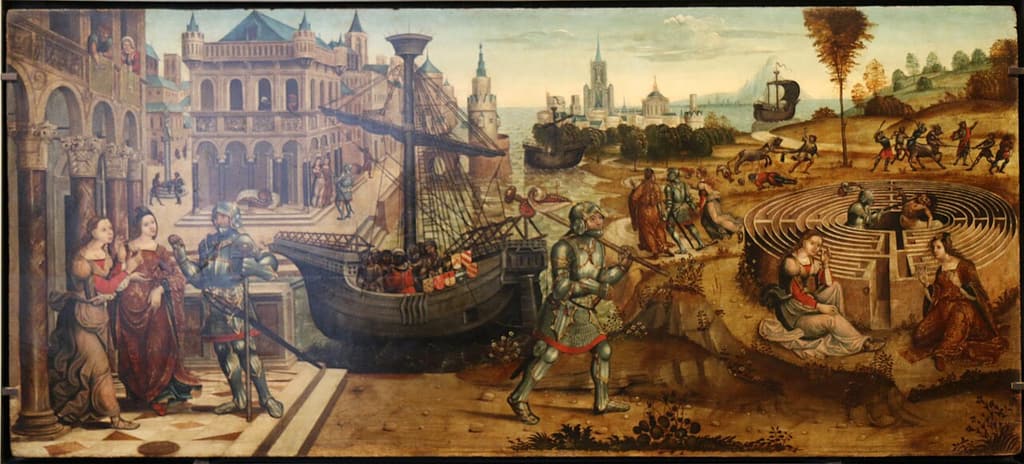
Athens paid a tribute in children. That is the fact the story is built on, and it is the part that classical Athenians found least comfortable, because their own historians could not agree on how often it was paid, whether the victims were killed or merely enslaved, or whether there was ever anything in the maze at all.
The debt
Minos of Crete had a son, Androgeos, who came to Athens for the games and died there — killed by a bull at Marathon in one account, murdered by rivals who could not beat him in another. Minos had a navy. Athens did not. The settlement he imposed was that the city send seven boys and seven girls to Crete, where they would be put into the labyrinth and not come out.
Plutarch says the tribute fell every nine years. Other authorities he cites make it annual, and the third instalment is the one that matters, because that is when the king's son volunteered. Theseus had arrived in Athens as a young man from Troezen, had already been recognised by his father Aegeus after a near-poisoning, and had cleared the coastal road of bandits on the way. Putting himself on the tribute ship was a political act as much as a heroic one: a prince offering his own body against a levy the city had accepted for a generation.
Aegeus gave the ship its usual black sail and a second sail — white, or in Simonides scarlet — to be raised on the return if his son was alive.
What happened on the crossing
Bacchylides' seventeenth ode preserves an episode that the popular version has entirely lost, and it is the best scene in the whole story. On the voyage out, Minos put his hand on one of the Athenian girls. Theseus objected — flatly, as an equal — and told the king that the son of Aegeus would not permit it. Minos replied by calling on his father Zeus for a thunderclap, which he got, and then pulled a ring off his finger and threw it into the sea: prove your father, then.
Theseus went over the side. Dolphins carried him down. He came to the house of his father Poseidon and saw the Nereids dancing, and Amphitrite put a dark cloak around his shoulders and a woven wreath on his head — a wedding gift she had had from Aphrodite. He surfaced beside the ship dry, crowned, and holding nothing at all, because the poem never says he retrieved the ring. He did not need it. The Cretans on deck were shouting.
Inside
Ariadne, Minos's daughter, saw him arrive and made a decision that cost her everything. She gave him a ball of thread — advice she had, in several sources, extracted from Daedalus, who had built the maze and knew that the only defence against it was a line back to the door. In exchange, Theseus was to take her with him and marry her.
He tied the thread at the entrance and went in. Apollodorus says he killed the Minotaur with his fists; other accounts give him a sword, smuggled or supplied. Then he wound the thread back up, let the other thirteen out, holed the Cretan ships in the harbour so they could not be followed, and sailed with Ariadne aboard.
Naxos, and the versions that will not reconcile
They stopped at the island of Dia, which everyone later called Naxos, and he left without her.
Plutarch's Life of Theseus is unusually valuable here because he refuses to pick one story and instead lists what he has found:
- She was abandoned while asleep, and Dionysus found her and married her — the version painters and composers overwhelmingly prefer, and the one that gives her a crown among the stars.
- Theseus left her because Dionysus had already claimed her in a dream and he did not dare refuse a god.
- He left her for another woman, Aigle, which Plutarch reports with distaste.
- A local Amathusian tradition on Cyprus, recorded by a writer named Paeon, held that she was put ashore because she was pregnant and seasick, the ship was blown out to sea, and she died in childbirth before it could return — and that the islanders kept a grove and a festival for her in which a young man lay down and imitated a woman in labour.
Catullus builds his longest and strangest poem around the first version, describing the scene as an embroidery on a wedding coverlet: Ariadne standing in the surf watching the sail go, her clothes fallen off her, calling curses that will land on Theseus's own father. Because in every version, the young man forgets the sail.
The black sail came up the coast into view of Athens. Aegeus, watching, threw himself down — from the Acropolis in Plutarch, into the sea in later accounts, which is how the Aegean is supposed to have got its name. Theseus came home to a funeral he had caused by inattention, and the city he inherited he then reorganised into a single state, which is the real subject of Plutarch's Life.
Athens kept the props
This story was not a story to Athenians. It was civic history with surviving physical evidence, and the evidence was maintained at public expense.
The ship in which he sailed was preserved in the harbour and sent annually to Delos on a sacred embassy — the voyage during which no executions could be carried out in Athens, which is why Socrates spent a month in prison after his trial. Plutarch reports that the Athenians replaced its rotting timbers plank by plank for centuries, and that philosophers used it as their standing example of a puzzle about identity. That puzzle is now taught in every introductory metaphysics course under his name.
On Delos the delegation performed the geranos, the crane dance, whose winding and doubling figures were said to reproduce the paths of the labyrinth. At the Oschophoria in Athens, two boys dressed as girls led a procession, in memory of the two boys Theseus was said to have smuggled into the fourteen. The story was, in short, load-bearing for the ritual calendar.
The rationalisers, ancient and modern
Greek writers were already explaining it away. The Athenian antiquarian Philochorus, quoted by Plutarch, reported a Cretan account in which the labyrinth was simply a prison, the tribute children were prizes in funeral games for Androgeos, and the winner every year was a brutal general of Minos named Taurus — "Bull" — whom Theseus eventually beat in the ring in front of the queen. Minos, in this telling, was pleased to be rid of him and cancelled the tribute. Plutarch also notes that Aristotle knew a version in which the children were not killed but grew old in service on Crete.
Modern rationalising centres on Knossos. Arthur Evans, excavating from 1900, found a Bronze Age palace of extraordinary complexity, frescoes of young people vaulting over bulls, and the double axe — labrys — as a recurring sacred sign, and proposed that "labyrinth" meant "house of the double axe". That etymology is not established: the -nth- element marks the word as pre-Greek, and its meaning is unknown.
What is established, and is much more interesting, is a Linear B tablet from Knossos recording an offering to the "mistress of the labyrinth". The word existed in Bronze Age Crete, in a religious context, centuries before any Greek told this story. What it named there, nobody can say.
Where he ends up
Theseus is the hero Athens made in its own image, and the fifth century worked hard on him: Cimon was said to have recovered his bones from Skyros in 475 BCE and brought them home to a shrine, which is state-sponsored relic politics of a very familiar kind. The later parts of his career are markedly less admirable — the abduction of Helen when she was a child, the attempt to carry off Persephone, the destruction of his own son Hippolytus through a curse he asked Poseidon to grant.
Modern retellings mostly stop at the maze. Mary Renault's The King Must Die gave the bull-leaping a novelistic realism that has shaped every version since; Borges wrote the Minotaur's own account in a page and a half, a lonely creature waiting for a redeemer; Picasso spent years drawing himself as one. The maze itself has drifted free of the story entirely and become a design motif on cathedral floors and a metaphor for anything complicated.
Ariadne has had the better afterlife of the two. Strauss and Hofmannsthal put her on Naxos in an opera about opera; her name is a common modern given name across Europe in half a dozen spellings; and the constellation Corona Borealis is traditionally her wedding crown, thrown into the sky — though, characteristically, some ancient sources make that same crown the one Amphitrite gave Theseus underwater, and the two claims cannot both be right.
Things the standard retelling skips
Was the Minotaur named? Yes — Asterion, or Asterius, "starry one", which is also the name of the Cretan king who raised Minos. Apollodorus gives it almost in passing, and the fact that the monster shares a royal name is a detail nobody has satisfactorily explained.
Where did the bull come from? Poseidon sent a white bull from the sea for Minos to sacrifice; Minos kept it. The god's punishment fell not on him but on his wife Pasiphaë, who was made to desire the animal, and who had Daedalus build a wooden cow so she could reach it. The Athenians told this story about the Cretan royal house with obvious relish.
Did Theseus have a historical original? There is no evidence for one. What can be said is that Athens's political consolidation of Attica, which Theseus is credited with, was a real process, and that attaching it to a single founder is what ancient cities did.
What became of Ariadne's thread as an image? "Ariadne's thread" is a standard term in mathematics and computer science for solving a problem by exhaustively recording the path taken, which is precisely, and unusually faithfully, what she supplied.
More on Crete's architect and his son, on the Greek tradition and on who is related to whom. The name is still in use, and its history is worth a look at a site that follows given names.