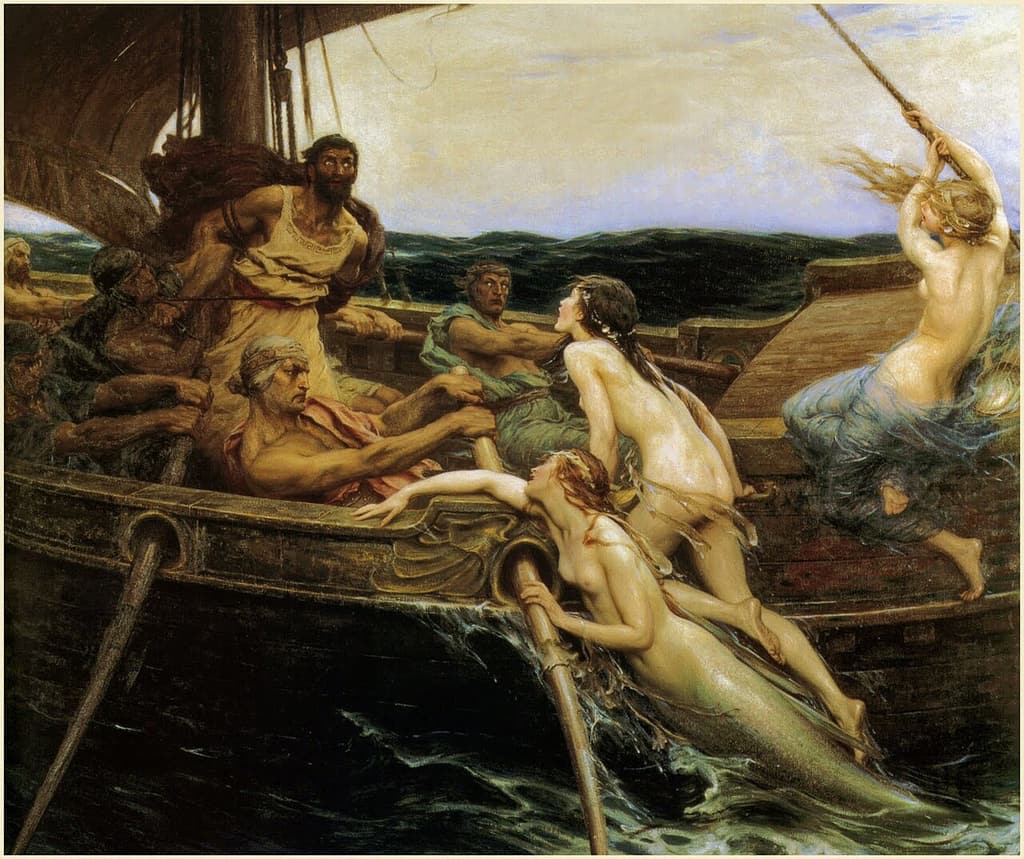
They have feathers. Every ancient depiction of a Siren — on vases, on funerary monuments, in terracotta, in bronze — shows a bird with a woman's head, or a bird body with a woman's head and arms, sometimes holding a lyre or pipes. There is no classical Siren with a fish tail, and the mermaid version everyone now pictures is a medieval development.
That matters because the bird form tells you what they were originally for. Bird-bodied female figures who take people away belong to the same visual family as the Harpies and the Keres, and Siren figures appear on Greek grave markers, standing on the tomb, sometimes beating their breasts in mourning. Whether they are lamenting the dead or carrying the soul off is disputed, but a monster with a permanent role in funerary art is not merely a hazard for sailors.
What they actually sing
The single most misread detail in the Odyssey. Circe warns Odysseus about them; he has his crew stop their ears with beeswax and has himself lashed to the mast, having been told he may listen if he cannot act. The sea goes flat calm. And what they sing, in Book 12, is this: come here, famous Odysseus, great glory of the Achaeans, and listen to our voice — for we know everything that happened at Troy, and we know everything that comes to pass on the fertile earth.
They offer knowledge. Not sex, not beauty, not love. They offer the one thing this particular man cannot refuse, which is to hear his own story told by someone who was not there and knows it anyway. The bones of the men who stopped are rotting in a meadow around them with the skin shrivelling on them, and Homer puts that detail immediately after the promise.
The temptation is precisely calibrated to the listener, and every modern version that makes it about seduction has replaced the point of the episode.
The Argonauts get past differently
Apollonius' Argonautica has the other solution: Orpheus takes up his lyre and plays louder and better, drowning them out, and only one crewman — Boutes — goes over the side, to be plucked out of the water by Aphrodite and set down at Lilybaeum in Sicily.
Two escapes, two philosophies. Odysseus survives by binding himself in advance because he knows he cannot resist in the moment; the Argonauts survive because they have something better. Cicero already used the passage as a moral example, and the pair have been used ever since as a model for how to handle temptation — Ulysses' mast has served in essays on addiction, contract law, constitutional pre-commitment and personal finance.
The meadow, the number, the location
Homer does not say how many. The dual grammatical form he uses implies two. Later sources give two, three or four, with names that vary — Thelxiepeia, Aglaope, Peisinoe, Parthenope, Ligeia, Leucosia. Their parentage is usually the river god Achelous and one of the Muses, often Melpomene or Terpsichore, which makes the deadly song the sister art of the divine one.
Various origin stories explain the bird bodies: they were companions of Persephone and were given wings to search for her after the abduction, or were punished for failing to prevent it, or lost a music contest with the Muses and were plucked. In several accounts they are fated to die if anyone ever passes them, and they throw themselves into the sea when Odysseus does. Parthenope's body was said to wash up at the site of Naples, which is why the city was called Parthenope and why Parthenopean still turns up in Neapolitan contexts. Their islands were located near Capri and the Sorrentine peninsula by Roman-era writers.
How they became mermaids
The change happens in the early medieval Latin west. Bestiaries and glossaries, drawing on late-antique compilations, begin to describe the sirena with a fish's tail rather than a bird's body, and by the twelfth century the fish-tailed version dominates in Western European art and moralising literature, where she becomes an emblem of worldly temptation. The bird-siren survives longer in Byzantine and eastern material.
The linguistic result is permanent: sirène in French, sirena in Italian and Spanish, syrena in Polish all mean mermaid. English kept both, with "siren" meaning a dangerously alluring woman and, from 1819, a noise-making device — invented as an acoustic instrument by Charles Cagniard de la Tour, who named it for them, and which is now the loudest surviving use of the word.
Kafka's version, and the modern reading
Kafka wrote a two-page piece, "The Silence of the Sirens", arguing that they have a weapon more terrible than singing, namely their silence, and that they did not sing as Odysseus passed — and that he, seeing their throats move and their eyes full, believed he had beaten them, when in fact they had simply declined to try. He adds a postscript suggesting Odysseus may have known and put on the whole performance as a shield.
That is the most influential modern treatment, and modern retellings have mostly followed the general direction: the Sirens as figures whose perspective has never been given. Margaret Atwood's "Siren Song" gives one of them a bored, manipulative voice explaining that the song works and that she is tired of it. Elsewhere they are simply mermaids with sharp teeth — the Pirates of the Caribbean films, Harry Potter, countless games and the entire "siren" fantasy genre, all of which inherit the medieval fish-tailed version rather than the Greek bird.
Bird-women, tombs, and the meadow of bones
Are they related to the Harpies?
Not by genealogy — the Harpies are daughters of Thaumas and Electra, wind spirits whose name means "snatchers", and their job is stealing food and people, most famously tormenting the blind seer Phineus until the Argonauts drive them off. But the two are visually similar, both bird-women, and later art and literature blur them constantly. The distinction to hold is that Harpies take by force and Sirens by invitation.
Did anyone worship them?
There is evidence of hero-cult for Parthenope at Naples, with games and a tomb, which is unusual for a monster and supports the idea that these figures had a funerary and civic dimension beyond the Odyssey episode. Siren figures on tombs across the Greek world point the same way. They are not gods, but they are not purely narrative furniture either.
Why does Odysseus want to hear them at all?
Circe tells him he may, if he wants to, provided he is bound — which means the option is presented as legitimate. He is a man defined by wanting to know things: he stays in the Cyclops' cave to see what sort of creature lives there, he goes to the underworld, he listens to Circe. The Sirens are the point at which curiosity becomes lethal, and the poem lets him have it without letting it kill him. It is the only temptation in the poem he does not simply resist.
Is the meadow of bones a real image in art?
The scene appears on Attic vases, most famously a red-figure stamnos in the British Museum showing the ship, Odysseus lashed to the mast, and three Sirens — one of them plunging headfirst from the cliff into the sea, presumably dying as the prophecy required. That vase is where most people's mental image of the episode actually comes from, and it shows birds.