Rome kept Vulcan outside the walls on purpose. His temples stood beyond the sacred boundary, and the reasoning preserved by Roman antiquarians is entirely practical: a god of destructive fire is not one you invite into a city of timber-framed apartment blocks. The exception was the Volcanal, a very old open-air precinct at the foot of the Capitol on the edge of the Forum, which was a raised area of rock rather than a building — a shrine that could not itself burn.
This is the key to him. Vulcan is worshipped less for what he makes than to keep him from doing what he does.
Live fish thrown into the flames
At the Vulcanalia on 23 August, when the summer had dried the city to its most flammable, householders lit bonfires and threw small live fish, caught in the Tiber, into them. Varro and Festus both report the practice, and both give the same explanation: the fish were offered pro se, in place of themselves — creatures from the god's opposite element, substituted for human lives.
The same season carried a domestic marker recorded by Pliny: around this date working by lamplight resumed as the evenings shortened, and the first lighting of the lamp was an occasion for a small observance. Fire as necessity and fire as threat, one week apart in the calendar.
Ostia's chief god
At Rome's port he was not a marginal figure at all. Vulcan was the principal deity of Ostia, and the pontifex Volcani et aedium sacrarum — the pontiff of Vulcan and of the sacred buildings — headed the entire religious establishment of the town, appointing the priests of other cults and holding office for life. Inscriptions record the sequence of holders in detail.
The reason is not documented but is not hard to guess at: Ostia was the warehouse of Rome, packed with grain stores and timber, where fire was the standing catastrophe. A city whose whole business is inflammable cargo makes the fire-god its chief magistrate.
Mulciber, and the forge under the mountain
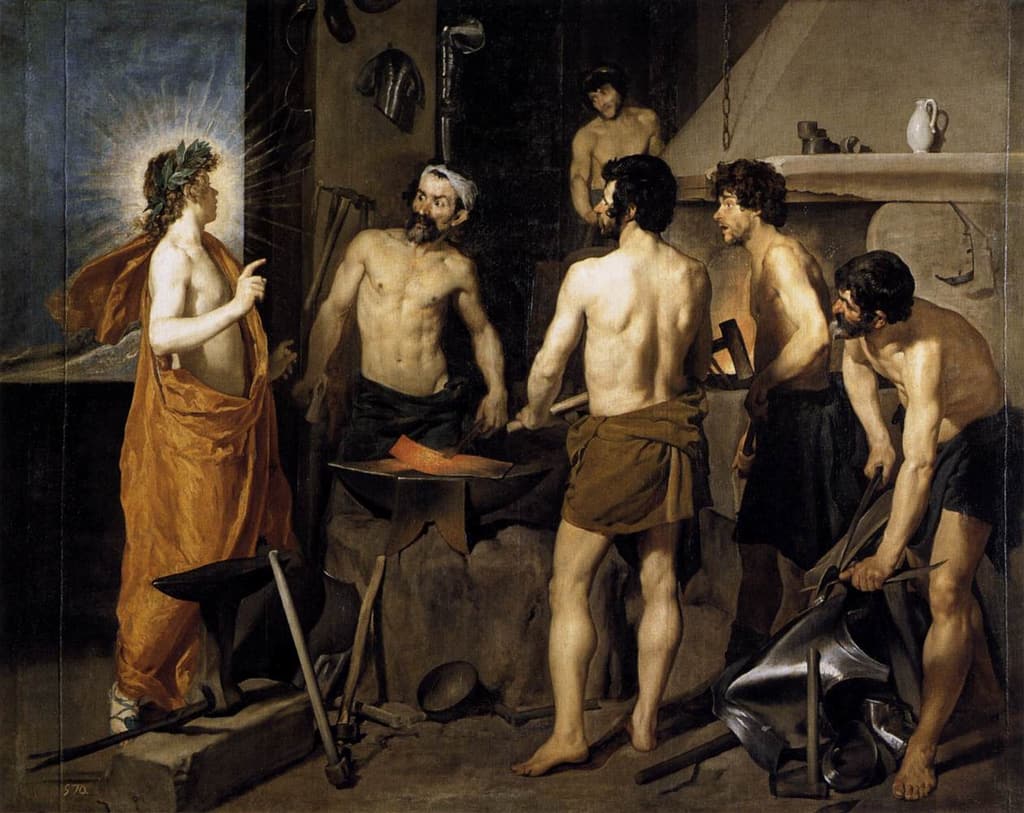
His literary character comes from Greece, where Hephaestus is the lamed smith of Olympus. Roman poets took the workshop and moved it: in the eighth book of the Aeneid, Virgil sets his forge in caverns under the Aeolian islands, where the Cyclopes hammer out Aeneas's shield with the whole future of Rome embossed on it. The volcanic island of Vulcano off Sicily was understood as the chimney.
The alternative Latin name Mulciber, connected by Roman writers with mulcere, to soften or soothe — either the softening of metal or the placating of fire — has no Greek counterpart and looks genuinely Italic. Milton later took it as the name of the fallen architect of Pandaemonium.
His Roman partner is not Venus. The flamen Volcanalis, one of the minor flamens, sacrificed to Maia on 1 May, and Roman sources pair him with Maia and with Stata Mater, a goddess whose specific function was stopping fires from spreading and who received honours at the Volcanal. The Venus pairing is the Odyssey's adultery episode arriving with the literature, and it never had a cult behind it.
Fire as a policy problem
Roman responses to major fires were religious and administrative at once. After the fire of 64 CE, Nero's programme of expiation included rites prescribed from the Sibylline Books; Domitian erected altars to Vulcan in the city regions with regulations attached, apparently including an annual sacrifice of a red calf and a boar. Augustus had already organised the vigiles, seven cohorts of firefighting watchmen, whose barracks and equipment are archaeologically attested.
So a Roman confronting a burning insula did two things that a modern reader separates and a Roman did not: he called the watch, and he made sure the god's sacrifice had been performed. Neither substituted for the other.
What Rome did not give him
The craft patronage that Hephaestus holds in Greece went largely elsewhere in Rome. Smiths and metalworkers appear in the guilds attached to Minerva's Aventine temple; Vulcan's own dedications come disproportionately from officials, towns and fire-conscious institutions rather than from artisans. And the mockery attached to Hephaestus — the limping god the others laugh at — has almost no Roman cult resonance. The Roman family tree shows his Greek parentage as imported precisely because there is no Latin tradition making him anyone's son.
The word that ate the world
Volcano is his. Through Italian vulcano, from the island named for his forge, the word entered every major European language, and every eruption anywhere on earth is now described using the name of a Roman god who was worshipped to prevent house fires. Charles Goodyear called his 1839 rubber process vulcanization because it used heat. Le Verrier proposed a planet called Vulcan inside Mercury's orbit in 1859 to explain an anomaly later accounted for by general relativity; the name outlived the planet and was recycled by Star Trek, whose Vulcans are its best-known modern bearers. There is a Vulcan bomber, a Vulcan rotary cannon, and in Birmingham, Alabama — a steel city — the largest cast-iron statue in the world, made for the 1904 World's Fair, showing the god holding up a spearpoint over the town.
Questions about the fire god
Why was his shrine at the foot of the Capitol so important?
The Volcanal is one of the oldest identifiable cult sites in the Forum, associated in Roman memory with the earliest period of the city and located next to the Lapis Niger complex. Assemblies were held there in the early Republic, and a bronze quadriga and a statue said to have been dedicated by Romulus stood in the area. Its antiquity is not in doubt; its original function is reconstructed largely from where it is and what was found nearby.
Did anyone worship him for good fire rather than against bad?
Bakers, potters, glassworkers and smelters all worked with contained fire, and provincial dedications from such trades exist. But the balance of the Roman evidence is heavily on the preventive side, and the calendar entry — August, bonfires, substitute victims — is unambiguous about which anxiety was doing the work.
Are the Vulcanalia connected to the eruption of Vesuvius?
Only by date and coincidence, though it is a coincidence people notice. Pliny the Younger's account has long placed the eruption on 24 August 79 CE, the day after the festival; the dating has since been questioned on the evidence of a charcoal inscription at Pompeii and of autumn produce found on site, with many specialists now preferring October. No ancient source draws a connection between the eruption and the god's festival.
Was he ever identified with foreign fire gods?
Yes, in the usual Roman way. Inscriptions from the provinces link him to local powers, and in Egypt Greek and Roman writers identified Ptah of Memphis with Hephaestus and so, in Latin, with Vulcan — an equation resting on Ptah's role as craftsman-creator rather than on anything to do with fire. It is a good example of interpretatio matching one function and quietly discarding the rest.