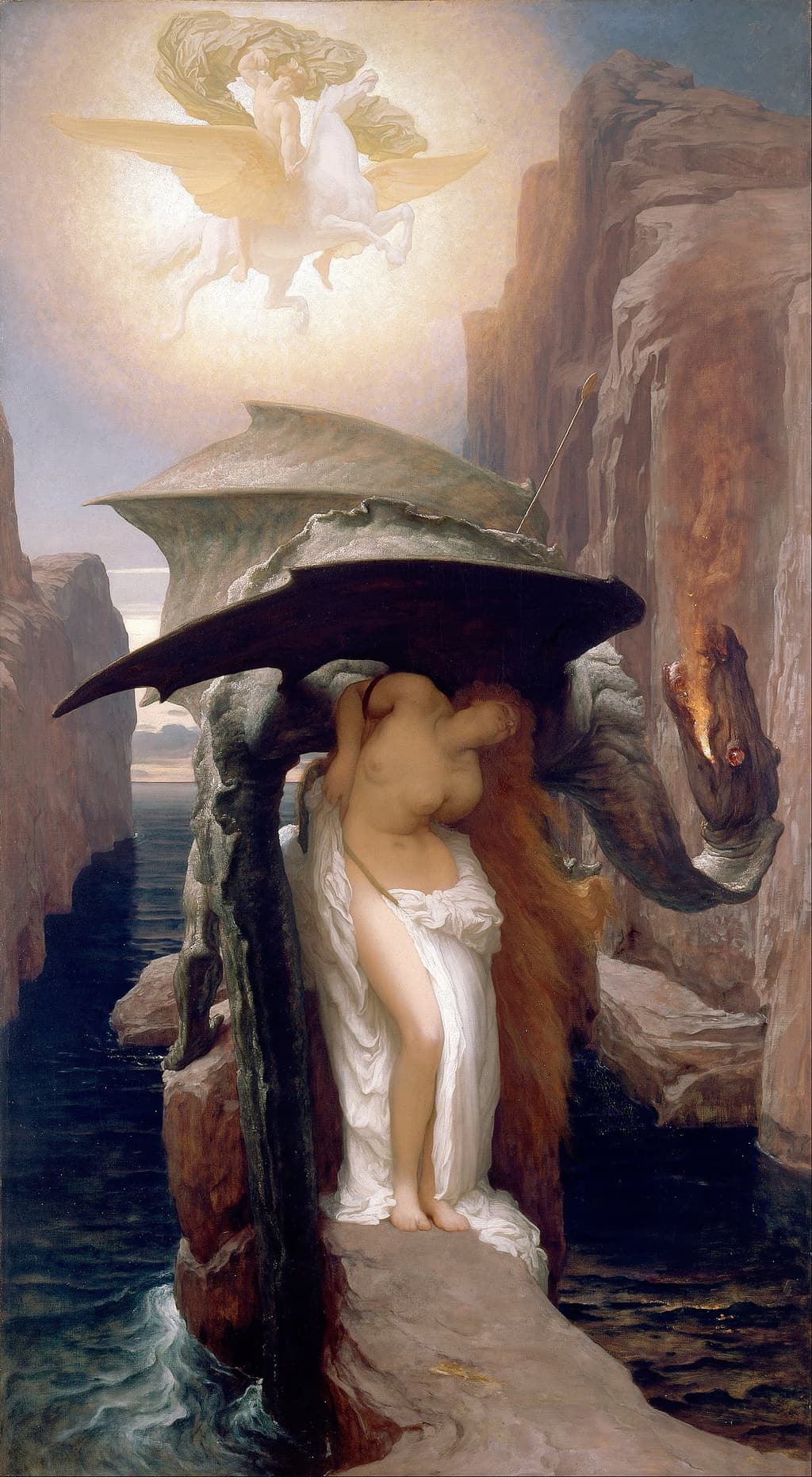
Greek heroic biographies almost all end badly. Heracles burns; Theseus is thrown off a cliff in exile; Jason dies alone under the rotting prow of his own ship; Bellerophon falls. Perseus is the exception. He kills the monster, saves the girl, rescues his mother from a forced marriage, founds a city, and dies old, having ruled a dynasty that produced Heracles four generations later. Even the prophecy that drives the plot — that he will kill his grandfather — is fulfilled by accident, at a games, with a discus, in a way that costs him nothing but grief. He is the one hero whose story is a success.
Locked in a bronze room, and set adrift
Acrisius, king of Argos, was told by an oracle that his daughter's son would kill him, and shut Danaë in an underground bronze chamber. Zeus reached her as a shower of gold — a detail that is either the poet's image for irresistible wealth or a straightforward miracle, depending on which ancient writer you ask, and which Renaissance painters seized on with enthusiasm. When the child was born, Acrisius put mother and son in a wooden chest and threw it into the sea.
The most affecting thing anyone wrote about Perseus survives from this episode: a fragment by Simonides, in which Danaë, in the chest at night with the waves breaking over it, speaks to the sleeping baby — telling him to sleep, and the sea to sleep, and asking the gods' pardon if she prays too boldly. It is one of the finest lyric fragments in Greek.
The chest washes up on Seriphos, where the fisherman Dictys takes them in. His brother Polydectes, king of the island, wants Danaë and finds the grown boy in the way. He announces he is collecting contributions for a bride-gift for another woman; each guest is to bring a horse; Perseus, who has none, rashly offers anything, and is sent for the head of the Gorgon.
The kit, and what it says about the danger
Apollodorus' Bibliotheca lists the equipment, and the quantity of it is the point — no Greek hero is more heavily supplied.
- Directions, obtained by stealing the single eye that the Graiai, three grey sisters, shared between them and passed hand to hand.
- Winged sandals, a kibisis (a specialised bag to hold the head safely), and the cap of Hades, which confers invisibility — all held by nymphs whose location only the Graiai knew.
- A harpe, the curved sickle-sword, from Hermes.
- From Athena, the crucial instruction: do not look at her, look at the reflection in the polished bronze shield.
He strikes while Medusa sleeps, drops the head in the bag, and escapes invisible from her two immortal sisters. From the severed neck spring the winged horse Pegasus and the warrior Chrysaor.
Which Medusa he killed depends entirely on the source, and the choice changes the story's moral weight. Hesiod's Theogony has her born a Gorgon, monstrous from the start, mortal where her sisters are not. Ovid's Metamorphoses, seven centuries later, makes her a beautiful woman assaulted by Neptune in Minerva's temple and transformed by the outraged goddess. A hero killing a born monster and a hero killing a victim of divine punishment are different heroes. Most modern retellings use Ovid's Medusa without adjusting Perseus at all, which produces the tension readers often notice and cannot place. Both accounts are on the dedicated telling of the quest.
Andromeda, and the constellations
Flying home over Aethiopia — or the Levantine coast, at Joppa, which is where later geographers pointed and where Pliny says the chain marks were shown — he sees a girl chained naked to a rock. Her mother Cassiopeia had claimed to outshine the sea-nymphs; Poseidon's reply was inundation plus a monster, and the oracle's terms for calling it off named the king's own daughter. Perseus kills the monster, marries her, and kills her uncle Phineus and his supporters at the wedding feast by producing the head — a scene Ovid turns into a long, gleeful catalogue of men frozen mid-gesture.
The whole family went into the sky: Perseus, Andromeda, Cassiopeia on her chair, Cepheus, and Cetus the sea monster, five adjoining constellations that between them make the northern autumn sky a single continuous illustration of one story. The variable star Algol, in Perseus, marks the Gorgon's head; its name is Arabic, ra's al-ghul, "the demon's head", and its regular dimming every 2.87 days was one of the first eclipsing binaries identified, by John Goodricke in 1783. The Perseid meteor shower each August takes its name from the constellation's position, and folk tradition once connected it to the golden shower that fathered him.
Home, and the accident at the games
He returns to Seriphos, finds his mother taking refuge at an altar from Polydectes, walks into the hall and turns the king and his court to stone, installing Dictys in his place. He gives the sandals, cap and bag back to Hermes and the head to Athena, who sets it on her aegis, where the terrible face becomes a protective one.
Acrisius, hearing of his grandson's return, flees Argos for Larissa in Thessaly. Perseus, travelling to funeral games there, throws a discus that swerves — driven by the wind or by fate, and in some tellings striking the old man's foot — and kills him. Unwilling to inherit the kingdom of a man he has killed, he exchanges Argos for Tiryns with his cousin Megapenthes, and from Tiryns he founds and fortifies Mycenae. Pausanias gives two etymologies he had heard on site: that the scabbard-tip (mykes) of Perseus' sword fell there, or that he found a mushroom (mykes) growing and drank the water beneath it.
That founding matters. Perseus is the ancestor of the Perseid line at Mycenae, which makes him the great-grandfather of Heracles and, through Electryon and Alcmene, the origin of the whole Argive heroic genealogy. Herodotus also has the Persians descended from his son Perses — a Greek etymological guess about a foreign nation's name, and a good example of how myth was used to explain the world's political map.
Cult and the odd survival at Mycenae
Perseus received worship — Pausanias mentions a sanctuary on the road between Mycenae and Argos, a hero shrine at Seriphos, and honours at Athens. A curious detail he preserves: the people of Mycenae and of Chemmis in Egypt both claimed him. Herodotus reports that at Chemmis the Egyptians held games in Greek style for Perseus and said he appeared there periodically, leaving behind a sandal two cubits long, whose discovery signalled prosperity for Egypt. It is one of the most concrete instances of a Greek hero being absorbed into a foreign local cult.
Perseus on screen
The 1981 Clash of the Titans, with Ray Harryhausen's stop-motion Medusa and a mechanical owl, is the version most people carry, and it is a loose one: it introduces the Kraken, a creature borrowed from Norse folklore with no place in Greek myth whatever, and gives Pegasus to Perseus as a mount, which no ancient source does — the winged horse belongs to Bellerophon. The 2010 remake and its sequel kept both errors and added more.
Painting has served him better and worse. Cellini's bronze in the Loggia dei Lanzi in Florence, holding the head aloft, was made as a political statement about Medici power; Caravaggio's Medusa shield in the Uffizi shows only the head, screaming. Renaissance and Baroque Danaës — Titian's, Klimt's much later — turned the shower of gold into one of European art's most-repeated erotic subjects, which has rather crowded out Simonides' woman in the chest.
One eye, one curved sword, and Andromeda’s Ethiopia
Why do the Graiai share one eye?
No source explains it and none treats it as strange. They are, in Hesiod, grey-haired from birth, sisters of the Gorgons, born of the same sea-deities Phorcys and Ceto, and they exist in the story chiefly as an obstacle solved by theft rather than force — which is the point. Perseus' first move is not combat but a con, which is unusual for a Greek hero and sets the tone for a quest won entirely by preparation.
Was Andromeda black?
Ancient sources place the kingdom in Aethiopia, which in Greek usage meant the lands south of Egypt and, more loosely, the far south generally; Ovid describes her once as fusca, dark. Some ancient authors relocated the episode to Joppa on the Levantine coast instead. European art from the Renaissance onward painted her uniformly white, and the question of how she should be depicted has been a live one in classical reception scholarship for decades. The honest position is that the sources locate her in Africa and describe her only vaguely.
What is the harpe?
A curved blade with a hook or secondary edge, distinct from a straight Greek sword, and the same weapon Cronus is said to have used on his father. Its use here is one of several small links tying Perseus to the older succession myths, and it is how you identify him in art: winged sandals, a bag, a curved sword and an averted face.
Did anyone try to explain the story rationally in antiquity?
Yes — the rationalising tradition that ran from the fourth century BCE onward handled Perseus as it handled everything else. Pausanias records the view that the Gorgon was a Libyan queen killed in battle whose head was cut off so her beauty could be admired, and other versions make her a beast whose gaze paralysed. Ancient writers were already uncomfortable with the supernatural elements and were producing sceptical readings long before modern scholarship existed.