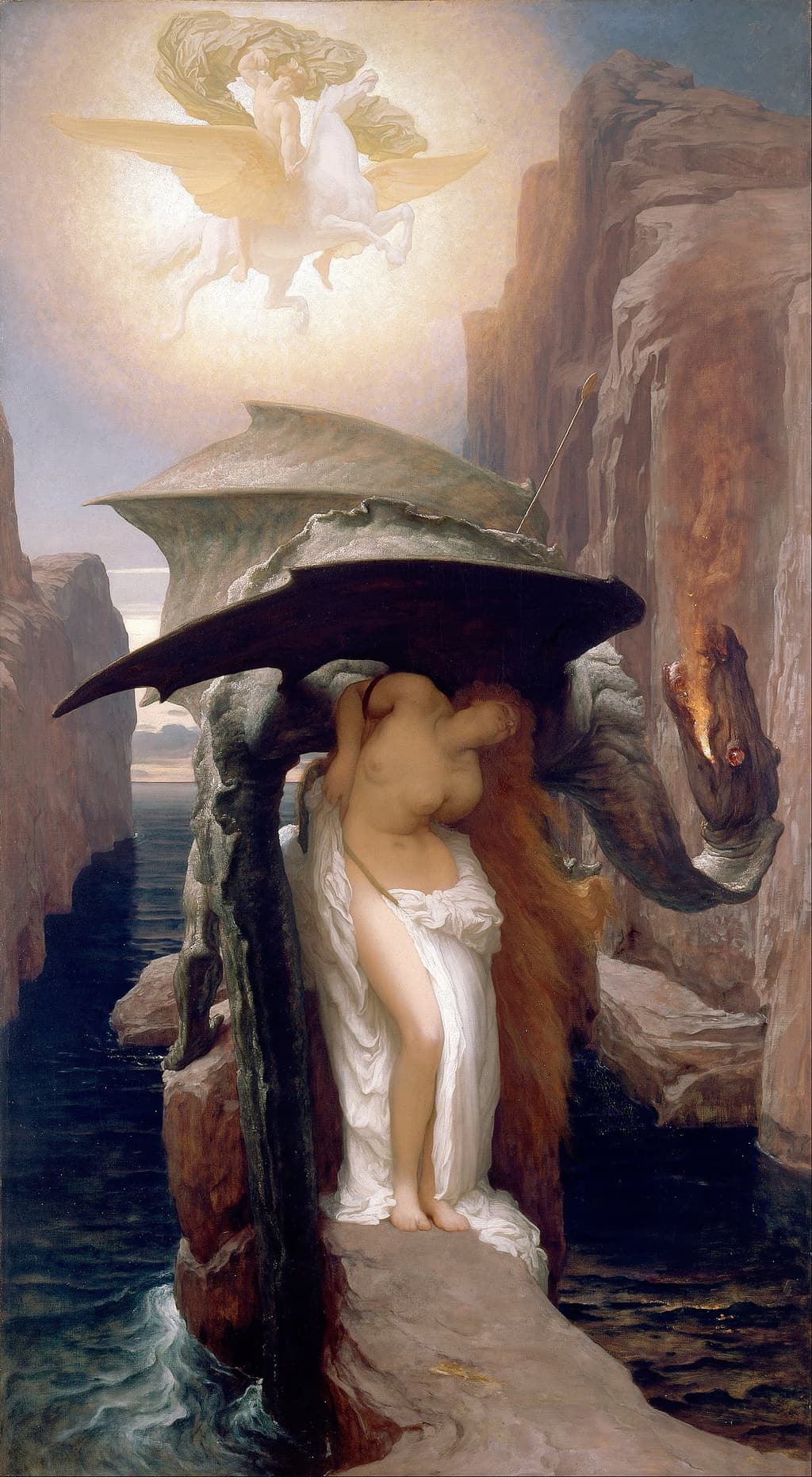
This is the one Greek quest with a full equipment list. Winged sandals, a cap that makes the wearer invisible, an unbreakable curved blade, a special bag to carry the head in, and a polished shield to look at it with — all of it borrowed, none of it his. Strip the gear out and the hero is a teenager from a fishing island who has been manoeuvred into promising something he cannot possibly deliver, by a king who wants him dead so he can have his mother.
Locked in a bronze room, then in a box
Acrisius, king of Argos, asked an oracle about sons and was told instead that his daughter's child would kill him. He shut Danaë in a chamber of bronze underground, which is a solution with an obvious flaw: it prevents husbands, not gods. Zeus came through the roof as a shower of gold, and Danaë had a boy.
Acrisius did not want the blood on his hands. He nailed mother and child into a wooden chest and put it in the sea. The lyric poet Simonides wrote a famous fragment on that night — the mother in the dark hull, the child asleep, the sea slapping the boards — and it is the only part of the story anybody has ever written well from her side.
The chest came ashore on Seriphos, a small poor island in the Cyclades, and a fisherman called Dictys pulled it out of the water and took them in. His brother Polydectes was king there.
The dinner party trap
Years later, Polydectes wanted Danaë and could not have her while a grown son was in the house. So he announced he was courting a different woman entirely, and held a feast at which every man was expected to contribute a horse toward the bride-price. Perseus, who had no horse, said in front of everyone that he would bring anything else the king named — even the head of the Gorgon.
The king named it, and held him to it. That is the whole plot of the trick: a boast extracted in public from a young man too proud to admit he owns nothing.
The grey sisters, and the tackle
Athena and Hermes took an interest. What they gave him first was not weaponry but directions, and even those had to be extorted.
The Graeae were three sisters, grey from birth, who lived at the edge of the world and shared between them a single eye and a single tooth, passed from hand to hand. Perseus waited for the moment of transfer and took the eye. He would give it back, he said, when they told him how to find the nymphs who kept the gear. They told him.
From the nymphs he had winged sandals, a cap belonging to Hades that made its wearer unseeable, and the kibisis, a bag made specifically to hold what he was going to put in it. Hermes gave him the harpe, a sickle-shaped blade of adamant. Athena gave him a bronze shield polished to a mirror, and instructions on how to use it.
The only mortal Gorgon
There were three Gorgons — Stheno, Euryale, and Medusa — and only the third could be killed. That asymmetry is in Hesiod and nobody explains it.
He came on them asleep, on their island in the far ocean, among the standing shapes of men and animals who had come before him. He would not look at her directly. He watched her reflection in the shield, and Apollodorus says Athena guided his hand. He cut, and put the head in the bag without seeing it, and two things came out of the severed neck: Pegasus, the winged horse, and a warrior named Chrysaor holding a golden sword — both fathered on her, in the older account, by Poseidon. The sisters woke and hunted for him, and the cap of invisibility is the reason he lived.
Pindar tells this story in his twelfth Pythian ode, which was written for a flute-player, and he uses it to explain where a particular piece of music came from: Athena, hearing the surviving Gorgons keening for their sister, transcribed the sound into a tune for the reed pipe. It is one of the few places in Greek myth where a monster's grief is treated as a thing worth preserving.
Andromeda, chained
Flying home along the coast of what the Greeks called Ethiopia, he saw a girl chained to a rock at the tide line and thought at first she was a statue.
Her mother Cassiopeia had boasted of being more beautiful than the Nereids. Poseidon had responded with a flood and a sea-monster, and the oracle's price for calling it off was the king's daughter. Perseus negotiated — he made her father Cepheus promise him the marriage first, which is not chivalry but contract — killed the monster, and took her.
At the wedding, her uncle Phineus, to whom she had been promised, arrived with an armed following to object. Ovid gives this fight two hundred lines of deliberately overblown carnage before Perseus, outnumbered, tells his own men to look away and lifts the head out of the bag. Phineus is the first of the tradition's many statues, frozen mid-plea.
Then Seriphos. Polydectes was at table, having spent the intervening period harassing Danaë. Perseus came in, said he had brought what was asked for, and used it. He made Dictys king of the island, and gave the head to Athena, who set it on her breastplate, where it stayed.
The discus
The prophecy had not gone anywhere. Years later Perseus was competing at funeral games in Larissa in Thessaly, and his discus went wrong — into the crowd, or into a wind, depending on the version — and struck an old man in the foot or the head, and killed him. It was Acrisius, who had left Argos precisely to avoid his grandson.
This is the most important structural fact about the story and it is almost always cut. The oracle is fulfilled by accident, decades late, by a man who did not know his grandfather was in the audience and had never intended him harm. Greek prophecy does not work by making people do things. It works by being true.
Perseus would not take the Argive throne after that; he traded it, and founded or fortified Mycenae instead. His descendants include Alcmene, and through her Heracles — which is why the greatest Greek hero is the great-grandson of this one.
Where the versions part company, especially about Medusa
The single largest divergence in the whole cycle concerns what Medusa was before she was killed.
In the Greek sources, she was born a Gorgon. Hesiod lists the three sisters as daughters of the sea-deities Phorcys and Ceto, monstrous from the start, living at the edge of the world; Medusa's mortality is stated as a bare fact of her birth. There is no transformation because there was nothing to transform.
The story that she was a beautiful priestess, raped by Poseidon in Athena's own temple, and punished by the goddess with snakes for hair, comes from Ovid's Metamorphoses 4 — a Latin poem written some seven centuries after Hesiod, whose entire artistic programme is bodies being changed into other things. It is a magnificent piece of writing and it is not the Greek tradition.
This matters because the modern reading of Medusa as a victim — the emblem of a woman punished for what was done to her, adopted as a tattoo, a protest image and a survivors' symbol — descends entirely from Ovid. That reading is legitimate; Ovid is an ancient source and a very good one. But it is not what an Athenian looking at a gorgon-face on a temple pediment in 550 BCE was thinking about, and pretending otherwise flattens six hundred years of difference.
Other conflicts worth flagging: whether the harpe came from Hermes or Zeus; whether the mirror was a shield or a plate; whether Perseus killed his grandfather with a discus or a spear-throw; and whether Andromeda's kingdom was in Africa or, as several ancient authors including Pliny insisted while pointing at the actual rocks, at Joppa on the Levantine coast.
The face on the wall
Before Medusa was a character she was a face. The gorgoneion — round, frontal, tusked, tongue out, staring directly at the viewer — is one of the earliest and commonest motifs in Greek art, painted on shields, moulded on roof tiles, stamped on coins, set over doorways and ovens. It is apotropaic: it is there to frighten off harm, and its power is precisely that it looks back at you, which no other figure in archaic Greek art does. The story of a hero who beheaded it may well be secondary to the image, an explanation attached later to a sign that already existed. This is one of the clearest cases in Greek myth of narrative catching up with an older piece of visual symbolism.
Romans put the head on breastplates and floor mosaics; it survives into modern use on a fashion house's logo, on the flag of Sicily, and on the badge of more than one military unit.
Modern lives
Cellini's bronze in Florence, with Perseus standing on the body and holding the head out at arm's length, is the version most people carry in their heads. Ray Harryhausen's stop-motion Medusa in Clash of the Titans (1981) gave her a snake's tail and a bow and, for a generation, replaced the classical image entirely. Percy Jackson made Perseus a name for a boy in New York. The story's sky-map survives intact: Perseus, Andromeda, Cassiopeia, Cepheus and Cetus are all adjacent constellations, and the star Algol in Perseus — an eclipsing binary that visibly dims every two days and twenty-one hours — has carried the name of the Gorgon's head, in Arabic and then Latin, for a thousand years.
Frequently tangled points
Did Pegasus carry Perseus? No — that is a later confusion, encouraged by Renaissance painting and by Clash of the Titans. Perseus flies with winged sandals. Pegasus is born from Medusa's neck and belongs to a different hero's story, Bellerophon's.
Are the Graeae the same as the Fates? They are not, though both are triads of women at the edge of the world and the confusion is ancient. The Graeae share an eye; the Moirai share a thread. Different bodies of story, different functions.
Why does Athena help him and then take the trophy? Because the gorgoneion was hers already. In cult terms the story ends where it must: it explains the object on the goddess's aegis, and the hero is the mechanism that delivers it. Several scholars read the whole quest as an aetiology for that image rather than the other way round.
Was Seriphos a real place? Yes, and an unimportant one — a small Cycladic island of a few hundred inhabitants, which is part of the point. The Argive royal story is decanted into a fishing community for a generation and comes back.
Related routes: the Greek hub, the family tree, and the sea-monster's cousin in Andromeda's rock and the Cetus tradition.