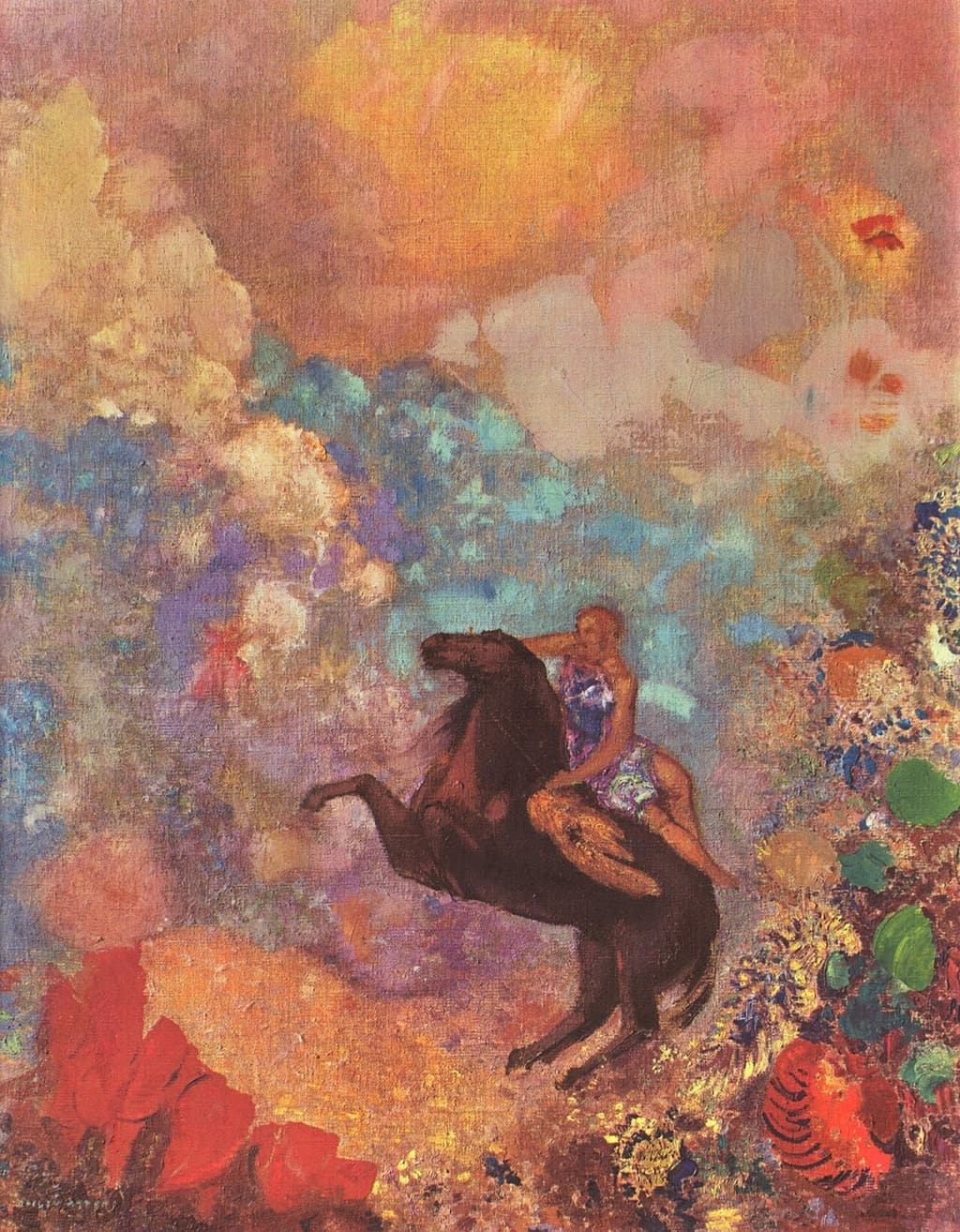
He is born out of a killing. When Perseus cuts the head from Medusa, Hesiod says, Pegasus and the golden-sworded Chrysaor sprang out of her neck — the offspring she had conceived by Poseidon in the soft meadow among the spring flowers. No source explains how that works or treats it as odd. Later writers offered a variant in which the horse rose from the earth where the Gorgon's blood fell, which tidies the biology at the cost of the image.
Hesiod gives the name an etymology: he was called Pegasus because he was born beside the springs, pēgai, of Ocean. Modern linguists are sceptical and have proposed a Luwian word for lightning as the source, connecting him to the storm-god's horse — attractive, and unproven. The spring connection stuck regardless, and it turns out to matter more than the ancestry.
Hoofprints that become springs
Wherever he strikes the ground, water comes up. The famous one is Hippocrene, "the horse's spring", on Mount Helicon: the Muses' mountain swelled with song until Pegasus struck it and the water burst out. Pausanias saw the spring and reports the story as the local explanation. Another, Peirene at Corinth, is where Bellerophon found and bridled him, and where the water still runs into a Roman fountain house.
Because Hippocrene belongs to the Muses, the winged horse became the emblem of poetic inspiration — but not until much later. There is nothing in the Greek sources about riding Pegasus as a metaphor for writing verse. That association is Renaissance and after, and once made it became permanent: "mounting Pegasus" for taking up poetry, the horse on the covers of poetry anthologies, the winged horse in Boiardo and Ariosto, Schiller's poem about Pegasus put to the plough.
Bellerophon, and the fall
Perseus never rides him. This is worth stating clearly, because films have made the pairing near-universal: the 1981 Clash of the Titans gave Perseus the winged horse and the 2010 remake kept it. In every ancient source the rider is Bellerophon.
Pindar's thirteenth Olympian tells the taming. Bellerophon could not catch the horse until he slept at the altar of Athena at Corinth, and the goddess appeared to him in a dream with a golden bridle. He woke with the bridle in his hands, sacrificed to her as Athena Hippia, and the horse accepted it. From the air he killed the Chimera — the standard account has him drop a lead-tipped spear into its fiery throat, where the metal melted and choked it — defeated the Solymi and the Amazons, and became a king.
Then he tried to fly to Olympus. Zeus sent a gadfly, the horse bucked, and Bellerophon fell — surviving, lamed and blinded in most accounts, and ending as Homer describes him in Iliad 6: wandering the Aleian plain alone, eating his heart, avoiding the paths of men. Pegasus flew on and reached Olympus, where Hesiod says he lives in the house of Zeus and carries the thunder and lightning.
The horse is the only one of the pair to complete the ascent. His rider's punishment is his promotion.
Corinth's brand
Corinth made him a civic emblem and put him on its coinage for centuries — the winged horse on one side, Athena in a Corinthian helmet on the other. Those pōloi, "colts", as the coins were nicknamed, circulated widely across the Greek west and are one of the most recognisable ancient coinages. The city had every reason: Peirene is a Corinthian spring, Bellerophon a Corinthian hero, and the bridle came from a Corinthian sanctuary.
The constellation and the square
Pegasus is one of the 48 constellations Ptolemy listed and one of the largest in the modern sky, though he is upside down and missing his hindquarters — the star that would be his shoulder, Alpheratz, was long shared with Andromeda and is now assigned to her. Four bright stars form the Great Square of Pegasus, an autumn landmark for northern observers.
In 1995 the first exoplanet confirmed orbiting a sun-like star was found there: 51 Pegasi b, a hot Jupiter whose discovery earned a share of the 2019 Nobel Prize in Physics and opened the field. It has the informal name Dimidium.
The modern winged horse
He is one of the most commercially reused figures in all of mythology: the Mobil Oil flying red horse, TriStar Pictures' logo, the emblem of British airborne forces in the Second World War and of the bridge at Arnhem, an Air France insignia, countless publishing houses, and the winged horse in Fantasia and in the Harry Potter, Percy Jackson and My Little Pony franchises. Fantasy gaming pluralised him into a species — pegasi — exactly as it did with the Minotaur, which no ancient source supports.
Two things get lost consistently. The first is that he is a war machine before he is anything else, used for a specific aerial assassination. The second is Bellerophon, who has been almost entirely written out of the popular version in favour of a hero whose story he never appears in.
His brother, his foals, and his promotion to Zeus’s stable
Did he have offspring?
A few, and they are inconsistent. Some sources give him a son, Celeris, and Melanippe; others credit the winged horses of later tradition to his line. The tradition is thin because he is not really a member of a species — he is a single miraculous animal, and the later idea of a breed of winged horses runs against how the Greeks treated him.
What is Chrysaor?
The other thing born from Medusa's neck: a figure whose name means "golden sword" and who is almost never depicted. He becomes the father of the three-bodied Geryon, whose cattle Heracles takes in the tenth labour, and of Echidna in some accounts. He is one of the emptiest slots in Greek myth — a name with a genealogy and no story attached, which is itself evidence that the Gorgon's decapitation was understood as generative rather than merely fatal.
Why does he end up carrying thunderbolts?
Hesiod puts him in Zeus' service as the bearer of the thunder and lightning, which is where the possible Anatolian storm-horse etymology becomes interesting: a lightning-horse serving a sky-god fits a wider Indo-European and Near Eastern pattern rather well. Whether Hesiod's line preserves an old function or invents a dignified retirement for a famous animal cannot be determined.
Is he in the story of the Muses' contest?
Adjacent to it. Ovid's version in Metamorphoses 5 has Minerva visit Helicon specifically to see the spring made by the winged horse's hoof, and it is during that visit that the Muses tell her about the contest with the daughters of Pieros. So the horse is the reason a goddess is present for the story, which is a small but neat piece of narrative carpentry.