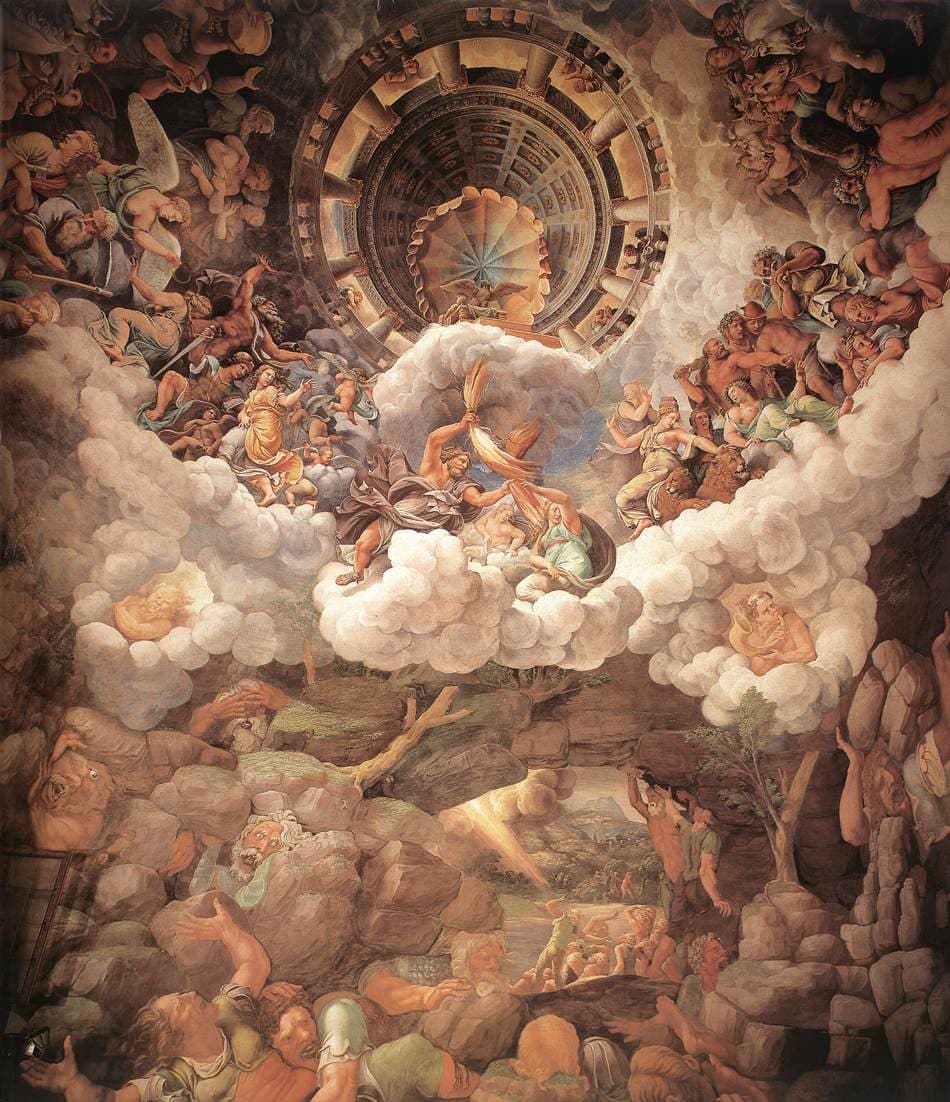
The gods do not live on the mountain. Homer is careful about this in a way that almost every retelling since has ignored.
In Odyssey 6 he describes Olympus as the seat of the gods that stands fast for ever: no wind shakes it, no rain falls on it, no snow comes near, but a cloudless brightness spreads over it and a white radiance runs across it. That is not a description of a Thessalian peak, which is snowbound for much of the year and generates its own weather. Homer's Olympus is above the summit — the gods' houses, built by Hephaestus, sit in a bright region that the mountain reaches toward.
Elsewhere the same poems slide between the two: the Iliad has the gods coming down from the peaks of Olympus, and the Hours opening the gate of cloud that closes the sky. Greek poetry uses the name for a real mountain, for the sky, and for a divine residence, sometimes within a few lines, and the ambiguity is original rather than a confusion introduced later.
The actual mountain
Mount Olympus is real, and it is the highest mountain in Greece: the summit, Mytikas, is 2,917 metres, on the border between Thessaly and Macedonia, close enough to the Aegean that it rises almost straight out of the coastal plain — which is why it looks so much larger than its height suggests. It has more than fifty peaks, deep gorges, and an unusually rich flora, with a substantial number of endemic species; it was declared Greece's first national park in 1938 and is a UNESCO biosphere reserve.
The summit was not climbed in recorded modern history until 2 August 1913, by the Swiss climbers Frédéric Boissonnas and Daniel Baud-Bovy with the Greek guide Christos Kakalos, a chamois hunter from Litochoro. Kakalos went on to become the mountain's official guide for decades. Whether anyone reached the top in antiquity is unknown; there is no ancient account of an ascent, which is itself suggestive.
There is, however, archaeology near the top. Excavations on the peak of Agios Antonios, at around 2,815 metres, have recovered ash, burnt animal bone and pottery including inscribed dedications to Zeus Olympios, indicating an open-air sanctuary in use in the Hellenistic and Roman periods. People were sacrificing to Zeus close to the summit, in conditions that would have made the journey a serious undertaking.
At the foot of the mountain, the sanctuary at Dion was a major Macedonian religious centre, where Philip II and Alexander held festivals and games in honour of Zeus and the Muses; the site has theatres, temples, baths and an extensive excavated town.
More than one Olympus
There are at least half a dozen mountains called Olympus in the Greek world — in Mysia, in Lycia, in Elis, on Cyprus, on Lesbos, in Arcadia — and the multiplicity caused confusion in antiquity as well as now. The name is generally thought to be pre-Greek, one of the substrate words absorbed from the languages spoken in the region before Greek arrived, which would explain why it attaches to so many high places without a Greek meaning.
The Mysian Olympus, now Uludağ in Turkey, was substantial enough that ancient authors sometimes had to specify which mountain they meant.
What is up there, according to the poets
The picture assembled from Homer, Hesiod and later poetry is domestic rather than palatial. Each god has a house, built by Hephaestus, with Zeus' the largest. There is a hall where they feast on nectar and ambrosia, served by Hebe and later by Ganymede, while Apollo plays the lyre and the Muses sing. The gates are of cloud and are kept by the Horae, the Seasons.
The council scenes are political meetings, and they are the funniest and most human passages in early Greek poetry — arguments about favouritism, threats, sulking, an injured Ares complaining to his father and being told he is the most hateful of the gods. The mountain's function in the poems is to give the divine a location from which the human plain can be observed and interfered with.
Hesiod adds that the assembly of the gods and the council of war during the Titanomachy happened there, and that Zeus fought from Olympus while the Titans held Mount Othrys — two real Thessalian mountains facing each other across a plain, which is one of the neater pieces of mythological topography.
Not everyone lives there
Worth stating, since the phrase "the Olympians" implies otherwise. Hades does not: he rules the underworld and has no seat above. Poseidon has his palace at Aigai beneath the sea and attends when required, and in Iliad 15 he pointedly reminds Zeus that they drew equal lots. Demeter spends the relevant part of the myth at Eleusis; Dionysus is largely on the move; Hestia is at the hearth.
Nobody in antiquity kept a register of who lived here. The "twelve Olympians" is a countable set assembled for sculptural programmes and state cult, not a tenancy schedule, and it comes out differently depending on which source you open — Hestia in one, Dionysus in her place in the next.
Olympus Mons, and the name's afterlife
The largest volcano in the solar system, on Mars, is Olympus Mons — around 22 kilometres high, roughly two and a half times the height of Everest above sea level, and so broad that from its summit the flanks would curve away out of sight. It was observed as a bright spot by nineteenth-century astronomers, who called it Nix Olympica, "the Olympian snow", and renamed once Mariner 9 revealed in 1971 that the spot was a mountain.
Elsewhere the name is a metonym for lofty detachment — "Olympian" in English means both "relating to the gods" and "aloof and superior", the second sense being a Victorian development. It is also, of course, the source of the Olympic Games' name, though those were held at Olympia in the western Peloponnese, some 300 kilometres away, and the two places are frequently confused. Olympia is a sanctuary in a river valley; Olympus is a mountain in the north. Zeus is the link and the only one.
The real mountain, and the games named after somewhere else
Can you climb it?
Yes, and tens of thousands of people do each year. The standard route starts from Litochoro or the Prionia trailhead, with mountain refuges partway; the final approach to Mytikas involves a scramble on loose rock that is genuinely exposed and has caused fatalities. Winter ascents are a serious mountaineering proposition. The lower slopes are forested and the gorge walks are among the best-known in Greece.
Did Greeks make pilgrimages to it?
There is no evidence of a large-scale pilgrimage cult of the kind Delphi or Olympia had, but the summit sanctuary finds show sacrifice was performed high on the mountain, and the sanctuary at Dion at its base was a major Macedonian centre. Greek religion generally located worship in sanctuaries rather than on peaks, but mountain-top altars to Zeus are attested elsewhere too, on Mount Lykaion in Arcadia and on Mount Ida in Crete.
Is Othrys a real mountain as well?
Yes — a range in southern Thessaly, south of the Thessalian plain, facing Olympus across it. Hesiod's placing of the Titans there and the Olympians on Olympus gives the Titanomachy a real map, with the two sides occupying real high ground on either side of a real plain. It is one of the few Greek cosmic conflicts with a coherent geography.
What is the connection to the Olympic Games?
Naming only. The games were held every four years at the sanctuary of Olympia in Elis, in honour of Zeus Olympios — the same epithet as the mountain's Zeus — with the great chryselephantine statue by Pheidias in the temple there. The modern games' rituals, including the flame lit at Olympia, refer to that sanctuary and not to the mountain. The shared adjective has caused confusion since antiquity.