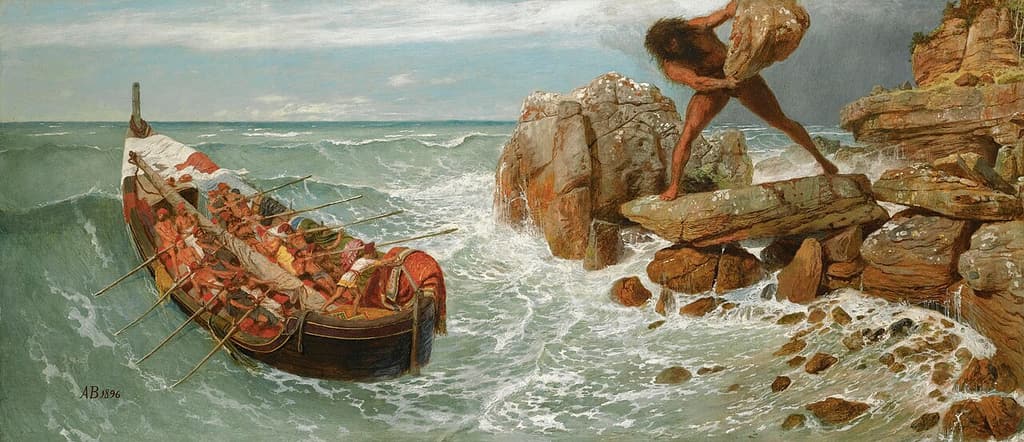
Circe's advice to Odysseus is one of the coldest pieces of counsel in Greek literature. There are two hazards in the strait and no route that avoids both. On one side is Charybdis, which sucks down the black water three times a day and spews it back, and if you are there when she swallows, nothing can save you. On the other is Scylla, in a cave high in a cliff, and she will take six men — one for each head — as you pass.
So you must go close to Scylla, Circe says, and lose six, rather than lose the whole ship. And when Odysseus asks whether he can fight her off, she tells him not to try, because she is not mortal but an immortal evil, and if he stops to arm himself she will simply come out again and take six more.
He does not tell the crew. Homer says so explicitly: he says nothing about Scylla, because they would have dropped the oars and huddled below. He watches them taken — Homer gives the image of a fisherman lifting small fish onto the rocks, and says it was the most pitiable thing he saw in all his wanderings, the men calling his name as they were lifted, hands and feet still moving.
What she is
Homer's description in Odyssey 12 is precise and grotesque: twelve feet, all dangling; six necks of great length, each with a horrible head with three rows of teeth set close and thick and full of black death; sunk to her middle in the hollow cave, with her heads out over the abyss, fishing for dolphins and dogfish and whatever larger sea creature she can catch. Her voice is a yelping, like a newborn puppy's — skylax is the Greek for puppy, and the name is generally taken to come from it.
There is no origin story in Homer at all. She is simply there, immortal, and the poem's advice is to lose six men and keep rowing.
Circe's jealousy, and Ovid's version
The transformation story is later. Ovid's Metamorphoses 13 and 14 give the fullest account: Scylla was a beautiful nymph, courted by the sea-god Glaucus, who had been a mortal fisherman before eating a strange herb. She refused him. He went to Circe for a love-potion, and Circe, who wanted him herself, poisoned the pool where Scylla bathed instead. The girl waded in and saw dogs' heads growing from her waist and could not run from them because they were part of her.
An earlier and different jealousy is also attested: that Amphitrite did it, because Poseidon wanted her. Others make her the daughter of Phorcys and Ceto — the same monster-parents as the Gorgons — or of Hecate's associate Crataeis, whom Homer names as her mother.
The pattern is now familiar: a monster that Homer presents as simply monstrous acquires, centuries later, a backstory in which she was a woman and something was done to her. The same thing happens to Medusa, and in both cases Ovid is the source, and in both cases the later version has almost entirely displaced the earlier one in popular understanding.
Charybdis, and the strait
Charybdis is the other half and gets much less attention. She is a whirlpool rather than a body — in later accounts a daughter of Poseidon and Gaia, punished by Zeus for stealing Heracles' cattle by being made to swallow and vomit the sea three times daily. Homer gives no genealogy for her either. Beneath her grows a great fig tree, and when Odysseus loses his ship and passes a second time alone, he clings to that fig root like a bat until his mast and keel come back up out of the water.
The traditional location is the Strait of Messina, between Sicily and Calabria, and the identification is ancient and consistent. The strait genuinely has strong tidal currents where two seas with different tidal timings meet, producing whirlpools — the local phenomenon is still called garofalo, and it was more dangerous to oared and sailing vessels than it is to modern ships. Scylla was placed on the Calabrian side, where the town of Scilla stands today with a castle on the rock.
Whether the myth grew from the navigation hazard or was attached to it later is unresolvable, but the correspondence between "two dangers, one on each side, and you must pick" and a narrow strait with a rock and a whirlpool is a good deal closer than most mythological geography gets.
The Argonauts, and the aftermath
Apollonius has the Argo pass the same point, and there the crew is protected: Thetis and the Nereids pass the ship from hand to hand between the rock and the whirlpool like girls playing with a ball on a beach, at Hera's request. It is a scene of extraordinary charm inserted into what is otherwise a horror location, and it makes the point that the same hazard can be survived if you have the right patronage.
Aeneas is advised in Aeneid 3 by Helenus to take the long route around Sicily rather than attempt the strait at all — which is, from a sailing point of view, the sensible answer that Homer's poem does not permit.
Later sources say Scylla was eventually killed by Heracles, when she took some of Geryon's cattle, and restored to life by her father Phorcys.
Between a rock and a hard place
The phrase "between Scylla and Charybdis" entered European proverb through Latin — the twelfth-century Latin poet Walter of Châtillon's line about running into Scylla while wishing to avoid Charybdis is the version most often quoted — and it names a specific kind of dilemma: not simply two bad options, but two bad options where avoiding one drives you into the other.
It has been used in political and diplomatic writing continuously since the Renaissance, and it is more precise than the English idioms that have largely replaced it ("between a rock and a hard place", "the devil and the deep blue sea"), because the Homeric passage includes the crucial advice that the options are not equal and one must be deliberately chosen. Circe's counsel is a lesson in accepting a known loss to avoid an unbounded one, which is why the phrase turns up in decision theory and risk-management writing.
Tentacles where the dog heads should be
She is a stock sea monster in games and film, usually rendered as a tentacled thing — the dog heads are visually awkward and modern designers reach for the kraken instead. Where the story survives intact it is usually in retellings of the Odyssey, and Madeline Miller's Circe gives her a substantial role, taking Ovid's version and making the transformation the central regret of the narrator's life.
The name is otherwise attached to the Calabrian town, to a genus of sea snails, and to a good deal of software and hardware named by people who liked the sound of it.
Six men, two Scyllas, and one strait
Why six men exactly?
Because she has six heads, and Homer keeps the arithmetic strict — one man per head, one pass, six lost. The precision is part of the passage's horror: it is a toll rather than an attack, and it is quoted in advance so that both Odysseus and the reader know the number before it happens. The second passage, when he returns alone, costs him nothing because there is nobody left to take.
Is she related to the Gorgons?
In one genealogy, yes: Apollodorus and others give her as a daughter of Phorcys and Ceto, the sea-deities who also produced the Gorgons and the Graiai. That places her in the mythology's principal family of sea-monsters. Homer instead names only her mother, Crataeis — "the mighty one" — and Homer's advice is to pray to Crataeis, which suggests a local cult figure rather than a genealogical position.
Is there another Scylla?
Yes, and confusingly so: Scylla daughter of Nisus, king of Megara, who cut the purple lock of hair on which her father's life and kingdom depended, out of love for the besieging king Minos, and was rejected by him in disgust. She is turned into a bird, pursued forever by her father in the form of a sea eagle. Ovid tells that story too, in Metamorphoses 8, and ancient and modern readers have conflated the two Scyllas regularly. The poem Ciris, attributed doubtfully to Virgil, is about her.
Did sailors really avoid the strait?
Ancient sailing preferred to hug coasts and to avoid narrow passages with strong currents where oars and small sails gave little margin. The Messina strait's currents reverse roughly every six hours and can run at several knots, with visible eddies at the northern end. Roman-era authors including Strabo discuss the danger in practical terms and Strabo connects it directly to the Homeric passage — an ancient geographer using a poem as a description of a real hazard.