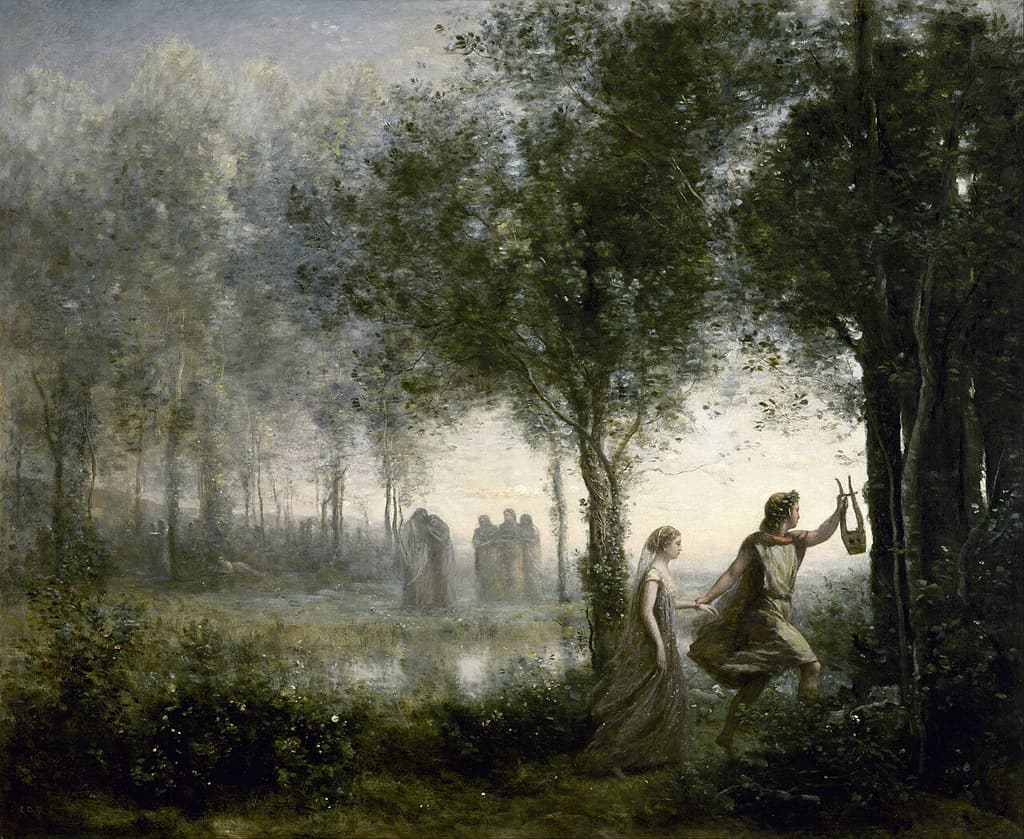
Everyone knows he looked back. Almost nobody knows how late that detail is.
The earliest references to Orpheus going down for his wife are fragmentary and do not clearly say he failed. A fragment of Euripides' Alcestis has Admetus wish he had the tongue and music of Orpheus so that he could charm Persephone and Hades and bring his wife back — phrased as though the precedent worked. A passage in Isocrates says Orpheus led the dead back up from Hades. Plato's Symposium gives a hostile version in which the gods showed him only a phantom of his wife because he was a coward who would not die for her, which implies a failure but by a different mechanism entirely.
The version with the backward glance, the second loss, and the name Eurydice in its familiar form appears fully formed in Virgil's fourth Georgic around 29 BCE and in Ovid's Metamorphoses a generation later. A number of scholars have argued the tragic ending is an Augustan invention, or at least an Augustan promotion of a minor variant, possibly Virgil's own. It is not provable either way. What can be said is that the most famous fact about Orpheus is not securely attested until the Roman period, and that the "successful Orpheus" was once available and has now vanished so completely that most readers find the idea startling.
What Virgil and Ovid actually wrote
Virgil embeds the story inside another — the beekeeper Aristaeus, whose pursuit caused Eurydice's death by snakebite, is told the tale by Proteus as an explanation for why his hives have died. Orpheus goes down, the shades gather, Cerberus' three mouths gape, Ixion's wheel stops. Persephone grants the return on the condition he not look back until they are out. Near the surface, dementia takes him — Virgil's word, a sudden madness — and he turns. She says a few words and is gone like smoke.
Ovid softens it and adds the details everyone remembers: the plea that if the fates refuse he will stay too, the goddess of the dead unable to refuse, the phrase about Eurydice not complaining because what was there to complain of, except that she was loved. And Ovid gives the reunion at the end, when Orpheus is killed and the shades meet again below, where he may look back at her as much as he likes.
The end: torn apart, and a head that keeps singing
After the loss he withdraws from women — Ovid says he turned his affections to boys, and credits him with introducing the practice to Thrace — and the maenads, women of Thrace enraged either by his rejection or by his neglect of Dionysus, tear him to pieces. Aeschylus wrote a lost Bassarids about it. His limbs are scattered; the Muses gather them and bury them at the foot of Olympus, where the nightingales are said to sing more sweetly than anywhere else.
His head and lyre float down the Hebrus to the sea and across to Lesbos, still singing. The head was said to have given oracles there until Apollo silenced it. The instrument was catasterised on its own account, and Vega now sits inside the small constellation named for it. The Lesbos landing is the standard ancient explanation for why that island produced the greatest lyric poets — Sappho and Alcaeus — which is a satisfyingly literal account of a literary tradition.
The religion that took his name
This is the part usually left out, and it is the more historically significant.
Orphism was a real strand of Greek religious practice: initiatory, concerned with the soul, with reincarnation, with purity, with abstention from meat and beans, and with a theogony that differs sharply from Hesiod's. In the Orphic account Dionysus as the child Zagreus is dismembered and eaten by the Titans, Zeus destroys them with the thunderbolt, and humanity is formed from the residue — carrying Titanic guilt and a Dionysiac spark, which is what the rites are for.
The physical evidence is remarkable. Thin gold tablets, small enough to fold, have been found in graves in southern Italy, Thessaly, Crete and elsewhere, dating from the fifth century BCE onward, inscribed with instructions for the dead: which spring to avoid and which to drink from, what to say to the guardians below — "I am a child of Earth and starry Heaven, but my race is heavenly" — and, on one from Pelinna, that Bacchus himself has released you. The Derveni papyrus, a carbonised roll recovered from a Macedonian tomb in 1962 and the oldest surviving European manuscript, is a philosophical commentary on an Orphic poem.
Plato refers repeatedly and with some contempt to itinerant Orphic priests who sold purification rituals. Whatever it was, it was a movement with texts, practitioners and paying customers, and it attached itself to a singer who was said to have gone to the underworld and come back — which is exactly the qualification such a movement needs.
Also an Argonaut
Apollonius' Argonautica has him aboard, and gives him two decisive jobs. He sets the stroke rate for the rowers, and he sings a cosmogony on the first night that stops a brawl. Later he out-sings the Sirens so that only one man goes overboard. He also performs the rites of initiation at Samothrace. Being the crew's musician sounds decorative until you notice that on this voyage the musician handles the two problems that force cannot.
Monteverdi to Hadestown
He is the most-set myth in the history of opera, and effectively founded the form: Peri's Euridice (1600) is among the earliest operas to survive, Monteverdi's L'Orfeo (1607) is the first still in the repertory, and Gluck's Orfeo ed Euridice (1762) reformed the genre. The choice of subject is not accidental — a story about whether music can overcome death is the natural first subject for an art form that claims music can do anything. Gluck's librettist added a happy ending, restoring Eurydice, which puts him accidentally on the side of the older Greek fragments.
Since then: Rilke's "Orpheus. Eurydice. Hermes", one of the great poems of the twentieth century, told largely from her side and suggesting she no longer wants to come back; Cocteau's Orphée; Camus' use of him; Marcel Camus' Black Orpheus in Rio at carnival; Anaïs Mitchell's Hadestown, which won the 2019 Tony for Best Musical and tells the audience at the outset that it is a sad song and they are going to sing it again anyway. Sarah Ruhl's Eurydice gives the wife the play. The story has become the standard vehicle for arguments about art, grief and whether either changes anything.
Her name, his two gods, and the instrument’s pedigree
Was Eurydice always her name?
Not certainly. Early references to the wife are scarce and one source calls her Agriope. "Eurydice" is standard from the Hellenistic period onward. The uncertainty about her name is part of the same problem as the uncertainty about the ending — the version we have inherited is well documented from the Roman period and thinly documented before it.
Why is he associated with Apollo and Dionysus at once?
He is a son of Apollo in the usual genealogy, plays the lyre, and is associated with order and purification; he dies at the hands of Dionysiac worshippers, and the religion named after him is centrally concerned with Dionysus. Ancient sources are aware of the tension: some make his death a punishment for honouring Apollo above Dionysus. Rather than a contradiction, it is a good indication that Orphism was a movement using Apolline discipline to handle Dionysiac material.
Did Greeks think he was a real person?
Generally yes, as an early poet of the age before Homer, and a substantial body of poems circulated under his name — hymns, a theogony, works on stones and on rites. Herodotus mentions "Orphic" practices as established. Aristotle, unusually, seems to have doubted that Orpheus ever existed. Nobody today regards the surviving Orphic corpus as by a single early author; the Orphic Hymns as we have them are from the imperial period.
What is the lyre's history?
Hermes invented it from a tortoise shell, traded it to Apollo, and Apollo gave it to Orpheus — a chain of ownership that Greek sources actually track, which is unusual for a mythological object. After his death it goes into the sky. The constellation Lyra contains Vega, one of the brightest stars in the northern sky and the pole star of about 12,000 BCE and again around 13,700 CE, which gives the instrument a longer tenure than the myth.