Ireland, Wales, Gaul and Britain
Celtic mythology
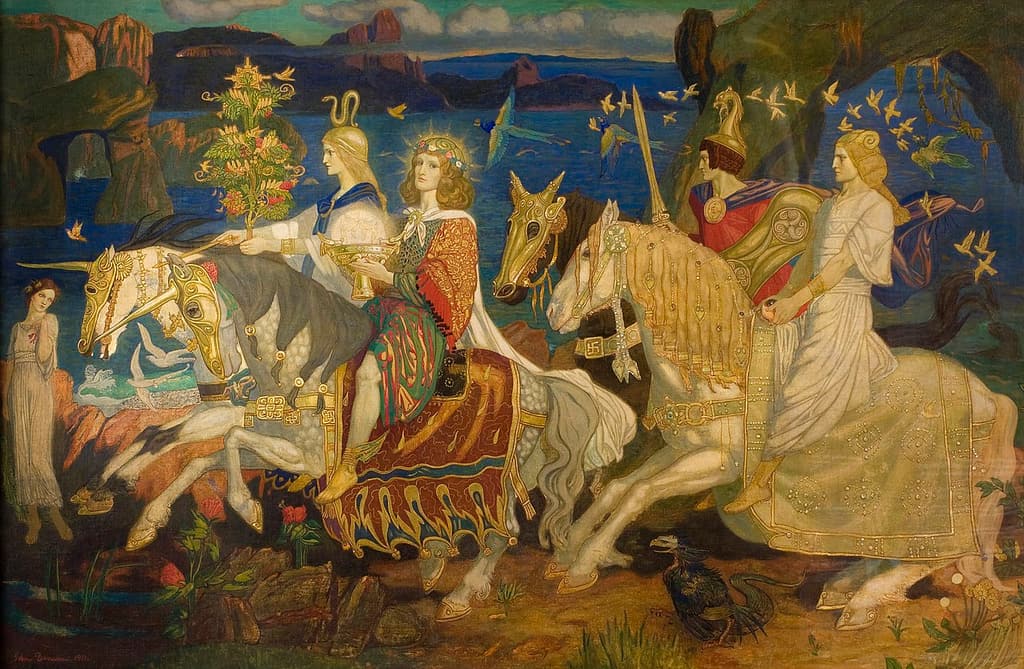
Celtic mythology is the hardest tradition on this site to write honestly, and the one where the most confident misinformation circulates. The reason is simple: the people who told these stories did not write them down, the people who did write them down were Christian monks working centuries later, and a great deal of what now passes for ancient Celtic religion was composed between 1890 and 1980.
Nobody wrote it down at the time
Classical authors describe the druids as forbidding their teaching to be committed to writing, requiring instead twenty years of memorisation. Whether or not that is precisely accurate, it matches the evidence: from the Iron Age Celtic world there are inscriptions, dedications and calendars, but no narrative texts. The Gaulish Coligny calendar is a bronze sheet of month names and ritual notations, not a story. The Gundestrup cauldron shows figures that are plainly religious and that nobody can securely identify.
What we have instead comes from two much later manuscript traditions, and they are separate literatures rather than two halves of one thing:
- Ireland. Monastic scribes from the eighth century onward wrote down an enormous body of material: the Lebor Gabála Érenn (Book of Invasions), constructing a pseudo-history of successive settlements of Ireland; the Mythological Cycle, concerning the Tuatha Dé Danann; the Ulster Cycle with the Táin Bó Cúailnge and Cú Chulainn at its centre; the Fenian Cycle around Finn mac Cumaill; and the Dindsenchas, explaining the origin of hundreds of place-names.
- Wales. A smaller, stranger, later corpus: the four branches of the Mabinogi, the tales collected with them, and the poems attributed to Taliesin. Different figures, different names, a different feel — Welsh material is not Irish material with a Welsh accent.
What the monks did to it
They preserved it, and they altered it, and both matter. The Tuatha Dé Danann — plainly gods in origin, given their names correspond to gods attested epigraphically in Gaul — are recast in the manuscripts as an earlier race of skilled people who invaded Ireland, were defeated by the Milesians, and retreated into the hollow hills. That is euhemerism: a device for keeping good stories while denying they are about gods. It is also, ironically, why the material survives at all, since a straightforwardly pagan text would probably not have been copied.
The scribes also inserted their own frame, fitting Irish pseudo-history into biblical chronology, giving the invaders descent from Noah, and occasionally adding a Christian saint to disapprove of the proceedings. Reading around that frame is the basic skill required for Irish material, and pages here mark where a detail belongs to the frame rather than the story.
Telling the Irish cycles apart
Irish material is conventionally sorted into four groups, and knowing which one a story belongs to tells you most of what you need about how to read it.
- The Mythological Cycle is where the gods are. The Tuatha Dé Danann arrive, fight the Fomorians at the two battles of Mag Tuired, and lose Ireland to the Milesians. Figures here — the Dagda, Lugh, Nuada, Brigid, the Morrígan — have divine functions and Continental cognates.
- The Ulster Cycle is heroic and aristocratic: chariots, single combat at fords, boasting matches over the champion's portion, and the Táin as its centrepiece. It preserves an Iron Age social world, though how faithfully is disputed.
- The Fenian Cycle follows Finn mac Cumaill and his roving warrior band outside settled society, in a landscape of hunting and the Otherworld. It is later in written form, was hugely popular for centuries, and supplied the eighteenth-century Ossian forgeries that shaped Europe's idea of Celticity.
- The Cycles of the Kings are quasi-historical tales attached to named dynasties, and are where sovereignty myth and political claim are most openly welded together.
What is actually known about druids
Less than any popular account implies. Classical writers — Caesar, Pliny, Tacitus — describe a learned class handling law, sacrifice, judgement and teaching, with the mistletoe-and-golden-sickle detail coming from a single passage of Pliny. Irish sources mention druí as magicians and advisers in a Christian narrative frame. There is no ancient source describing druidic doctrine from the inside, no druidic text, and no archaeological structure securely identifiable as a druid's. Modern druidry is an eighteenth-century revival movement with its own genuine history, and it is not a survival.
Gaul: the evidence that is not literary
Continental Celtic religion is known almost entirely from archaeology and Roman-era inscriptions, and it gives a very different picture from the Irish tales. Several hundred divine names are attested, mostly local, mostly known from a single dedication. Some are widespread: Lugus, whose name lies behind Lyon, Leiden and Carlisle's Roman name, and probably behind Irish Lugh; Epona, the horse goddess, unusually popular with the Roman cavalry and the one Celtic deity to receive an official festival in Rome; Cernunnos, antlered and cross-legged, named on exactly one monument in Paris; Sulis, whose hot spring at Bath produced a hoard of curse tablets in which ordinary people ask her to punish the theft of a cloak.
Caesar, describing Gaulish religion, uses Roman names throughout — a Gaulish Mercury, Apollo, Mars, Jupiter and Minerva — which tells us how a Roman general categorised what he saw and almost nothing about what the Gauls called them. Ritual sites and votive deposits show weapon offerings in water, head cults and shafts, and the bog bodies from Denmark to Cheshire suggest sacrificial killing whose meaning remains argued.
Recurring shapes rather than a pantheon
There is no Celtic pantheon in the sense that there is a Greek one, and any book presenting a tidy family tree of Celtic gods is presenting a modern construction. What genuinely recurs are shapes.
- Sovereignty as a goddess. Kingship is legitimated by union with a goddess of the land, who may appear as a hag transformed by the rightful king's acceptance. The motif runs from Irish tales into Arthurian romance and is one of the clearest structural features of the material.
- Triads. Deities appear in threes — the Morrígan's shifting triple identity, the three mothers of Gaulish and Rhineland reliefs — and triplication seems to intensify rather than multiply.
- The Otherworld as a neighbour. Not an afterlife above or below, but a parallel country reachable across water or through a mound, where time runs differently and a returning visitor may crumble to dust on touching home soil.
- Poets with power. The satire of a fili could raise blisters on a king's face and end his reign. Speech is a weapon in this literature to a degree unusual anywhere.
- Geasa. A hero carries personal prohibitions, often contradictory and often trivial-sounding, and his death arrives when circumstances force him to break one. Fate in Irish story works through etiquette rather than prophecy.
What is modern invention
This needs stating bluntly, because it fills the search results. The "Celtic tree calendar" and its assignment of trees to birth months was devised by Robert Graves in The White Goddess in 1948, and Graves was writing poetic argument, not history. The eightfold wheel of the year, in the form now standard in modern paganism, was assembled in the mid twentieth century from real but separately-attested Irish festivals and Germanic solstice observances. Most published "Celtic zodiacs", deity-and-crystal correspondence tables and Celtic-knot meaning charts date from the last fifty years.
Two of the four Irish quarter-days are securely ancient — Samhain and Beltane appear in early Irish sources, with Imbolc and Lughnasadh also attested — but what modern accounts say happened at them frequently is not. Where this site describes a festival, it names the medieval source; where a practice cannot be traced further back than a modern book, the page says whose book.
The Arthurian question
Arthurian legend grows out of Welsh material — Arthur appears in early Welsh poems and in Culhwch and Olwen as a very different, wilder figure — and then leaves it entirely. Geoffrey of Monmouth's twelfth-century History and the French romances that followed added Lancelot, the Grail and most of what people picture. It is medieval European literature building on a Celtic foundation, and this site treats the early Welsh Arthur as Celtic material and the romances as a later tradition that borrowed from it.
Where to start
Read the Táin Bó Cúailnge — Ciaran Carson's or Thomas Kinsella's translation — for an epic unlike any other in Europe: a cattle raid, a single teenage champion holding a ford, and a heroine whose argument with her husband about property starts a war. Then the four branches of the Mabinogi, which are short and genuinely strange. Then, for the Gaulish side, any museum catalogue of Romano-Celtic dedications, which will do more to correct romantic ideas about druids than any argument.
A practical warning about sources online: material about Celtic gods is unusually likely to have been copied from Victorian handbooks, from Graves, or from modern devotional writing, none of which distinguish between what a medieval manuscript says and what a nineteenth-century antiquarian wished it said. Checking whether a claim names a manuscript is the fastest available filter.
The Celtic family tree is necessarily the most heavily-annotated on this site, because Irish genealogies contradict each other freely and Welsh figures do not slot into Irish lines at all. Every Celtic page currently on the site is indexed below.
gods
- the Dagdaabundance, druidry, the club and cauldron
- the Morriganwar, fate, sovereignty
- Lughskill in every art, light, kingship
- Brigidpoetry, smithcraft, healing
- Nuadakingship, the silver arm, justice
- Danuthe ancestral mother of the gods, rivers, the land
- Dian Cechthealing, surgery, the well of restoration
- Ogmaeloquence, strength, the ogham script
- Manannan mac Lirthe sea, the otherworld, illusion
- Aenguslove, youth, poetic inspiration
- Boannthe river Boyne, inspiration, transgression
- Bresfailed kingship, inhospitality, the half-Fomorian
- the Tuatha De Danannthe divine race of Ireland, the four treasures, the sidhe mounds
- Rhiannonhorses, sovereignty, unjust punishment
- Bran the Blessedgiant kingship, the cauldron of rebirth, the severed head
- ArawnAnnwn, the otherworld hunt, hospitality
- Ceridwenthe cauldron of inspiration, transformation, awen
creatures
heros
- Cu Chulainnsingle combat, the warp-spasm, the geasa
- Queen Medbsovereignty, Connacht kingship, the cattle raid
- Fionn mac Cumhaillthe Fianna, hunting, wisdom from the salmon
- Oisinpoetry, Tir na nOg, the return that ages
- Diarmuid and Grainneelopement, the love spot, the fatal boar hunt
- Deirdreprophesied beauty, exile, betrayal
- Conchobar mac NessaUlster kingship, Emain Macha, the curse of Macha
- Scathachmartial training, the Gae Bolg, prophecy
- PwyllDyfed kingship, the otherworld exchange, honour
- Taliesinpoetry, rebirth, prophecy