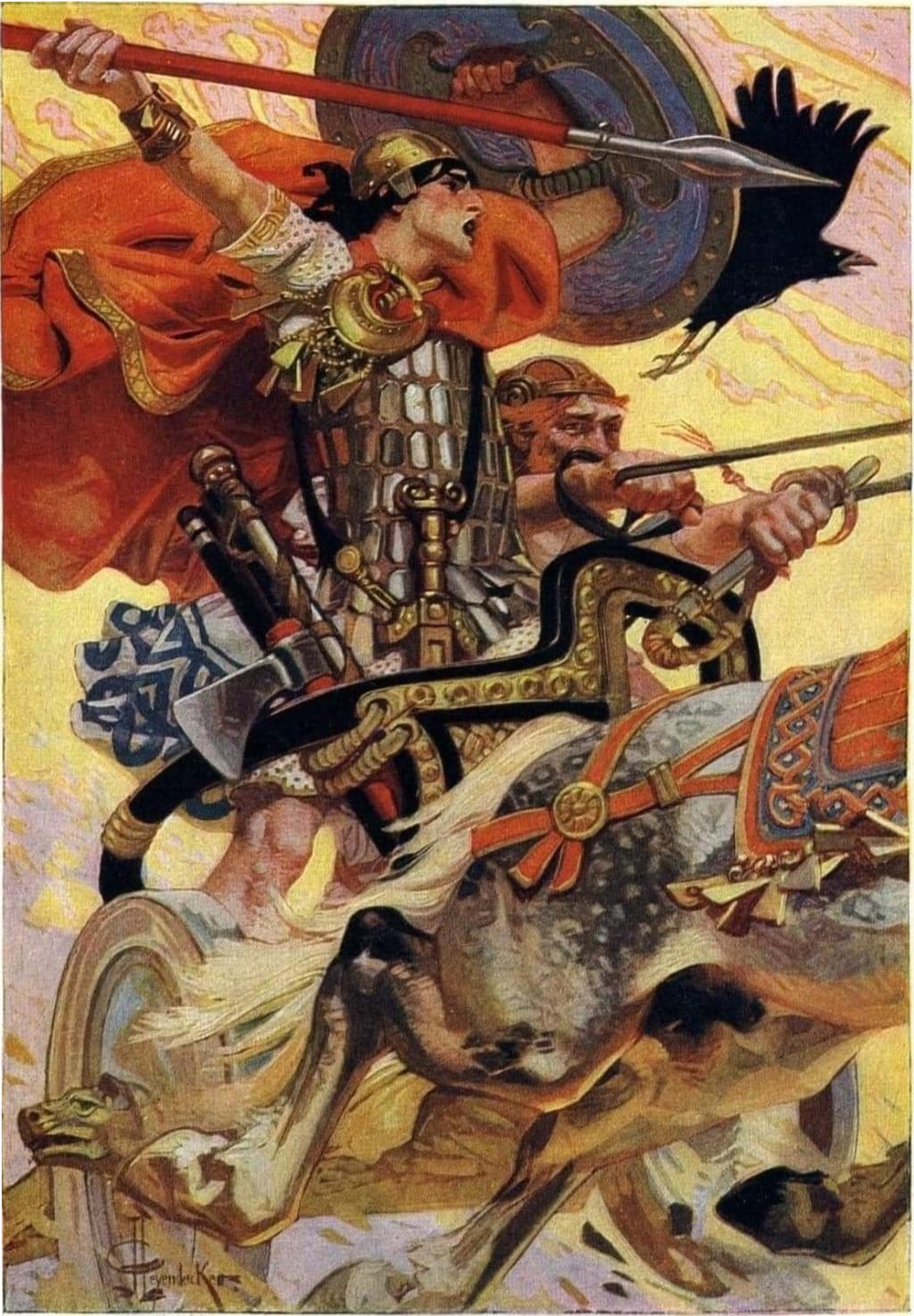
The scribe who finished copying the Táin Bó Cúailnge into the Book of Leinster in the twelfth century added a note in Latin at the end. He does not believe it, he says. Some of it is the trickery of demons, some is poetic invention, some is plausible, some is not, and some was put in to amuse idiots. Then he closes the book.
That colophon is the honest frame for Ireland's greatest hero. Everything we know about Cú Chulainn comes through monks who were preserving stories they were also disowning, and the disowning is written into the manuscripts.
Sétanta, and the dog he replaced
He is born Sétanta. His mother is Deichtine, sister or daughter of King Conchobar mac Nessa depending on the version, and Compert Con Culainn — the tale of his conception — does not settle on one father either. In one telling Lugh comes to Deichtine in a dream; in another she swallows a small creature in a drink; in another Conchobar himself is implicated. The text preserves the contradictions side by side rather than choosing, which is normal for this literature and unusual for a hero's birth story anywhere else.
The name arrives at about age six. The boy comes late to a feast at the house of Culann the smith, whose guard-dog has already been loosed, and kills it — in the standard version by driving a ball down its throat with his hurling stick. Culann is ruined without his hound, so the boy offers to guard the smith's property himself until a replacement can be reared. Hence Cú Chulainn, the Hound of Culann. He is a boy who accepts a debt and pays it with his own body, which is the shape of the whole life.
Cathbad the druid then says, on a particular day, that any youth taking up arms will be famous and short-lived. Cú Chulainn overhears, demands weapons, and breaks fifteen sets before Conchobar gives him his own. Nobody deceives him about the price. He is told the terms and takes them at seven years old.
Training under Scáthach, and the son
For his weapons training he crosses to Alba — Scotland — to Scáthach, a woman who runs a fortress-academy reached by a bridge that throws off anyone who steps on it wrongly. He gets across by the salmon leap. She teaches him the feats: the thunder-feat, the apple-feat, the rope-feat, the chariot-feat, and above all the Gáe Bolg, the barbed spear cast with the foot, which she gives to him and nobody else.
While there he fathers a son on Aífe, Scáthach's rival, leaving a token and a set of prohibitions. Years later a boy comes to Ulster who will not give his name, because his father forbade it. Cú Chulainn kills him, learns who he is as he dies, and the tale ends with Ulster's champion mourning over a child whose only fault was obeying him. Aided Óenfhir Aífe is one of the oldest and bleakest things in the cycle, and it makes plain that the geis system — the personal prohibitions that bind every important figure here — is not a magic power. It is a trap that goes off eventually.
The winter at the ford
The Táin works because everyone else is disabled. The men of Ulster fall into the ces noínden, the pangs of Macha, whenever the province is threatened — a curse laid by a pregnant woman forced to race the king's horses, whose story is told alongside the Morrígan's other faces. Cú Chulainn, being partly of the Tuatha Dé, is exempt.
So a seventeen-year-old holds the border against the army of Medb alone, using the convention of single combat at a ford as a delaying mechanism: one champion a day, and the army does not advance while a fight is pending. He kills them in sequence for months. The Táin is not a battle narrative, it is a siege told as an appointment book, and its most famous passages are the interruptions — the boyhood deeds told to Medb by men who knew him, the chariot inventories, the roll-call of the enemy dead.
The fight with Ferdiad, his foster-brother from Scáthach's school, is the emotional centre and is also the clearest case of the manuscripts disagreeing with each other. The earlier recension gives it comparatively briefly; the Book of Leinster expands it into three days of combat with the two men exchanging healing herbs and food across the ford each night, until Cú Chulainn calls for the Gáe Bolg down the water and then carries the body north himself, lamenting in verse. Anyone quoting "the Táin says" about this episode is quoting one manuscript tradition rather than a single fixed text.
The ríastrad, and why it is not a berserk rage
His battle transformation is described at length and it is not fury. It is anatomical distortion. The body revolves inside its own skin; the feet and knees reverse; one eye is sucked back into the skull while the other stands out on the cheek; the mouth opens to the ear; the hair bristles with a drop of blood at the point of every strand; a column of dark blood rises from the crown of the head, and beside it the lúan láith, the hero's light or hero's moon. Afterwards he must be cooled in three successive vats of water, the first of which bursts.
Thomas Kinsella's 1969 translation coined "warp-spasm" for ríastrad, and the phrase has since been repeated so often that people take it for the Irish word. Ciaran Carson's 2007 version chose "torque". The underlying noun means something like a distortion or twisting. Whatever it is, it is closer to a body horror set piece than to a Norse berserker's rage, and the text treats it as monstrous rather than admirable: women and boys are sent out naked to shame him back into human shape before he wrecks his own city.
Emer, Fand, and the deaths
Tochmarc Emire, the wooing of Emer, has him win his wife through a riddling conversation in a private register her father cannot follow, then earn her by the trip to Scáthach. Serglige Con Culainn — his wasting sickness — sends him into the otherworld to Fand, wife of Manannán, and ends with Emer's jealousy, a reconciliation, and both couples drinking a draught of forgetting. It is the one text in which he is genuinely helpless, and it is the one in which the women get the arguments.
His death, Aided Con Culainn, is engineered rather than fought. The children of Calatín, satirists trained abroad for the purpose, manoeuvre him into breaking his personal prohibitions: he may not refuse hospitality, and he may not eat dog. Old women roasting a hound by the roadside offer him a share, and the hand that takes it withers. Weakened, wounded, with his entrails out, he ties himself to a standing pillar with his belt so that he will die upright. The enemy will not approach until a crow settles on his shoulder. A pillar-stone at Clochafarmore in County Louth has been pointed out as the place since the nineteenth century, on no ancient authority.
Two claims to Cú Chulainn in the twentieth century
Oliver Sheppard sculpted a bronze of the dying hound-lashed hero in 1911. In 1935 Éamon de Valera had it installed in the General Post Office in Dublin as the memorial to the 1916 Rising, and it appeared on Irish coinage and stamps: the man who fights alone against an empire, dying on his feet. That reading is entirely political and entirely modern; the medieval texts are about a boy who is told the price and pays it, not about a nation.
The same figure was then claimed from the opposite direction. Loyalist murals in Belfast from the 1980s onward show Cú Chulainn as the defender of Ulster against invaders from the south — which is, awkwardly for everyone, what the Táin actually describes. A hero appropriated by both sides of the same conflict, on opposite readings of the same story, is a good demonstration of why the Celtic tradition hub insists on dating every layer. Beyond Ireland his largest modern audience is Japanese: the Fate franchise has made "Cú Chulainn" a recognisable name to millions of people who have never heard of Ulster, complete with the Gáe Bolg and a rune-based magic system with no Irish source whatever.
Why does he never become king?
The cycle keeps him structurally outside kingship. He is the champion of a province he does not rule, attached to Conchobar's court but not in the line of succession, and his divine parentage points to Lugh rather than to the royal house. The Ulster tales are precise about the difference between the man who holds the border and the man who holds the throne, and that separation is exactly what Fionn mac Cumhaill inherits in the later Fenian material, where the warrior band operates alongside the king rather than within him.
How old is the language of the Táin?
Older than the manuscripts that carry it. Recension I survives in the eleventh-century Lebor na hUidre and the fourteenth-century Yellow Book of Lecan, but linguists reading its verse passages find Old Irish forms consistent with an eighth-century composition, with later prose layered around them. That is the usual pattern: the poetry is the oldest stratum, because verse resists modernisation while prose gets quietly updated by every copyist.
Is there anything archaeological behind Emain Macha?
Yes, and it is strange. Navan Fort in County Armagh, the site the texts call Emain Macha, contained an enormous circular timber structure built around 95 BCE from a single felling season of oak, which was then deliberately filled with limestone cairn material, burnt, and covered with a mound — built to be destroyed. The tales set at Emain Macha were written down more than a millennium after that happened. The site is real; the continuity between the ritual and the stories is not demonstrable.