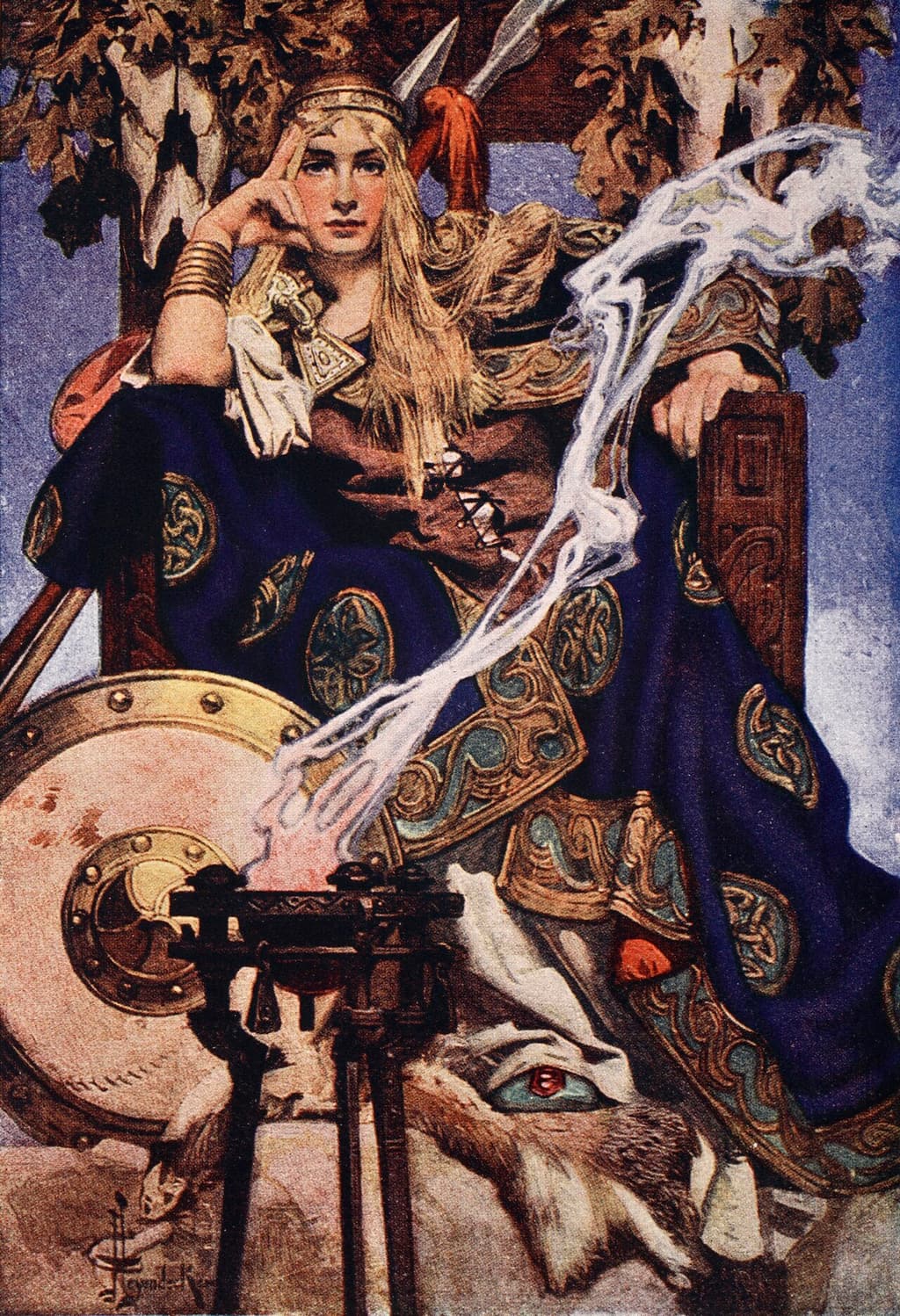
The longest epic in Irish literature is set in motion by a couple lying in bed arguing about money. Ailill and Medb of Connacht compare what each brought to the marriage — cups, rings, herds, chariots, clothing — and everything matches, item for item, until they reach the cattle. Ailill has a bull, Finnbennach, which had been born into Medb's herd and moved itself over to his, because it would not be under a woman's control.
She has nothing to set against it, and that is intolerable. So she sends messengers to Ulster to hire the Donn Cúailnge for a year, the negotiation collapses when her envoys get drunk and boast that they would have taken the bull by force anyway, and four provinces go to war over a comparison of possessions. The Cattle Raid of Cooley is what happens next.
The name is an argument in itself
Medb derives from the same root as mead and means something like "she who intoxicates". That is not a poetic flourish; it points at a specific institution. Irish kingship was conferred in a rite the texts call the banais rígi, the wedding-feast of kingship, in which a woman representing the territory gives the candidate a drink. A queen whose name means the intoxicating one, who tells her husband to his face that she was never without one man in another's shadow, and whose consent to a man is what makes him king of Connacht, is standing where that goddess stands.
There is a second Medb who makes the case stronger. Medb Lethderg, associated with Tara rather than Cruachan, is said to have been the partner of a series of kings, and a man was not king of Tara until he had been with her. Two Medbs, two royal sites, the same function.
Whether this makes the Connacht Medb a euhemerised sovereignty goddess or a literary queen constructed from a familiar template is one of the standing arguments in Irish studies. The Táin itself shows no awareness of her divinity. It treats her as a formidable, vain, capable and politically ruthless human ruler, and reads perfectly well that way.
What she is actually like in the text
She is not a warrior queen in the Boudica sense, though she fights. She is a commander and a negotiator, and the Táin is largely a record of her deal-making. Her standard offer to a man she needs to send against Cú Chulainn is a package: land, a chariot, her daughter Findabair in marriage, and her own "friendly thighs". She makes it repeatedly, to men who die one after another, and Findabair — promised to so many that the arrangement becomes public — dies of shame when she learns how often she has been sold.
Medb's stated requirements in a husband are given in her own voice and are worth noting as a piece of characterisation: a man without meanness, without fear and without jealousy, the last because she would never be without a lover on the side and could not have a jealous man reacting to it. She then explains that she pays the province's dues out of her own resources, so any husband is her dependent.
The narrative punishes her, but it does not simplify her. When her army finally breaks and runs, she is caught by her own menstrual flow and has to ask for a pause; Cú Chulainn finds her defenceless and lets her go, because he does not kill women. The episode gives its name to a place, in the way this literature always does, and it is the one moment where she has no move to make.
Cheese, and the death nobody expects
Her end is recorded outside the Táin. Furbaide Ferbend, whose mother Clothru she had killed, practised with a sling until he could hit an object at a fixed distance, then killed Medb while she was bathing in a pool on Inis Clothrann in Lough Ree — with, in the standard version, a piece of hardened cheese.
It is not a joke at her expense so much as a demonstration of the tradition's habit of ending enormous figures with something small and specific. It also completes a family cycle: she killed her sister; her sister's son killed her.
Two piles of stones, three thousand years apart
Cruachan, now Rathcroghan in County Roscommon, is her capital in the texts and is a genuine and enormous archaeological landscape — a ceremonial complex of mounds, enclosures and linear earthworks spread over several square kilometres, in use across a very long span. It includes Oweynagat, a souterrain and natural cave which medieval texts call a door of the otherworld and from which destructive creatures emerge at Samhain. That association is medieval and textual, not modern invention.
Knocknarea in County Sligo is different. The vast unexcavated cairn on its summit, Miosgán Médhbh, is popularly said to be her grave, with the queen buried upright in armour facing her enemies in Ulster. The cairn is Neolithic, built around 3000 BCE, and the burial-upright tradition is not recorded before the modern period. It is a fine story about a real monument and it is not archaeology. Visitors are asked not to add stones to it, because the erosion is real too.
Queen Mab, and the pound note
Two afterlives, one dubious and one documented.
The dubious one is Shakespeare's Queen Mab, the tiny fairy of Mercutio's speech in Romeo and Juliet, routinely described as a diminished Medb. The names resemble each other in English spelling and the derivation has been argued, but it is not established; competing explanations draw on English fairy tradition and on ordinary name forms, and the fairy queen of the speech has nothing of Medb about her but the syllable.
The documented one: from 1977 the Irish one-pound note carried her portrait, with a background taken from the Táin itself and a reverse drawn from Lebor na hUidre, the manuscript that preserves the oldest recension. A state that had spent the previous half-century arguing about which past to claim put the woman who invaded Ulster over a bull on its smallest banknote.
The name has since become a genuinely popular given name in the anglicised form Maeve, particularly in Ireland and North America — one of the few Irish mythological names to make that transition without needing a spelling change. Name histories traces that separately. The rest of the cast she fights against is set out at the Celtic tradition hub.
Is she the villain of the Táin?
The text is less certain about that than modern summaries are. She starts an unjust war for a possession, breaks the terms of single combat, and manipulates men into dying for her — but the Táin also gives the Ulstermen a king who abducted Deirdre and broke his sureties, and Cú Chulainn's own record is not clean. The narrative is interested in the mechanics of honour and obligation rather than in assigning blame, and the closest thing to a moral verdict comes from the two bulls, who fight each other to death and leave everyone with nothing.
What is the pillow talk scene actually doing structurally?
It is establishing property law. Under early Irish marriage arrangements the relative wealth each partner brought determined authority within the household, and a wife of equal or greater property held a correspondingly strong position. Medb's insistence on matching Ailill item for item is not vanity but a legal claim, which is why one bull can destabilise a marriage and, through it, a province. Audiences who knew the law heard a jurisdictional dispute, not a squabble.
How different is she between the two recensions of the Táin?
Noticeably. The earlier recension is terser and gives her less speech; the Book of Leinster version expands her dialogue, sharpens her exchanges with Fergus, and adds much of the material that makes her quotable. Modern popular retellings almost always draw on the later, more literary version, which means the Medb most readers know is the twelfth-century redactor's Medb rather than the oldest one available.