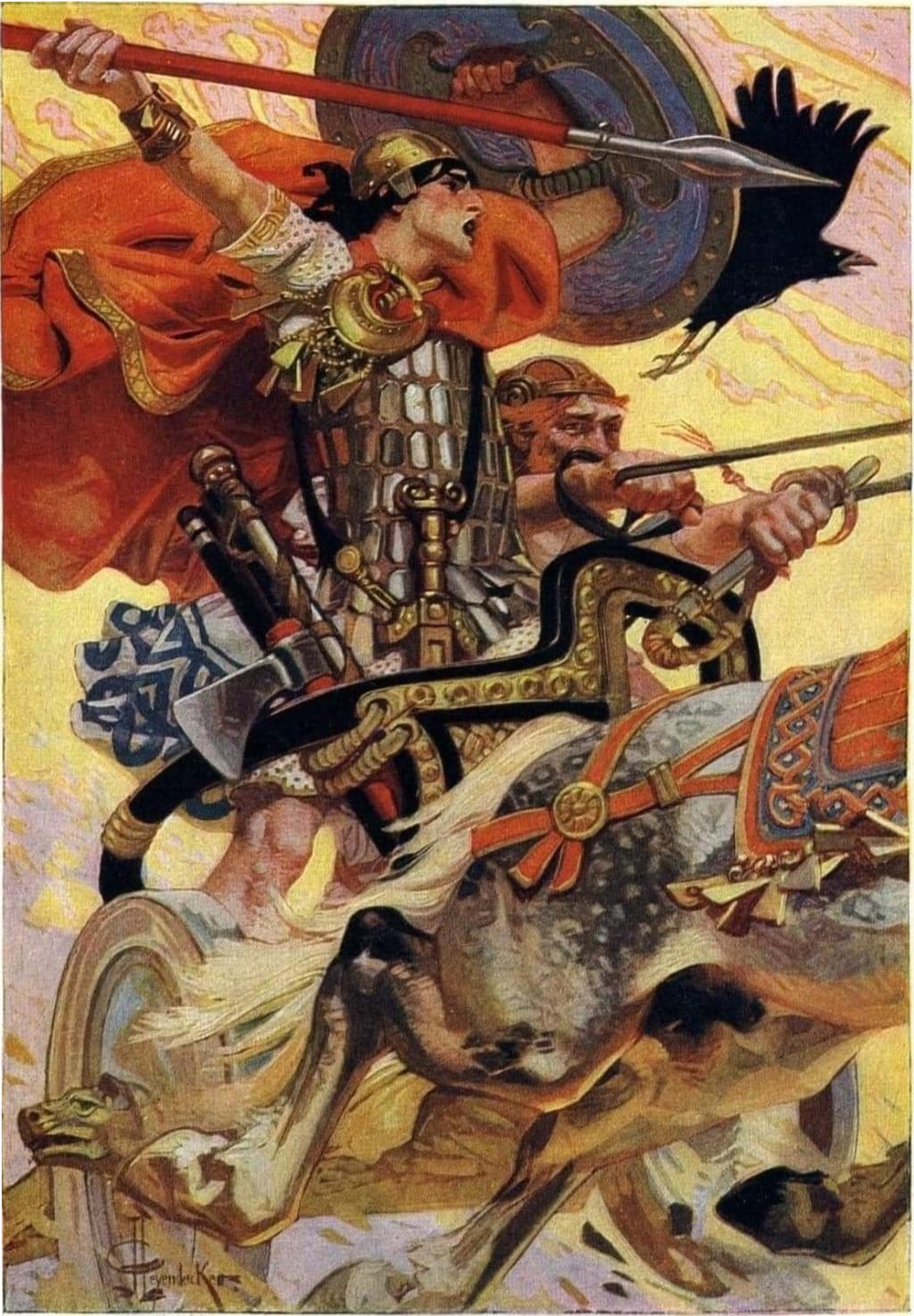
Ireland's longest heroic tale starts with a married couple in bed, competitively listing their possessions. It ends with two bulls tearing each other apart across the whole island. In between, an army of four provinces is held up for an entire winter by one adolescent, because everyone else is in labour.
The argument about the bulls
At Cruachan in Connacht, Medb and her husband Ailill fall into the kind of quarrel that begins as flirtation. He remarks that she is better off than she was the day he married her; she takes exception, and they send servants out to fetch and count everything they own. Basins, rings, vats, brooches, horses, flocks, herds — matched item for item, all night, until one animal is left over on his side. A bull called Finnbennach, the White-Horned. It had been born into her herd, and had refused to remain the property of a woman, and had walked itself across to her husband's cattle.
Medb will not be short by one bull. The only beast in Ireland to match it is Donn Cúailnge, the Brown Bull of Cooley, in the Ulster kingdom of Conchobar. She sends envoys to its owner, Dáire mac Fiachna, offering a year's loan of the animal for fifty yearling heifers, a chariot, land and, if he wants it, her own friendship in bed. He agrees delightedly and puts on a feast. Then one of her messengers, drunk, says within earshot that it is just as well Dáire agreed, since otherwise they would simply have taken it. In the morning the deal is off, and the war is on.
Why nobody in Ulster can stand up
The army Medb raises includes contingents from every province, and — this is the detail that makes the whole thing possible — a body of Ulster exiles under Fergus mac Róich, who left after Conchobar's treachery in the affair of Deirdre and the sons of Uisliu, and who is now guiding an invasion of his own country while quietly steering it wrong.
Ulster cannot fight, because Ulster is under the ces noínden, the debility of the men of Ulster. Its origin is a short and vicious tale set generations earlier: a farmer named Crunniuc boasts at an assembly that his wife can outrun the king's chariot horses. The wife, Macha, is heavily pregnant and begs to be excused; the king says the boast will cost her husband his head; she runs and wins, gives birth to twins at the finishing line, and curses the watching men of Ulster to suffer the pains of a woman in childbed for five days and four nights, at every moment of their greatest need, for nine generations. The royal seat is called Emain Macha, the Twins of Macha, after her.
One man is exempt. Cú Chulainn is seventeen, is the son of the god Lugh, and does not fall under the curse. So the defence of the province is his alone.
One ford at a time
He does not fight the army; he fights its individuals. He invokes the ancient convention of single combat at fords and holds Medb's advance to the pace of one champion killed per day, whittling her force down while Ulster lies groaning in its beds. When the convention is broken he responds with a sling, and the sling is more dangerous than the sword — he kills Medb's pet bird and squirrel off her shoulders as a warning, and drops men from a distance the story clearly considers unsporting.
Woven through the march are the macgnímrada, the boyhood deeds, told by Fergus and other exiles to a Connacht army that wants to know what it has walked into. This is where the famous material sits: the small boy who beats the boy-troop of Emain Macha single-handed on his first day; the child who kills the smith Culann's monstrous hound in self-defence and offers to guard the house himself until a replacement is reared, and so acquires the name Culann's Hound; the boy who overhears the druid Cathbad say that whoever takes up arms on that day will be famous for ever and short-lived, and goes straight to the king for a spear.
The war-goddess makes her approach in the middle of it. The Morrígan comes to him as a young woman offering herself, is turned down flatly at the worst possible moment, and promises to be there when he is fighting. She attacks him in the water as an eel round his legs, on the bank as a she-wolf driving cattle at him, and in the herd as a hornless red heifer — and he wounds her three times. Later an old woman milking a cow with three teats offers him three drinks, and he blesses her for each, and each blessing heals one of the wounds he gave her. Neither of them ever says what has happened.
Fer Diad at the ford
The centre of the poem is not a battle but a killing between friends. Medb finds Fer Diad, who trained alongside Cú Chulainn under Scáthach in Scotland, who is his foster-brother in every sense that matters, and who has fought beside him with the same weapons. She offers land, her daughter Finnabair, and treasure; he refuses; she has the satirists threaten to compose against him, which in this culture is a threat of disfigurement and social death. He goes.
They fight for three days. Each evening they stop, throw their weapons to the same attendants, and the men embrace; healing herbs are sent across the ford from Cú Chulainn's side, and food and drink from Fer Diad's, and their horses share a paddock and their charioteers share a fire. On the last day the courtesy is gone. They fight in the water, and Cú Chulainn calls for the gáe bolg — the barbed weapon sent downstream and driven up with the foot, which enters as one point and opens inside the body. Fer Diad dies in his arms, and the lament that follows is the finest thing in early Irish literature, a hundred lines of a man explaining that everything before yesterday was play.
The distortion, and the end
Wounded past use, Cú Chulainn is visited by a warrior in strange armour who fights in his place for three days while he sleeps — his father Lug, appearing exactly once and saying almost nothing. In his absence the boy-troop of Emain Macha, none of them grown, march out and are killed to the last child. He wakes, hears it, and undergoes the ríastrad: the warp-spasm, in which his body turns inside its own skin, one eye sucked into his skull and the other forced out onto his cheek, his hair standing in spikes with a drop of blood at each point, and a column of dark blood rising from his crown. What follows is not combat but a mowing, and the field is named for the number of dead.
Ulster's men finally rise and the armies meet at Gáirech. Fergus, honouring an old bargain, forces Conchobar to give ground and then turns aside and strikes the tops off three hills rather than kill his own king. Medb, unluckily timed, has to withdraw behind her army for reasons the text states with unusual bluntness, and Cú Chulainn, who has her at his mercy, lets her go, saying he does not kill women.
She does get the bull. Donn Cúailnge is taken to Connacht, meets Finnbennach, and the two fight for a day and a night across Ireland, and the Brown Bull wins — carrying pieces of the White-Horned on its horns and dropping them as it goes, which is how a series of Irish places got their names. Then it turns for home, reaches Cooley, and its heart bursts. The war has been fought to a draw over two animals that are now both dead.
The manuscripts, and the scribe who didn't believe it
The Táin survives in three recensions. Recension I, in the Lebor na hUidre (the Book of the Dun Cow, around 1100) completed from the Yellow Book of Lecan, is visibly stitched together from more than one exemplar — it repeats episodes, contradicts itself, and switches between Old and Middle Irish, which is why linguists date parts of its core to the eighth century or earlier. Recension II, in the twelfth-century Book of Leinster, is smoother, longer, more rhetorical and more consciously literary; the pillow talk that opens this account is its contribution. Recension III survives only in fragments.
The Book of Leinster copy ends with a Latin colophon from the scribe, and it is one of the most quotable things in Irish manuscript studies: he blesses everyone who has memorised the text faithfully, and then adds that he himself who has written it out gives no credit at all to this story, or rather this fiction — some of it being the trickery of demons, some poetic invention, some plausible, some not, and some designed for the entertainment of fools. A Christian cleric preserved the great pagan epic of his nation, and left a note saying he thought it was nonsense.
A cluster of remscéla, foretales, explains things the main text takes for granted: why Fergus is in exile, and where the bulls came from — the latter in De Chophur in Dá Muccida, in which they are two rival swineherds of the síde who have already fought each other through a sequence of shapes as birds, sea creatures, stags and warriors, and have arrived at bulls as the latest round.
Questions people ask after reading it
Is this a window on the Iron Age?
That was the standard view for most of the twentieth century, associated with Kenneth Jackson: chariot warfare, head-hunting, cattle as wealth and single combat at fords looked like a description of a Celtic society matching what classical authors said about Gaul, preserved orally for a thousand years. It has been under sustained attack since the 1950s. James Carney, and later Kim McCone and others, argued that the texts are the work of Christian monastic scholars steeped in Latin epic, that the "archaic" material is often deliberate literary archaism, and that the society described fits early medieval Ireland better than the Iron Age. The dispute is genuinely open; most working scholars now hold some middle position, and anyone who tells you it is settled is choosing a side.
Did Medb exist?
Almost certainly not as a queen of Connacht in the first century. Her name means something like "she who intoxicates", the same root as mead, and one influential line of argument sees behind her a sovereignty figure — a personification of kingship whom a would-be king symbolically marries, which would explain why she has so many husbands and why the text is so preoccupied with who is entitled to what through her. The cairn on the summit of Knocknarea in Sligo is called Medb's tomb; it is a Neolithic monument some three thousand years older than the story attached to it.
Why is Cú Chulainn on a statue in the Dublin GPO?
Oliver Sheppard's bronze The Death of Cúchulainn, modelled around 1911 and installed in the General Post Office in 1935, shows the hero lashed upright to a pillar with the Morrígan's raven on his shoulder — the death scene from a different tale, not the Táin. It became the memorial to the 1916 Rising. It is also, awkwardly for everyone, claimed as an emblem by Ulster loyalist muralists who read him as an Ulsterman defending his province against an invasion from the south. Both readings are available in the text, which is a fairly precise illustration of what happens when a nation uses a medieval manuscript as a flag.
What should I read?
Thomas Kinsella's 1969 version, illustrated with Louis le Brocquy's brush drawings, is the one that put the tale back into general circulation; it follows Recension I and imports the pillow talk. Ciaran Carson's 2007 translation is brisker and funnier. Cecile O'Rahilly's parallel-text editions of both recensions are the scholarly standard. Lady Gregory's Cuchulain of Muirthemne of 1902 reads beautifully and quietly removes everything Victorian readers would have objected to.
The two translations named above
Both give the tale as a continuous narrative; the section above sets out what each one does with the recensions.
- The Táin, translated by Thomas Kinsella
The 1969 version illustrated by Louis le Brocquy — the translation that put the tale back into general circulation, following Recension I.
- The Táin, translated by Ciaran Carson
The 2007 translation, brisker and funnier, by a poet who kept the strangeness instead of smoothing it out.
As an Amazon Associate we earn from qualifying purchases made through these links, at no extra cost to you.