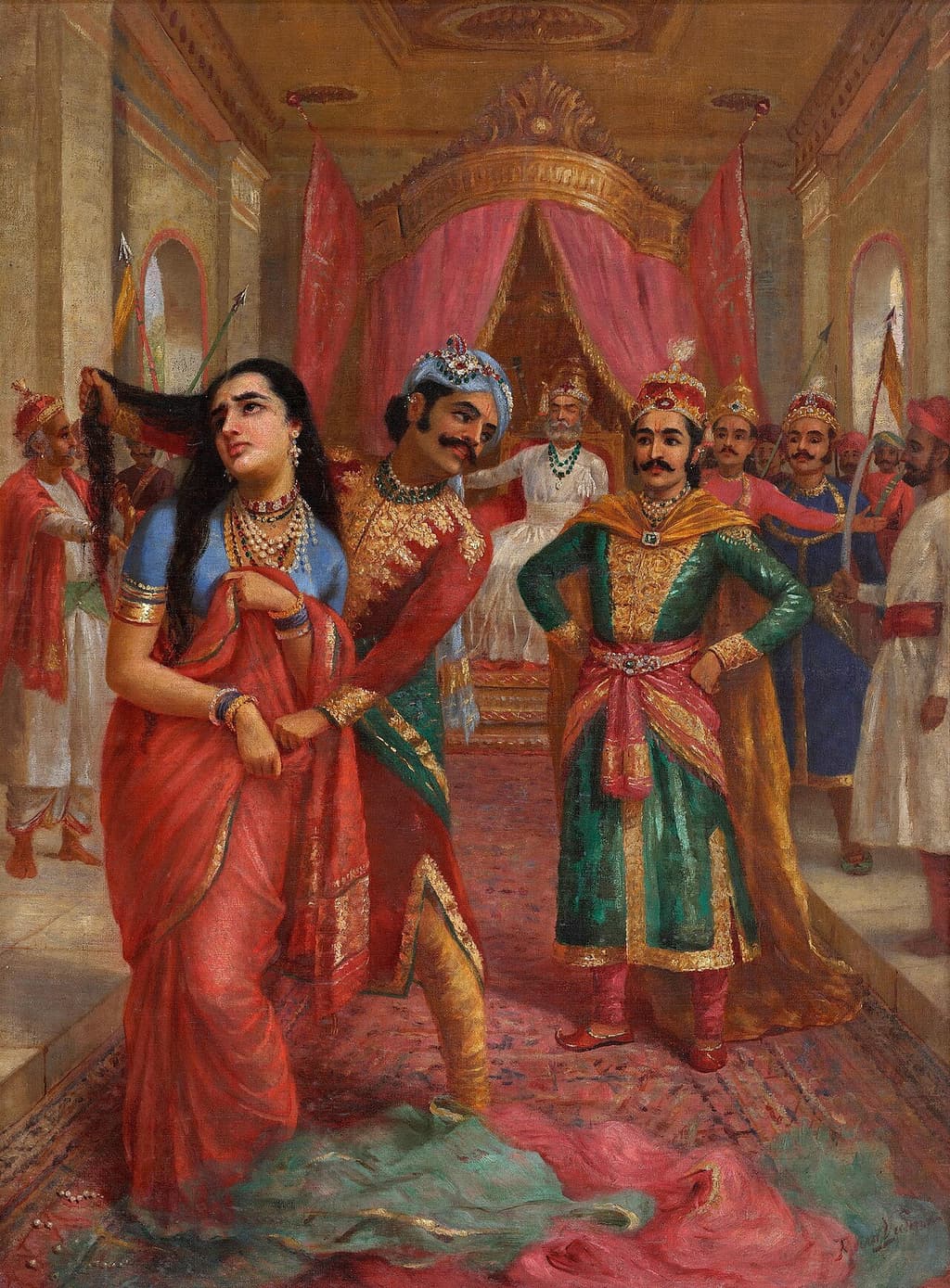
A woman in a hall full of the most eminent men of her age asks a legal question, and not one of them can answer it. That is the engine of the world's longest poem. Everything before the dice game is preparation and everything after it is consequence, and the war that kills almost every named character in the book proceeds from an unresolved point of property law.
What is at stake before anyone rolls
The Kuru realm has two sets of cousins. Dhritarashtra, born blind, was passed over for the throne in favour of his younger brother Pandu, and inherited it anyway when Pandu died young. Pandu's five sons — Yudhishthira, Bhima, Arjuna and the twins Nakula and Sahadeva — grew up alongside Dhritarashtra's hundred, of whom Duryodhana is the eldest and the only one who really matters.
The kingdom had already been split once to keep the peace. The Pandavas took the wilder half and built a capital, Indraprastha, and performed the imperial rajasuya consecration, which is a formal declaration of paramountcy. Duryodhana came to it, walked through their new hall of illusions, mistook a polished floor for water and a pool for a floor, and went in up to his neck in front of everyone.
(Popular retellings, and the great television versions, have Draupadi laugh at him from a balcony and call him a blind man's blind son. That line is not in the Sanskrit critical edition, where it is her husbands and the servants who laugh. It has nonetheless become, in the popular imagination, the cause of everything — which is worth noticing, because it relocates the blame from a man's humiliation to a woman's mockery.)
Duryodhana went home wanting the whole thing, and his mother's brother Shakuni — who is the best dice player alive and, in most tellings, cheats — proposed a game. Dhritarashtra, who could never refuse his son anything, sent the invitation.
Losing everything, in order
Yudhishthira has two relevant characteristics: he is incapable of lying, and he cannot resist a game of dice. He also cannot refuse a formal challenge without dishonour. So he came to Hastinapura and sat down opposite Shakuni.
The staking is done as an inventory, and the Mahabharata recites it at length because the accumulation is the horror. Pearls and gold. Chariots. A thousand elephants. Herds, slaves, the treasury, the army. Then the kingdom itself. Then — with the hall now completely silent — his brothers, one at a time, starting with Nakula and ending with Arjuna. Then himself.
Then Shakuni observed, quite gently, that there was one thing left that he had not yet staked, and named her.
He staked his wife, and lost.
The question
Duhshasana was sent to fetch her. She was in the women's quarters, secluded, in her monthly period, wearing a single cloth, and her answer to the summons was not a plea but a query: had her husband lost himself before he staked her? Because if he had, he was already property when he wagered her, and property cannot own a wife, and the stake was void.
Duhshasana's response was to drag her into the assembly hall by the hair.
She put the question again, standing on the floor of the hall, to the elders. And the Mahabharata does something that almost no epic anywhere does: it lets the question stand. Bhishma, the grandfather of the house and the greatest living authority on right conduct, answers that the way of dharma is subtle, that a man without freedom cannot stake anything, that a wife is nonetheless under her husband's authority, and that he therefore cannot resolve it. That is the most senior moral voice in the poem admitting, on the record, that he does not know.
One of Duryodhana's own brothers, Vikarna, speaks up for her and is shouted down. Karna — whose grievances against the Pandavas are real and lifelong — settles the matter by declaring that a woman with five husbands is a whore, that the assembly need not treat her as a wife, and that the losers and their possessions may be stripped of their clothing.
The brothers begin removing their upper garments in submission. Duhshasana takes hold of Draupadi's cloth.
(Here the versions diverge in a way that matters. The endless sari — the miracle in which the cloth she is wearing is replaced faster than it can be pulled away, until Duhshasana collapses exhausted beside a mountain of fabric — is absent from the Pune critical edition and is regarded by its editors as a later interpolation. In the critical text her appeal is answered without the extended miracle. Almost every modern retelling, every calendar print and every screen version uses the miracle, and it changes the scene fundamentally: with the miracle, God intervenes and the assembly's failure is covered over; without it, nobody comes, and a woman is assaulted in a room full of the finest men in the world while they look at the floor.)
Bhima, restrained by his elder brother, swears aloud that he will break Duhshasana's chest open and drink his blood. Duryodhana, to finish the display, bares his left thigh to her and slaps it, and Bhima swears he will smash it.
The reversal, and the second game
Then jackals begin howling in the king's fire-chamber, and donkeys bray, and the old blind man is frightened enough by the omens to intervene. He calls Draupadi over and offers her a boon. She asks that Yudhishthira be freed, so that her son will not be the son of a slave. Offered a second, she asks freedom for the other four and their weapons. Offered a third, she refuses it — the rule for a woman of her rank being two — and the property is restored.
They leave. And Duryodhana, watching his advantage evaporate, persuades his father to call them back for a single throw with a different stake: the losers go into exile for twelve years, then live one further year in disguise, and if they are recognised during that thirteenth year, the whole term begins again.
Yudhishthira, who has learned nothing whatsoever, plays and loses.
Thirteen years, then eighteen days
The exile occupies two enormous books. The incognito year is spent in the court of Virata with the five brothers in absurd disguises — Arjuna, the greatest archer of the age, teaching dance to the princess as a eunuch — and Draupadi as a queen's hairdresser, in which capacity she is harassed by the queen's brother and Bhima kills him in the dark.
They come back and ask for their kingdom. Krishna goes to Hastinapura as an envoy and asks for five villages, one for each brother. Duryodhana says he will not concede land the width of a needle's point.
Eighteen armies gather at Kurukshetra, eleven on one side and seven on the other, and on the first morning Arjuna asks to be driven into the space between them, looks at his cousins and his teachers and his grandfather, and puts down his bow. What Krishna says to him next occupies seven hundred verses and became, on its own, the most widely read Hindu scripture in the world.
Then the fighting, which lasts eighteen days, and in which every one of the war's conventions is broken by somebody:
- Bhishma cannot be killed while he holds a weapon, and will not raise one against a woman, so Arjuna shoots him from behind Shikhandi and he falls on a bed of arrows, where he lies for weeks giving instruction before choosing to die.
- Drona is stopped only when Yudhishthira, who has never lied, says that Ashvatthama is dead and then adds inaudibly that he means the elephant. His chariot, which the poem says had never touched the earth, comes down.
- Abhimanyu, sixteen, knows how to break into a spiral formation and not how to get out, and is killed inside it by six men at once.
- Karna's chariot wheel sticks in the ground, and he is shot while lifting it, unarmed, after invoking the rule he has broken himself.
- Duryodhana is beaten in a mace duel by a strike below the waist, which is illegal, delivered because of a vow made in the dice hall thirteen years earlier.
And the day after the victory, Ashvatthama enters the sleeping camp at night and kills everyone in it, including Draupadi's five sons, and then aims a weapon of last resort at the womb of the last pregnant woman of the line. The child, Parikshit, is revived, and the dynasty survives by exactly one heartbeat. Draupadi, who has won, has no sons; Gandhari, who has lost, has none either.
The text, and how it grew
The Mahabharata is around a hundred thousand verses in its vulgate form, roughly four times the Iliad and Odyssey combined. The critical edition prepared at the Bhandarkar Oriental Research Institute in Pune between 1919 and 1966, under V. S. Sukthankar and his successors, worked from over a thousand manuscripts and produced a reconstructed text of about seventy-four thousand verses — the difference being the measure of how much the epic accumulated.
The text itself describes its own growth, naming a shorter core called Jaya and an intermediate Bharata. Modern scholarship generally places composition across a long span from roughly the fourth century BCE to the fourth century CE, with the didactic books, the Bhagavad Gita's present form and much of the Krishna theology belonging to later layers than the war narrative.
Where the disputes actually are
- Draupadi's five husbands. The epic is visibly uncomfortable with polyandry and supplies a justification after the fact: Kunti, without looking, tells her sons to share whatever they have brought home. Yudhishthira then argues that a mother's word cannot be broken. Whether this reflects an actual practice in some community, or a narrative fossil the redactors could not remove, is unresolved and much debated.
- Did the war happen? Indian tradition dates it to the beginning of the Kali Yuga, conventionally 3102 BCE. Archaeological work at Hastinapura and other named sites, associated with B. B. Lal from the 1950s, links them to the Painted Grey Ware culture of roughly the early first millennium BCE. There is no inscriptional or material evidence for the war itself. That a dynastic conflict of some kind lies behind the poem is plausible; that anything in the narrative can be recovered from the ground is not currently supportable.
- Whose story is it? Yudhishthira's, if you read it as a treatise on dharma; Krishna's, if you read it through the Gita; Karna's, if you read it as tragedy — and modern Indian literature has read it that way repeatedly and powerfully. Draupadi's, if you take the dice hall as the centre, which is how a great deal of recent scholarship and fiction takes it.
Questions readers bring to the dice hall
Why does nobody simply refuse?
Because every character is trapped in a different obligation. Bhishma has sworn absolute loyalty to the throne, not to its occupant's judgement. Drona and Kripa are salaried teachers. Vidura is a counsellor of low birth whose advice is heard and ignored. Yudhishthira cannot decline a challenge or repudiate his own stake without ceasing to be what he is. The epic's argument is that a society can be composed entirely of people acting according to their own binding duties and still walk, collectively, straight into atrocity — which is a considerably more sophisticated proposition than good against evil.
Does Draupadi ever get an answer?
Not to the legal question. She gets the boons, she gets Bhima's oaths, and thirteen years later she gets both men killed exactly as promised — and in many tellings she keeps her hair unbound until she can wash it in Duhshasana's blood, which she does. The redress is total and it is also entirely retributive; the assembly never rules.
Is she worshipped?
Yes, and substantially. In northern Tamil Nadu and neighbouring regions there is a widespread Draupadi Amman cult with its own temples, its own annual festival cycle dramatising the epic over many nights, and a firewalking rite in which devotees cross a bed of embers — often understood in relation to her ordeal and her vow. This is living religion with its own priesthood and calendar, not a literary afterlife.
Where do modern audiences meet the story?
B. R. Chopra's Mahabharat, broadcast on Doordarshan from 1988 to 1990, is the single most influential retelling of the last century in India, and its dice-hall episode is what most people picture. Peter Brook's nine-hour stage version of 1985 and its film adaptation brought it to Western theatre audiences and drew sustained criticism from Indian scholars over what a European company had taken and what it had left behind. In print, Shashi Tharoor's The Great Indian Novel recasts the whole epic as twentieth-century Indian politics, and Mahasweta Devi's short story "Draupadi" sets the disrobing in a police station in Bengal and makes the refusal to be shamed the entire point.