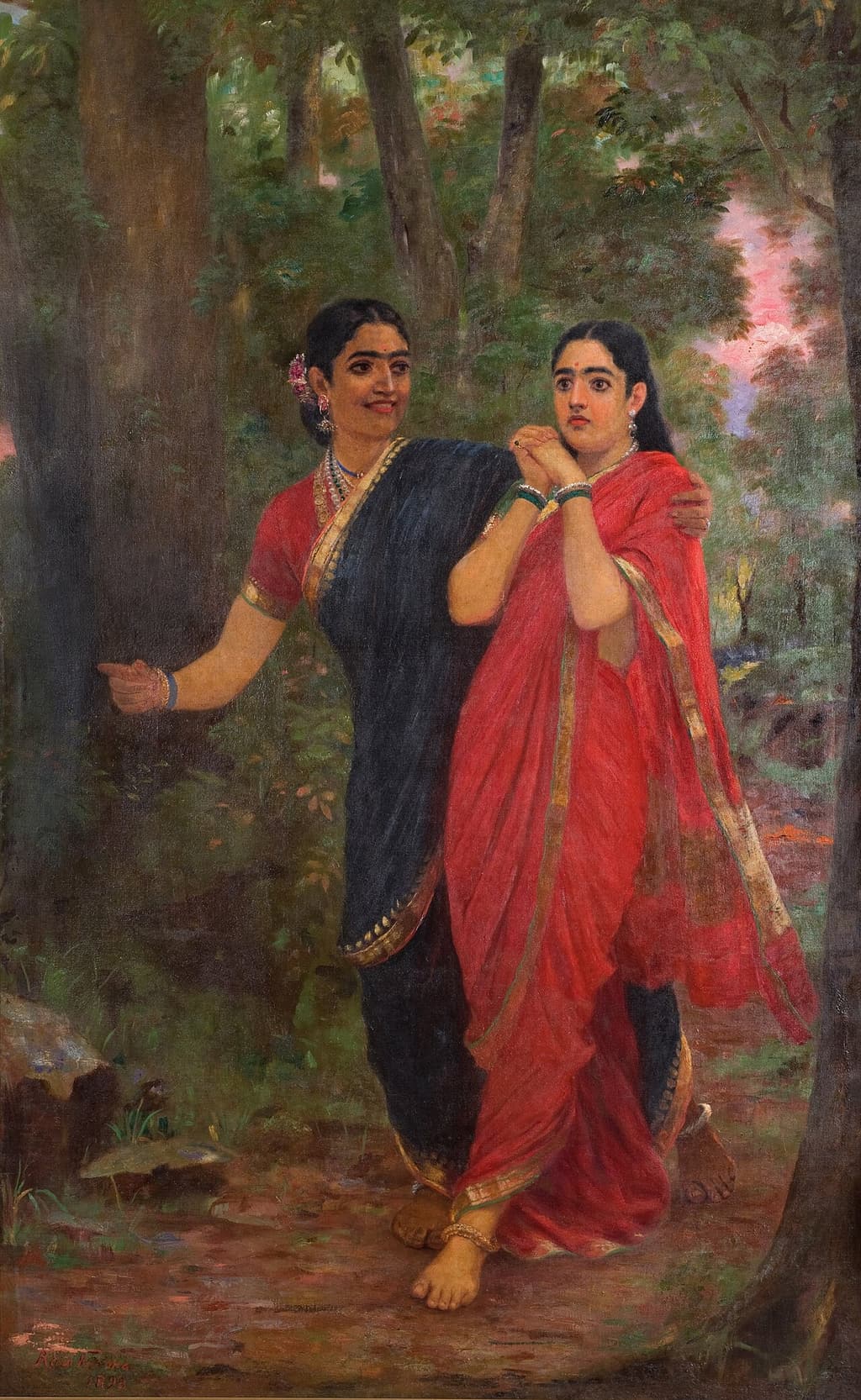
She asks a legal question in a room full of the finest legal minds of the age and none of them will answer it. Her husband has staked himself in a dice game and lost, and has then staked her. Dragged into the assembly, she puts it plainly: did a man who had already lost himself, and was therefore no longer his own master, retain the standing to wager his wife? Bhishma's reply is that the ways of dharma are subtle and he cannot determine it. That evasion, by the most respected man present, is the moment the Mahabharata turns, and the war that follows is in a real sense the answer nobody would give her.
Born out of a fire lit for revenge
Draupadi does not have a childhood. King Drupada, humiliated by Drona, commissions a sacrifice to obtain the means of revenge, and out of its fire step a young man, Dhrishtadyumna, who will kill Drona, and a young woman, dark-skinned and already grown. Her names record all of it: Draupadi for her father, Panchali for the kingdom, Krishnaa for her colour, and Yajnaseni, born of the sacrifice. She enters the epic as an instrument of a grudge and spends the rest of it refusing to be an instrument of anything.
Arjuna wins her at the swayamvara by hitting a rotating target through its reflection. The polyandry that follows is set up as an accident — Kunti, not looking up, tells her sons to share what they have brought — and then justified retrospectively by a past-life story in which she asked Shiva five times for a husband with a particular virtue and was granted five husbands. The layering is transparent: an unusual marital arrangement, possibly reflecting real practice in some Himalayan communities, being explained after the fact by a text that finds it needs explaining.
The dice hall
Yudhishthira loses in stages — wealth, kingdom, brothers, himself, and then her. Dushasana drags her into the hall by the hair while she is menstruating and wearing a single garment, and attempts to strip her. Duryodhana slaps his thigh and invites her to sit on it. Bhima swears to break that thigh and to tear open Dushasana's chest; Draupadi swears not to bind her hair until she can wash it in Dushasana's blood.
The detail everybody knows — the sari that lengthens endlessly as it is pulled, so that Dushasana collapses exhausted amid a mountain of cloth — is not in the critical edition of the epic. The Pune editors, working from hundreds of manuscripts, found it to be a later insertion, and in the oldest recoverable text Draupadi is saved by her own appeal and by the assembly's growing horror rather than by a miracle. That difference matters: the interpolation converts an indictment of the men in the room into a demonstration of Krishna's grace, which is a much more comfortable story.
Vidura and Vikarna do object. Everyone else — the grandfather, the teacher, the blind king, her own husbands under their oath of obedience — sits still. Dhritarashtra eventually grants her boons out of fear, and she uses them to free her husbands rather than herself.
Thirteen years and a court in disguise
In exile she is the one who argues. Long passages of the forest books are her disputes with Yudhishthira about whether patience is a virtue or an alibi, and she is the most articulate advocate of action in the poem — at one point telling him bluntly that a king who does not act when acting is required is not being righteous but ineffective.
In the final year, disguised as a queen's attendant at Virata's court, she is harassed by the queen's brother Kichaka and again finds no protection from anyone with authority; Bhima kills him at her direction, in her clothes, in the dark. The pattern of her story is consistent — institutions fail her and a specific man acts.
She loses all five of her sons in one night, killed in their sleep by Ashvatthama after the war is over, and it is she who insists that his life be spared when he is captured, on the ground that his mother should not suffer what she has.
The goddess who walks on fire
In Tamil Nadu, Draupadi is not a character but a deity. Draupadi Amman temples cluster in the northern districts and around Gingee, with festival cycles lasting up to eighteen days in which the Mahabharata is performed as terukkuttu street theatre, night after night, culminating in a fire-walking ceremony — theemithi — in which devotees cross a bed of embers. The theology holds her to be a form of the goddess descended to burn away impurity, and her fire-birth is the anchor for it. Related traditions exist in parts of Karnataka, Andhra Pradesh and among Tamil communities in Sri Lanka, Malaysia and Singapore, where the Singapore fire-walking festival is a major annual event.
There are also Himalayan villages in Garhwal and Himachal Pradesh where the Pandavas are worshipped and where local polyandry has historically been justified by reference to her marriage.
Modern readings, and a court case
Draupadi has become the figure through whom Indian writers examine sexual violence, honour and the failure of institutions.
- Pratibha Ray's Yajnaseni (Odia, 1984) retells the epic as her letter to Krishna.
- Chitra Banerjee Divakaruni's The Palace of Illusions (2008) made her first-person narration of the war an international bestseller.
- Mahasweta Devi's short story "Draupadi" (1978) transposes her into Dopdi Mejhen, a Santhal insurgent tortured in police custody who refuses to be clothed afterwards and walks towards her interrogator. The story's removal from a Delhi University syllabus in 2021 caused a public controversy, and the resignation of academics from the committee involved.
Television adaptations have generally handled the disrobing with the miraculous sari intact, which keeps it watchable and removes its accusation.
Questions the assembly hall leaves behind
Was her question ever answered in the text?
Not directly, and the epic seems to know this. It returns to the problem repeatedly in later books through Yudhishthira's own agonising, and the Shanti Parva's long treatise on kingship can be read as an extended attempt to supply the jurisprudence that failed in the hall. Some commentators argue that Bhishma's refusal is itself the answer — that dharma cannot cover a situation created by a man who has abandoned it — but the poem does not say so.
How does she divide her time among five husbands?
The epic specifies an arrangement of a year with each in turn, with a rule that no other brother may enter while she is with one — the rule Arjuna breaks, incurring his twelve-year exile. Later texts add that she regained maidenhood at each transition, a detail that is doing obvious apologetic work. The practical texture of the arrangement is one of the things regional and folk retellings elaborate most freely.
Why is she associated with fire in worship rather than with the dice game?
Because in the south Indian cult she is a goddess of the fierce, purifying type, and her origin in the sacrificial flame is what qualifies her. The fire-walk is a vow fulfilled and a re-enactment at once. The dice game supplies the emotional charge of the festival dramas, but it is her birth, not her humiliation, that grounds the ritual.
Does she have a relationship with Krishna beyond the sari episode?
Yes, and it is one of the epic's most sustained friendships. He calls her sakhi, friend, and she calls him sakha; she appeals to him at crises and he arrives; and the tradition of tying a thread to a brother's wrist is popularly connected to her binding a strip of her sari around his bleeding finger. Much of that material is later devotional accretion, but the friendship itself is in the older narrative and is quite distinct from his relations with Radha or the gopis.