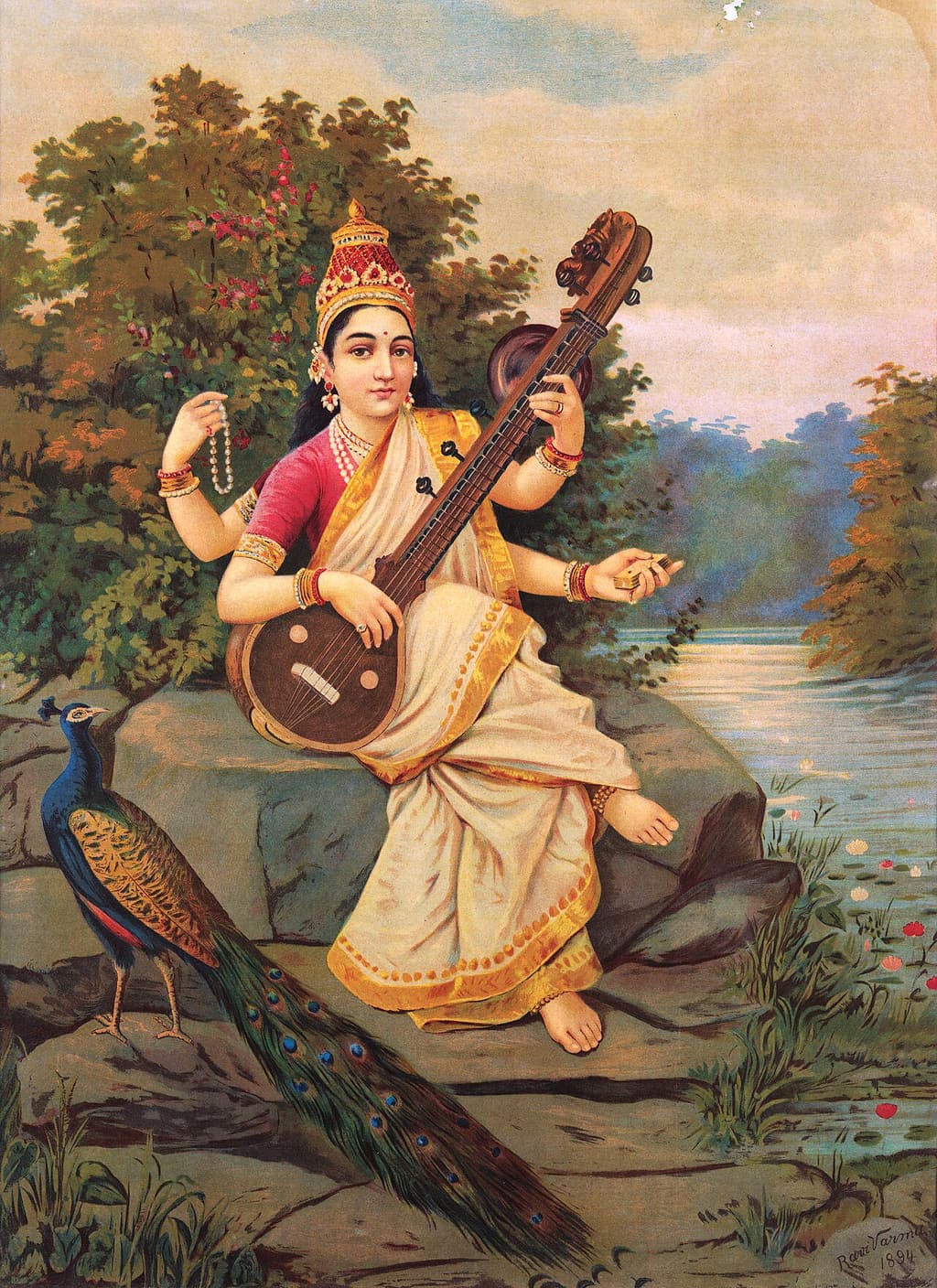
Saraswati began as water. In the oldest layer of the Rigveda she is a river — a real one, praised in whole hymns as the mightiest of streams, bursting ridges with her waves, and addressed in a famous line as best of mothers, best of rivers, best of goddesses, in that order. The Nadistuti hymn lists the rivers of the north-west geographically, and she sits in it between the Yamuna and the Sutlej, exactly where a river ought to sit in a list. By the classical period she has no water at all and holds a lute and a book. Very few deities anywhere have made a transition that complete while keeping the same name.
She is worshipped today by students, musicians and scholars across India, Nepal and the diaspora, and by Buddhists and Jains under related names.
From river to speech
The pivot is the Brahmanas, the ritual manuals of the layer after the hymns, where Saraswati is identified with Vac, Speech — herself a goddess with a striking Rigvedic hymn spoken in the first person, in which she declares that she moves with the gods and that whoever she loves becomes formidable. The merger makes sense inside a religion whose entire mechanism is the correct utterance of memorised sound: the sacrifice works because the words are right. A goddess of the flow of speech, in that context, is not a poetic conceit but a description of what the priesthood depends on.
From there she accumulates: the Vedas themselves, then metre, then Sanskrit, then writing, then music and every art that uses ordered sound. The epithets follow the accretion — Vagdevi of speech, Sharada of the autumn, Bharati, Vani.
The river question, which is not only archaeological
Where the Rigvedic Saraswati actually flowed is a live and unusually charged debate. The mainstream identification is with the Ghaggar-Hakra, a seasonal river system whose dry palaeochannel runs across Haryana, Rajasthan and Cholistan and along which a very large number of Indus-era settlements are strung. That much is agreed. What is contested is whether it was ever a great perennial river during the Vedic period at all: sediment and isotope studies have argued that its main Himalayan feeders, the Sutlej and Yamuna, were diverted away much earlier, leaving a monsoon-fed stream, while other work argues for a later and larger flow.
The dispute matters beyond hydrology because the dating of the Rigveda relative to the Indus cities depends partly on it, and because the label "Indus-Saraswati civilisation" carries a claim about continuity between the Harappan cities and Vedic religion. That claim is entangled with the wider argument over Indo-Aryan migration, which is genuinely unsettled in some respects, better resolved than partisans on either side admit in others, and politically loaded in contemporary India. The honest position is that the geological question is open, that it does not by itself decide the historical one, and that anyone presenting either as closed is arguing rather than reporting. Government-funded channel-revival projects in Haryana proceed on one reading of it.
Veena, swan, book, white
Her iconography is almost aggressively restrained next to the rest of the pantheon. She wears white, sits on a white lotus, and carries a veena, a manuscript, and a rosary; no weapons, no jewellery to speak of, no mount that could be called impressive. The hamsa, the goose or swan she rides, carries a specific and much-quoted property: it is said to be able to drink milk from a mixture of milk and water, leaving the water — discrimination, the ability to take the real thing out of a mess. The peacock appears with her in some regions, and where it does the contrast is usually being made deliberately: the bird of display beside the goddess of substance.
Her relationship to Brahma is one of the awkward places in Puranic genealogy. He is her consort in the standard scheme, but several texts describe her as produced from him — as his daughter, or his own speech given form — and then recount his pursuit of her, growing extra heads to keep watching as she moves away, an episode some Puranas use to explain why he lost the right to be worshipped. The family diagram marks this pairing as disputed rather than drawing it as a marriage. In a separate strand she is counted with Lakshmi and Parvati as one of three great goddesses, and Bengali practice treats her as a daughter of Durga, arriving with the family at the autumn festival.
Vasant Panchami and the day the books rest
Her main festival falls in late January or February, at the beginning of spring. In Bengal, Bihar, Odisha and Nepal it is a clay-image festival on the scale of a small Durga Puja, with pandals in every school and neighbourhood, students wearing yellow, and immersion afterwards. The rite that matters most is hate khori or vidyarambham: a small child's hand is guided to write a first letter, often in rice or on a slate, with the goddess present. Many literate Indian adults can name the day they were taught to write.
The southern observance is different in emphasis. During the autumn Navaratri, on Saraswati Puja and Ayudha Puja, books, instruments and the tools of a trade are stacked before her image and deliberately not used for a day, then taken up again on Vijayadashami. A carpenter's plane and a violin and a schoolbook go on the same pile. It is one of the more elegant ritual statements about where skill is thought to come from.
Her temples are fewer than her importance suggests, which is normal for a deity worshipped mainly at home and at school: Basara on the Godavari in Telangana, where the first-writing rite draws large numbers; the Sharada Peetham at Sringeri, one of the monastic seats associated with Shankara; Kuthanur in Tamil Nadu; Panachikkadu in Kerala. The Sharada Peeth in the Neelum valley of Kashmir, once a celebrated centre of learning whose script is named after it, is a ruin on the far side of the Line of Control, and pilgrimage access to it is a recurring diplomatic proposal.
Benzaiten, Yangchenma, and Bali
She travelled with Buddhism and changed instruments on the way. In Japan she is Benzaiten, one of the Seven Lucky Gods, arriving through the Sutra of Golden Light; she keeps the music but plays a biwa, and her association with water reasserts itself so strongly that her major shrines — Enoshima, Chikubushima, Itsukushima — are on islands. Tibetan Buddhism knows her as Yangchenma, patron of learning and eloquence. In Bali she has her own day in the pawukon calendar, on which manuscripts and books are honoured and, by custom, not read. A Balinese-style Saraswati statue stands outside the Indonesian embassy in Washington, D.C., presented in 2013.
Modern reception, including a painting
The best-known modern episode involving her is a legal and political one. M. F. Husain, arguably India's most celebrated twentieth-century painter, made a line drawing of a nude Saraswati in the 1970s; when it resurfaced in the 1990s it became the centre of criminal complaints, gallery attacks and a long campaign that contributed to Husain leaving India and dying in exile in 2011. The Delhi High Court eventually held that nudity in Indian religious art has ample precedent and quashed the charges. It is the sharpest available case of the collision between the tradition's own artistic history and modern religious sentiment, and it does not resolve neatly in either direction.
Otherwise her presence is quieter and more pervasive than that of the more cinematic deities: on school prize certificates, in the names of universities and libraries, in Amar Chitra Katha panels, and as a common given name. Western appropriation has been comparatively light — she is difficult to convert into an aesthetic, having no weapons, no consort drama, and nothing to sell.
What people want to know after the river
Why is a goddess of learning also the goddess of music?
Because in Sanskrit thought they are one field. Vac covers speech, metre and pitch alike; the veena is a tuning instrument as much as a performing one; and classical music theory was written down as a science of ordered sound alongside grammar and prosody. Musicians in both the Hindustani and Carnatic traditions invoke her before performance, and the Carnatic tradition's principal composers wrote hymns to her that are themselves part of the concert repertoire.
Is she worshipped by Jains?
Yes, as Shrutadevata, the goddess of scriptural knowledge, and Jain manuscript libraries honour her at the start of study. Her presence in a tradition that has no creator god at all is a good demonstration that Indian goddesses of learning travel by function rather than by pantheon.
What is the Gayatri mantra's relationship to her?
None directly, and the confusion is common. The mantra is addressed to the light of Surya, and its personified form, Gayatri, is a distinct goddess named after the metre in which it is composed. Popular art sometimes merges the two figures, since both are radiant, seated and connected to sacred utterance, but the texts keep them separate.
Why does she carry a rosary if she is not an ascetic?
The akshamala she holds is usually glossed as the alphabet rather than as a counting aid — akshara means both an imperishable thing and a letter, so the string of beads is the string of sounds. Read that way the four objects in her hands are the complete apparatus of learning: the text, the sound, the instrument and the gesture of teaching.