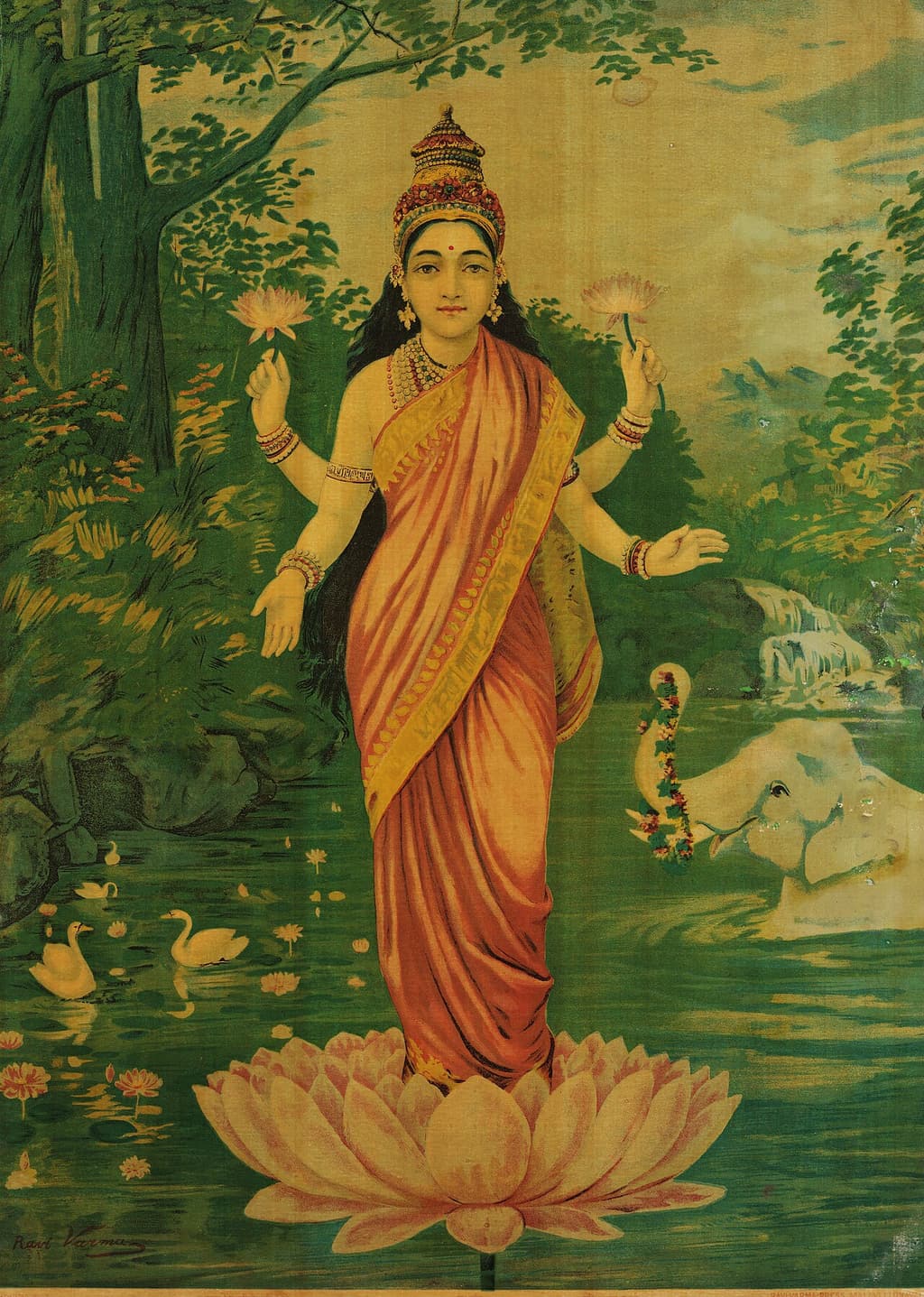
On the night of Diwali the practical instructions are unusually specific: sweep the house out, settle what you owe, light the entrance, and leave a window open. The goddess is understood to be walking, and to be fastidious. That is not a metaphor bolted onto a festival — it is close to the whole theology of Lakshmi, who is fortune conceived as something mobile, discriminating and capable of leaving. Sanskrit calls her chanchala, restless. Prosperity that stayed put would not need a goddess.
She is among the most widely worshipped deities in the world at present, in homes and in businesses. What follows is the textual and art-historical record.
Two words that became one goddess
Sanskrit had śrī, meaning radiance, splendour and the aura of legitimate power, and lakṣmī, meaning a mark or token and by extension good luck. They are not obviously the same idea. The Shri Sukta, a hymn appended to the fifth book of the Rigveda rather than belonging to its core, addresses a golden, lotus-standing, deer-and-elephant-attended figure of abundance, and is the earliest text that reads unmistakably like her. By the epics and Puranas the two words have fused into one name and one goddess, and Shri has become a prefix of respect that any Indian language speaker uses dozens of times a week without thinking about its owner.
She is also, unexpectedly, one of the earliest Indian deities securely attested in art. Reliefs of a goddess flanked by elephants pouring water over her — Gaja-Lakshmi — appear on the Buddhist railings at Bharhut and the gateways at Sanchi in the second and first centuries BCE, which means she was being carved on Buddhist monuments before most of the classical Hindu pantheon was being carved at all. Jain tradition has the mother of a Tirthankara dream of Shri among the auspicious dreams announcing his birth. Three religions have used her, and she predates the sectarian divisions that later claimed her.
Coming out of the ocean
Her best-known origin is the churning of the ocean of milk, in which gods and antigods use Mount Mandara as a churning staff and the serpent Vasuki as the rope. A succession of treasures rises — the moon, the wish-cow, the physician of the gods with the nectar — and among them Lakshmi, standing on a lotus, who surveys the assembly and garlands Vishnu. The choice is hers, and the texts are careful about it: nobody wins her, nobody is awarded her. The full account of the churning is one of the tradition's central narratives and produces half a dozen other figures on this site.
The Puranas also give her an earlier existence. She is said to have deserted the gods after the sage Durvasa's garland was slighted by Indra's elephant, and the entire churning is undertaken to get her back — that is, the loss of prosperity is caused by arrogance about prosperity, and the world becomes barren until it is repaired. The moral is delivered with no subtlety whatsoever, which suggests it was thought worth repeating.
What the image tells you
She stands or sits on a lotus, usually with four hands: two holding lotuses, one in the gesture of giving with coins falling from it, one in the gesture of reassurance. The lotus is the fixed element and its logic is agricultural before it is symbolic — a plant rooted in mud that produces something immaculate, which is what wealth is supposed to do. The two elephants are rain clouds and royal power at once. In Bengal her mount is an owl, an odd choice usually explained as the creature that sees in the dark or, less charitably, as a warning that wealth blinds those who chase it in daylight.
The Ashta Lakshmi, eight forms, systematise her into distinct prosperities: grain, courage, offspring, victory, learning, wealth, elephants and the primordial. The Chennai temple built to that scheme in the 1970s gives each a separate shrine on a separate storey.
She had a sister, and the tradition has quietly dropped her. Alakshmi, also called Jyeshtha, the elder, is misfortune personified and had real temples in early medieval south India with her own priests and offerings; she is worshipped out rather than in, at the start of Diwali in some households, with noise and by sweeping towards the door. A goddess of bad luck who must be honoured before the good one arrives is a more interesting religious idea than the sanitised festival preserves.
The Sri Vaishnava argument about her
In Sri Vaishnavism she is not decorative. Ramanuja's tradition assigns her the role of purushakara — the intercessor whose presence makes the god approachable, who argues the devotee's case, and without whom the divine justice would be unbearable. The community then split, in the centuries after him, partly over exactly how far that goes: the northern Vadakalai school holds her to be infinite and divine in her own right, the southern Tenkalai treats her as a mediating being of a different order. Devotees still hold these positions today and the two schools mark their foreheads differently. It is worth registering that a question a casual reader would call abstract has produced a durable institutional division.
Where and when
Diwali is her principal festival across most of India, with Lakshmi Puja on the darkest night of the lunar month; merchant communities in Gujarat and Rajasthan open new account books that day in a rite called Chopda Pujan, and the fiscal year of a family firm may genuinely begin then. Bengal and Odisha keep Kojagari Lakshmi Puja at the full moon a fortnight earlier, the name meaning "who is awake?" — she is said to visit and reward whoever is still up. Varalakshmi Vratam in the south is a Friday observance kept by married women in the month of Shravana.
Her temples include the Mahalakshmi shrine at Kolhapur in Maharashtra, one of the Shakta seats and old enough that the goddess there is worshipped independently rather than as a consort; Padmavathi at Tiruchanur near Tirupati, where pilgrims to Vishnu as Venkateswara are expected to visit her first; and the Ashtalakshmi temple on the Chennai shore.
From coins to abundance courses
Her image on Indian currency and on the letterheads of businesses is so routine it stops registering. She is the default deity of Indian advertising in October, the goddess most likely to appear in a jewellery commercial, and the figure whose name attaches to countless firms and to a very large number of women — one of the enduringly popular given names in India and its diaspora.
The Western afterlife has been thinner and more careless. She is the goddess most often absorbed into the manifestation and abundance industry, where she appears in prosperity affirmations, crystal grids and "money mindset" courses detached from any of the texts or observances above; the transaction is presented as automatic in a way no Diwali householder would recognise, since the whole point of a restless goddess is that she is not obliged. Her image has also turned up printed on swimwear by an Australian label in 2011, withdrawn after protests, in the standard pattern by which a living deity becomes a graphic to somebody who has not asked.
Questions that follow from a goddess of wealth
Does Hinduism actually approve of getting rich?
The classical scheme of four legitimate human aims puts artha, material gain, second on the list, after dharma and before pleasure and liberation — legitimate, ordered, and explicitly not the highest. Lakshmi's own literature is consistent with that ranking: the texts warn constantly about wealth pursued outside dharma, and she is said to abandon the dishonest household. The Vishnu Purana pairs her with Vishnu precisely so that fortune is tethered to order.
Why is she worshipped alongside a different god of wealth?
Kubera, the yaksha treasurer of the gods, is honoured with her at Diwali in many households, and the two are not redundant. Kubera guards a hoard; Lakshmi is the flow. The distinction between stored treasure and circulating prosperity is made explicitly in ritual manuals, and it is why Kubera is asked to keep and Lakshmi to come.
What is the connection between her and rangoli patterns at a threshold?
The floor drawings made at doorways during Diwali and on ordinary mornings across south India are, in local explanation, an invitation and a welcome mat for her — which is why the design begins at the entrance and why in some regions small footprints are drawn leading inward. The associated practice of feeding ants and insects with the rice flour used to draw them is often given as a second reason for the custom.
Is Diwali her festival everywhere in India?
No, and assuming so flattens the country. In Bengal the same night is largely given to Kali; in parts of the south the emphasis falls on Krishna's defeat of Narakasura the previous day; in Gujarat it marks the new year; and Jains observe it as the anniversary of Mahavira's liberation. The tradition overview sets out how regional calendars diverge under shared festival names.