the Indian subcontinent
Classical Hindu mythology
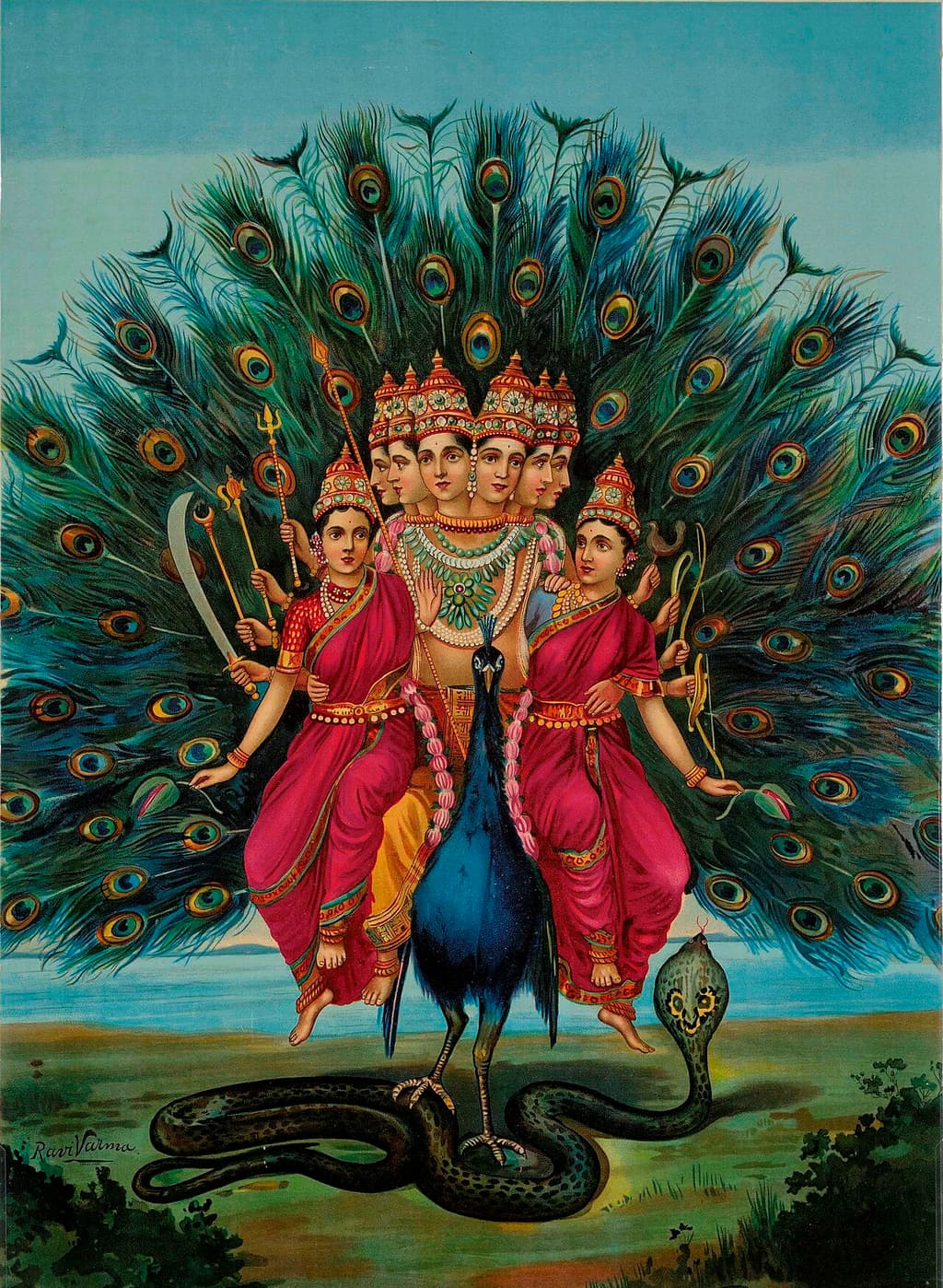
One thing has to be said before anything else on this page: this is not a dead religion. The gods described here are worshipped by around a billion people today, in temples that have functioned continuously for a thousand years and more. Everything below is written as an account of narrative literature and its history, not as a description of somebody's living faith, and the difference between those two things is kept visible throughout.
The second thing to say is that "Hindu mythology" is not one corpus. It is at least three thousand years of literature in several languages, containing genuinely incompatible theologies that coexist by design rather than by accident.
The layers, in order
- The Vedas (from roughly 1500 BCE, transmitted orally with astonishing fidelity long before being written). The Rigveda's thousand-odd hymns address gods who are largely not the ones worshipped today: Indra the thunder-wielding warrior is the most prominent, with Agni the fire that carries offerings and Soma the pressed plant and its god. Vishnu appears as a minor figure who takes three strides; Rudra, an outsider archer god, is the ancestor of Shiva.
- The Upanishads (c. 800–400 BCE) turn away from ritual toward philosophy: the identity of the individual self, atman, with the ultimate reality, brahman. This is the layer that supplies the intellectual framework later devotional religion assumes.
- The epics. The Mahabharata, the longest poem in the world at roughly 100,000 verses, tells of a dynastic war between cousins and contains within it the Bhagavad Gita, in which Krishna instructs Arjuna on duty on the eve of battle. The Ramayana tells of Rama's exile, the abduction of Sita by the demon king Ravana, and the war to recover her. Both were composed and expanded over centuries.
- The Puranas (c. 300–1500 CE) are where most of what people call Hindu mythology actually lives: encyclopedic collections of cosmology, genealogy and story, each broadly aligned with the worship of Vishnu, Shiva or the Goddess, and each therefore giving that deity the supreme position.
Because of that last point, the same event is told differently depending on which Purana you read, and the differences are theological arguments rather than variant folklore. A page here that says "the Shiva Purana has it otherwise" is pointing at a real dispute between traditions.
The gods you will actually meet
The Vedic pantheon receded and a new configuration emerged, usually described as a triad — Brahma the creator, Vishnu the preserver, Shiva the destroyer — which is a genuine formulation and also a simplification that no worshipping community actually uses. In practice:
- Vaishnavas hold Vishnu supreme, and meet him chiefly through his avatars: descents into the world to restore order, of which Rama and Krishna are overwhelmingly the most important.
- Shaivas hold Shiva supreme — the ascetic on the mountain, the lord of the dance, the god who drinks the poison churned from the ocean to save the world, worshipped principally in the form of the linga.
- Shaktas hold the Goddess supreme, in her own right rather than as anyone's consort. The Devi Mahatmya is her scripture, and its account of Durga destroying the buffalo demon after the male gods have failed is one of the great set-pieces of the literature.
- Brahma, despite his position in the triad, has almost no active cult and famously few temples, for reasons the Puranas themselves supply as stories.
Then there is Ganesha, the elephant-headed remover of obstacles invoked before any undertaking; Hanuman, the monkey-hero of the Ramayana whose devotion made him a god in his own right; Lakshmi, Saraswati and Parvati; and a very large number of regional and village deities who are not in the Sanskrit texts at all.
Time, and why the scale is different
Hindu cosmology runs on a scale that no other tradition on this site approaches. The world passes through four yugas of declining virtue, the last and worst being the Kali Yuga we are said to be in; a thousand such cycles make a single day of Brahma, and a night of equal length follows in which the cosmos is unmade. Brahma himself lives a hundred of his own years. The resulting figures run into hundreds of billions of ordinary years, and the crucial structural point is that creation is not a unique event: it has happened before and will happen again, endlessly.
This is why the tradition can hold multiple creation accounts without contradiction — the cosmic egg, the sacrifice of the primordial man in Rigveda 10.90, Vishnu asleep on the serpent Shesha with Brahma emerging from a lotus at his navel. They describe different cycles, or the same process at different depths.
Words the stories run on
Four concepts appear constantly and are usually mistranslated in popular retellings.
- Dharma — duty, order, the right way of acting, specific to your role and situation rather than universal. The entire Mahabharata can be read as an argument about it.
- Karma — action and its consequences, working across lifetimes. Not fate and not moral scorekeeping by a deity.
- Maya — the world's appearance as a kind of creative illusion, not a lie but a projection.
- Moksha — release from the cycle of rebirth, which is the actual goal, and one that the gods of the stories are not necessarily closer to than anyone else.
Asuras, incidentally, are not devils. They are the counterparts and rivals of the devas, frequently pious, sometimes winning, and often possessing boons obtained by austerities so severe the gods cannot refuse them. Rakshasas are a different category again. Translating either as "demon" imports a Christian framework that badly distorts the stories.
The ten avatars, and the churning of the ocean
Two narrative structures do a disproportionate amount of work in this tradition and are worth knowing before you meet any individual figure.
The avatars of Vishnu are usually listed as ten, and the list is a sequence rather than a set: a fish who saves the first man from a flood, a tortoise who supports a mountain, a boar who lifts the drowned earth, a man-lion who kills a demon protected by a boon against every ordinary category of killer, a dwarf who asks for three paces of ground and takes the universe, an axe-wielding brahmin, Rama, Krishna, and a tenth still to come at the end of the age. The ninth slot is contested — the Buddha in many Puranic lists, Balarama in others — and that disagreement is itself a piece of religious history.
The churning of the ocean of milk is the story most often referenced elsewhere in the literature. Gods and asuras cooperate, using a mountain as a churning stick and a cosmic serpent as the rope, to produce the nectar of immortality. What comes up first is a poison capable of destroying everything, which Shiva drinks and holds in his throat, turning it blue. Then treasures emerge in sequence, Lakshmi among them, and the nectar is finally won by a trick. It is a rare episode in which the two sides work together, and it explains a dozen attributes and epithets at once.
What the epics are for
Neither epic is primarily a story about gods. The Mahabharata is about people trapped in obligations that cannot all be honoured at once, and it is unremittingly honest about the cost: the heroes win by breaking the rules of war several times, and the victory is desolate. The Ramayana offers the opposite, an ideal of duty embodied — Rama as the perfect king and son — and later Indian tradition has argued with it fiercely, particularly over Sita's treatment after her rescue, with regional versions rewriting the ending and Tamil and Southeast Asian retellings giving Ravana a far more sympathetic hearing.
There is no single authoritative text of either. Tulsidas' Hindi Ramcharitmanas, Kamban's Tamil version, the Javanese and Thai and Cambodian Ramayanas, and the televised serial of the 1980s that emptied Indian streets each Sunday are all part of how the story exists.
Where to start
Start with the Bhagavad Gita, which is short, self-contained and the single most influential text in the tradition. Then a good abridgement of the Mahabharata — R. K. Narayan's or John Smith's — rather than an attempt on the whole thing. Then the Devi Mahatmya for the Goddess, which is brief and ferocious. The full Ramayana is best met in a translation of a specific regional version rather than a synthesised one.
A word on how this site handles the material: because the tradition is living, pages here describe what a text narrates and what a community holds, and attribute each. Where a story is told very differently in a temple's own tradition from the way a Sanskrit Purana tells it, both are given. Where a nineteenth-century European scholar's framing — the "Aryan invasion", the tidy triad, the ranking of philosophical texts above devotional practice — has shaped the popular English account, the page says so, because that framing is still doing damage in the search results.
The family tree for this tradition shows relationships as the major Puranas give them, and marks where the sectarian sources disagree — which, on the question of who is supreme and who descends from whom, is often. A directory of the deities and heroes covered here follows.
gods
- Vishnupreservation, cosmic order, the avatars
- Shivadestruction and renewal, asceticism, dance
- Brahmacreation, the Vedas, the four faces
- Parvatidevotion, the mountain, marriage
- Lakshmiwealth, fortune, beauty
- Saraswatilearning, music, speech
- Durgavictory over demons, protection, the lion
- Kalitime, destruction, liberation
- Ganesharemoving obstacles, beginnings, writing
- Kartikeyawar, victory, the divine general
- Indrarain, thunder, the king of the devas
- Agnifire, sacrifice, the messenger between worlds
- Varunacosmic law, oaths, the waters
- Vayuwind, breath, life force
- Suryathe sun, health, time
- Yamadeath, the judgement of the dead, dharma
- Krishnadivine love, statecraft, the Gita's teaching
- Ramaduty, kingship, exile
- Sitathe earth, fidelity, endurance
- Hanumandevotion, strength, celibacy
- RavanaLanka's kingship, scholarship, devotion to Shiva
- Narasimhathe fourth avatar, protection of devotees, the breaking of a loophole