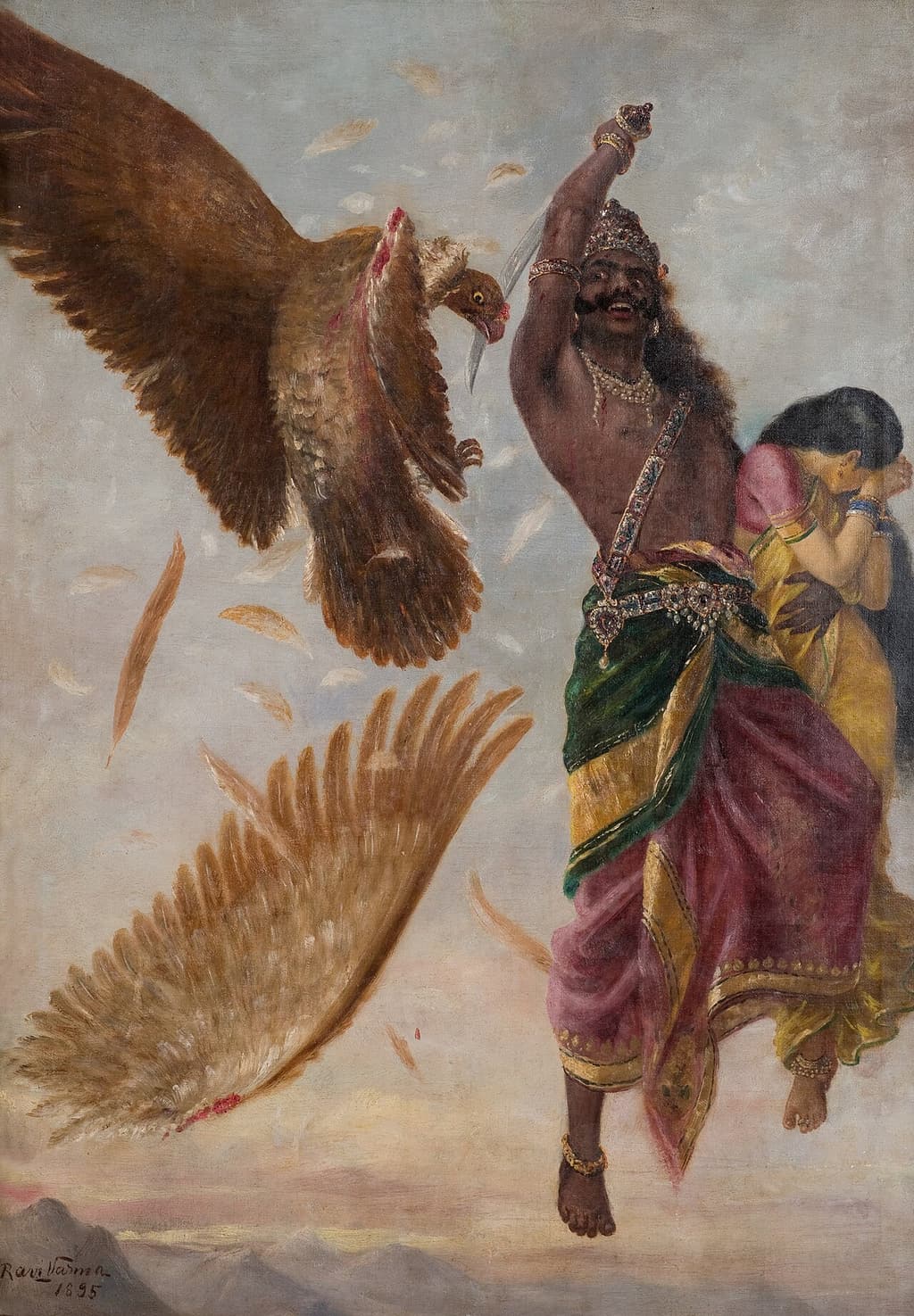
Every autumn in north India, towering effigies packed with fireworks are set alight in public grounds while crowds cheer. And in Bisrakh in Uttar Pradesh, which claims to be his birthplace, the same days are kept as mourning. In Mandsaur in Madhya Pradesh, where local tradition makes Mandodari a daughter of the town, the villagers cover the statue's face rather than watch him insulted, because a son-in-law is not burned in his wife's home. In parts of Sri Lanka he is a national ancestor. The most straightforwardly evil figure in Indian narrative turns out to have a constituency.
A brahmin, a scholar, and a musician
Valmiki does not write him as a brute, and the details are specific enough to make the point unavoidable. He is the son of the sage Vishrava and the rakshasi Kaikasi, and his grandfather is Pulastya, one of the mind-born sons of Brahma — so the demon king of Lanka is by descent a brahmin. He is a master of the Vedas, and the ten heads are conventionally glossed as command of the four Vedas and the six subsidiary sciences. He plays the veena well enough to carry one on his banner. His attainments are the reason his fall registers as tragedy rather than as pest control.
He acquires his empire the ordinary way, by austerity and boons. Brahma grants him invulnerability to gods, asuras, gandharvas and every other class of being he considered worth worrying about — and, contemptuously, not to humans or animals. The entire architecture of the Ramayana rests on that omission, which is why Vishnu must come as a man and why an army of monkeys and bears is the force that arrives.
He also takes Lanka by eviction. Its previous ruler was Kubera, his own half-brother and the treasurer of the gods, from whom he seizes both the island and the flying palace Pushpaka.
Devotion, which he is very good at
The most famous story about Ravana has nothing to do with the abduction. Passing Kailash and finding his way blocked, he sets his twenty arms under the mountain and lifts it. Shiva, sitting on top with Parvati, presses down with one toe and traps his hands beneath the mass. Ravana, crushed and unable to free himself, sings — and the hymn he composes there is the Shiva Tandava Stotra, a dense, thundering piece of Sanskrit metre that is still recited and recorded constantly. Shiva, delighted, releases him, gives him the sword Chandrahasa, and grants him the name Ravana, "he who made the world roar".
He is thus a great devotee of one god and the enemy of an incarnation of another, and the tradition has never quite tidied that away. Some Shaiva-leaning retellings treat his destruction by Rama as a favour: death at the hands of God grants liberation, and the demon's hostility is a faster route to it than an ordinary devotee's patience.
The household, and the brother who leaves
His family is drawn as carefully as he is. Mandodari, his queen, is consistently the voice of good sense and tells him to return Sita from the moment she hears of it. His son Meghanada earned the name Indrajit by defeating Indra in battle, and is the most dangerous fighter on either side. His brother Kumbhakarna, cursed to sleep for months at a stretch, wakes, tells him plainly that he is in the wrong, and then goes out to die for him anyway — one of the epic's clearest statements about loyalty running independent of judgement. His other brother Vibhishana argues the same case, is thrown out for it, defects to Rama, and is installed as king of Lanka afterwards; whether he is a moral exemplar or a traitor is a question the poem raises and different regional traditions answer differently. His sister Shurpanakha's mutilation is what starts everything.
Valmiki also supplies the limit on his conduct. Ravana cannot force Sita, because Nalakubara cursed him after an earlier rape that his head would burst if he touched an unwilling woman. The captivity in the ashoka grove is therefore a year of argument, and the poet is explicit that the restraint is imposed rather than chosen.
Deaths, plural
Rama kills him with an arrow to the navel, where a store of nectar keeps him alive — a detail supplied variously by Agastya's hymn to the sun or by Vibhishana's knowledge of his brother's anatomy. But this is one of the places where the versions diverge most sharply:
- Jain Ramayanas, from Vimalasuri's Paumachariya onward, have Lakshmana kill him, because a Jain ideal hero does not take life. Ravana in these texts is a Vidyadhara king of high attainment brought down by a single passion, and several Jain traditions hold that he will be reborn as a Tirthankara in a future age.
- Kamban's Tamil Iramavataram grants him a grandeur and a pathos the Sanskrit does not, and the Tamil poem's Ravana is among the great characterisations in Indian literature.
- Later north Indian tradition adds an episode with no basis in Valmiki: the dying Ravana teaching Lakshmana statecraft and the arts of governance, with Rama sending his brother to sit at the enemy's feet.
Burned in some places, garlanded in others
Dussehra ends with Ravan Dahan, the burning of effigies of Ravana, Kumbhakarna and Meghanada, and in Delhi's Ramlila grounds the figures now run to thirty metres. That practice is real and enormous, and it is also not universal.
- Bisrakh, near Greater Noida, performs no burning and holds memorial rites instead.
- Mandsaur in Madhya Pradesh has a standing Ravana statue that receives worship; the town's claim on Mandodari makes him family.
- Kanpur has a Dashanan temple whose doors open one day a year, on Dussehra itself.
- In Sri Lanka, a strand of Sinhala historical writing and popular culture treats him as an ancient king with advanced technology, and sites along the hill country — a waterfall, caves — carry his name for tourists and for believers.
- In the Dravidian movement of twentieth-century Tamil Nadu, Periyar and the Self-Respect Movement read the epic as an account of northern conquest, sided openly with Ravana, and burned effigies of Rama instead, prompting arrests. Whatever one thinks of the historiography, it is a documented political reading with a long afterlife.
Modern Ravanas
Arvind Trivedi's performance in the 1987 Doordarshan Ramayan made the character oddly beloved — the actor reported being greeted with affection in the street for the rest of his life. Mani Ratnam's Raavanan (2010) transplanted the story to a Tamil forest and inverted the sympathies, casting the abductor as an insurgent and the pursuing officer as the rigid one. Amish Tripathi gave him a novel of his own in 2019. Ashok Banker, Anand Neelakantan and a run of other novelists have written the epic from Lanka's side, and "Ravana as misunderstood king" is now common enough in Indian publishing to be a genre rather than a provocation. In everyday political speech the name still functions as an insult, which is why the burning continues to carry a charge.
Questions the ten heads leave open
Does he have ten heads in art, and how is it drawn?
Sculptors almost always compromise: one principal face with nine smaller ones stacked or fanned behind it, since ten equal heads at the same scale are unmanageable in stone. The Ellora relief of him shaking Kailash solves the problem by burying the multiplicity in a mass of arms and letting the strain in the composition do the work. Some texts also let him regrow a severed head, which is what makes the final duel take so long.
Was Lanka the modern island of Sri Lanka?
The identification is traditional and ancient, and the Sri Lankan sites built around it are real places drawing real visitors. Whether the Ramayana's Lanka corresponds to it geographically is a different question, and scholars have proposed locations in central India and elsewhere on the basis of the poem's own distances and descriptions. The honest answer is that a poem's map is not an atlas.
What is the Pushpaka vimana?
A self-moving aerial palace, taken from Kubera and returned to him after the war, which carries Rama's party home from Lanka at the end. It has become a fixture of modern claims about ancient Indian aviation, made mostly on the basis of a twentieth-century text of disputed provenance rather than of the Ramayana itself. The epic describes a magical vehicle belonging to the god of wealth, in the same register as talking birds and flying monkeys.
Is there any tradition in which he is worshipped as a deity rather than honoured as an ancestor?
There are shrines that receive offerings — the Kanpur temple and the Mandsaur image among them — and small communities, including some who claim descent from him, who treat him as a clan deity. This sits alongside, rather than replacing, his role as antagonist, and the tradition overview sets out how regional and sectarian readings of a single narrative can be this far apart without either being a deviation.