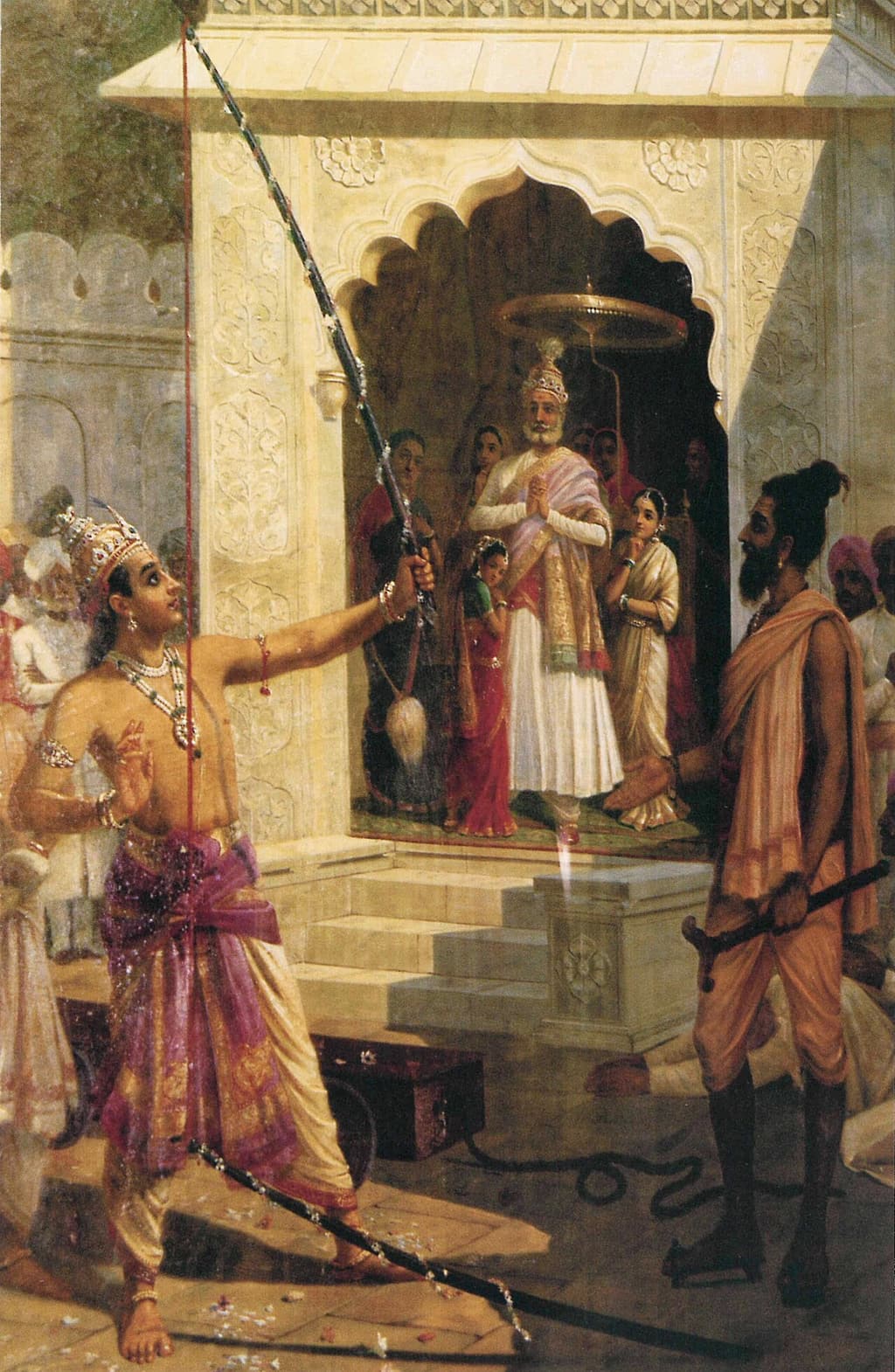
A. K. Ramanujan opened a famous essay by asking how many Ramayanas there are, and answering: three hundred, at least. That is the correct starting point for Rama. There is no single story of him, there is a family of stories told in Sanskrit, Tamil, Awadhi, Bengali, Telugu, Thai, Khmer, Javanese, Malay and Tibetan across two thousand years, and the versions disagree about things that matter enormously — who kills Ravana, whether Sita ever entered the fire, whether the hero is a god or a very good man.
Rama is worshipped daily by very large numbers of people and is also, at present, a central figure in Indian public life. This page reports the mythology and its textual history, and names the modern context without arbitrating it.
Valmiki's poem and its seams
The Sanskrit Ramayana attributed to Valmiki runs to about 24,000 verses in seven books. Philologists have long argued that the first and last books, the Bala Kanda and Uttara Kanda, are later additions to a core of five, on grounds of language, of narrative logic, and of theology: the middle books largely treat Rama as a man, while the framing books identify him as Vishnu descended. If you read only the core, the divinity of the hero is not the poem's subject at all — his conduct is.
The plot of that core is a chain of promises kept at ruinous cost. Dasharatha of Ayodhya, of the solar line of Ikshvaku, has four sons by three queens. On the eve of Rama's installation as heir, the queen Kaikeyi calls in two old boons — her son Bharata to rule, and Rama to the forest for fourteen years. Rama goes without argument, because his father's word cannot be broken. Sita insists on going with him; Lakshmana follows. Bharata, appalled, refuses the throne and rules as regent with his brother's sandals placed on it.
In the forest the demon princess Shurpanakha propositions Rama, is mocked, and is mutilated by Lakshmana; her brother Ravana takes Sita in revenge, using a golden deer as a lure. The old vulture Jatayu dies trying to stop the chariot. Rama allies with the exiled monkey king Sugriva by killing his brother Vali from behind a tree — a shot the epic itself makes Vali object to as dishonourable, and to which Rama's answer has been debated for centuries. Hanuman leaps to Lanka and finds Sita alive. An army of monkeys and bears builds a causeway; the war takes the whole sixth book; Ravana dies.
The fire and the second exile
Then the poem does something that no amount of devotional rereading has smoothed over. Rama, on recovering Sita, does not embrace her. He states publicly that he fought to erase an insult to his house, not to reclaim a wife, and that she cannot return to him after living in another man's household. Sita asks for a fire to be built and walks into it; Agni returns her unburnt, and Rama accepts her, saying he never doubted her but that the people required proof.
The Uttara Kanda then repeats the injury. A washerman's remark about the queen's time in Lanka reaches the king, and Rama, as king rather than husband, sends her pregnant into exile. She bears Lava and Kusha in Valmiki's hermitage; the boys grow up and sing their father's story to his face. Offered a second public oath of purity, Sita instead calls on her mother the earth, who opens and takes her back.
Modern readers usually assume this ending embarrasses the tradition. In fact the tradition has been arguing with it since at least the eighth century, when Bhavabhuti's play Uttararamacharita rewrote the reunion, and the disagreement is the single most productive thing in the whole Rama literature.
Which Ramayana are you reading?
- Kamban's Iramavataram (Tamil, twelfth century) is a poem of devotion rather than a translation, notably more sympathetic to Ravana and structurally quite different.
- Tulsidas's Ramcharitmanas (Awadhi, begun 1574) is the version most of north India actually knows. It is sung, performed as Ramlila every autumn, and quoted in ordinary speech. It is thoroughly devotional: Rama is God without qualification, and the harshest material is softened or reframed.
- The Adhyatma Ramayana solves the fire ordeal by having Sita hide in the fire in advance and a shadow-Sita be abducted. The real one is never touched. Tulsidas uses this device.
- Jain Ramayanas, beginning with Vimalasuri's Prakrit Paumachariya, make Ravana a noble Vidyadhara king brought down by his one flaw, and assign the killing to Lakshmana instead, since taking life would disqualify the protagonist of a Jain narrative from the perfection the genre requires of him.
- The Thai Ramakien, the Khmer Reamker and the Javanese Kakawin Ramayana are national literatures in their own right; Ayutthaya was named for Ayodhya, and Thai kings have been titled Rama since 1782.
- Women's folk traditions across India — Telugu songs, Bengali Chandrabati's fifteenth-century retelling — tell the story from Sita's side and are considerably less forgiving.
Ramanujan's 1987 essay setting out this diversity was itself withdrawn from a Delhi University syllabus in 2011 after protest, which is a good indication of how live the material is.
Rama as king: the idea of Ram Rajya
The reason he matters beyond narrative is the political ideal attached to him. Ram Rajya — the reign in which rain falls on time, nobody buries a child, and the king is bound by the same dharma as everyone else — became a durable shorthand for good government. Gandhi used the phrase constantly, glossing it as the sovereignty of moral law rather than of any religion, and the same phrase is used very differently in present-day Indian politics.
His epithet Maryada Purushottama means the ideal man of proper limits, and the emphasis is on limits: he is admirable for what he refuses himself. It is also, as critics inside the tradition have pointed out for a long time, an ideal purchased at his wife's expense.
Worship and places
He is worshipped with Sita, Lakshmana and Hanuman as a group; the four-figure shrine is a standard household image across north India. Rama Navami in spring marks his birth. His return to Ayodhya after the fourteen years is one of the origin stories given for Diwali, the row of lamps being the city lighting his way home, and Ramlila performances in the preceding weeks end with the burning of Ravana effigies at Dussehra — though not everywhere, and there are communities in India and Sri Lanka that decline to burn them.
Ayodhya in Uttar Pradesh is his birthplace. Rameswaram in Tamil Nadu marks the point on the coast from which the causeway was built; the shoal running from there towards Sri Lanka appears on colonial charts as Adam's Bridge and in Indian usage as Ram Setu, and its geological origin as a natural sandbank chain is well established even as its identification remains a matter of faith and of live litigation over shipping-canal proposals. Chitrakoot, Nashik and Hampi all claim episodes of the exile.
The chanting of his name is itself a practice — Ramnam — and "Ram Ram" is a common greeting in parts of north India.
Ayodhya, reported plainly
The Babri Masjid, built in Ayodhya in the sixteenth century, stood on a site many Hindus hold to be Rama's birthplace. Legal disputes ran from the nineteenth century onward; a political campaign in the 1980s made the site a national issue; the mosque was demolished by a crowd on 6 December 1992, with communal violence following in several Indian cities. In November 2019 the Supreme Court of India awarded the site for a temple and directed that alternative land be allotted for a mosque; a temple was consecrated there in January 2024. Those are the events. What they mean is contested along political lines that this page does not attempt to settle.
Screen, comic and song
Ramanand Sagar's Ramayan ran on Doordarshan in 1987–88 and stopped the country weekly; its rebroadcast during the 2020 lockdown drew audience figures that were reported as records for the medium. Amar Chitra Katha's comics have kept a fixed visual Rama in print since the 1970s. Nina Paley's animated Sita Sings the Blues (2008) retold the story with 1920s jazz vocals and drew both admiration and protest, the objections centring on a foreign artist's comic framing of a living deity's marriage. The 2010s brought big-budget Indian animation and, in Adipurush (2023), a live-action adaptation whose colloquial dialogue for Hanuman caused enough offence to be re-dubbed after release. The name Rama and its variants remain among the most widely given names in South Asia.
What readers of the epic end up asking
Why does Rama kill Vali from hiding?
The poem raises the objection itself and gives Rama three answers — that Vali had taken his brother's wife, that a king may punish, and that men hunt animals from cover. None of them has satisfied everybody, and Tamil and Jain retellings handle the scene very differently. It is the clearest example of the epic building in its own criticism rather than presenting a flawless hero.
Is the monkey army meant literally?
The vanaras are described as speaking, city-building people with kings and treaties, not as animals, and one reading of them is as forest tribes rendered through the poem's own hierarchies. That reading has its own politics in modern India, since some communities claim descent from them, and it is worth noting rather than asserting.
What is Rama's relationship to the ten-avatar list?
He is the seventh, and his position matters chronologically: he belongs to the Treta Yuga, the second age, while Krishna belongs to the Dvapara that follows. Where the Ramayana's core presents a mortal prince, the avatar frame supplies the reason he must behave as one — a descended god who knows he is God cannot demonstrate anything about how a man should live.
Does any tradition worship Rama as supreme rather than as an avatar?
Yes. The Ramanandi order, one of the largest ascetic communities in north India, centres its theology and practice on Rama and Sita directly, and Tulsidas's poem functions as its scripture in the Hindi-speaking regions. The tradition overview explains how such a sect-level claim differs from a Purana's incidental ranking.