Three figures share this name and a devotee is expected to hold all three at once: a toddler who steals butter and is tied to a mortar for it, a young man whose flute empties the village of women at night, and a middle-aged politician on a battlefield explaining why his friend must kill his cousins. Nothing in the tradition treats these as separate careers. The theological weight of Krishna sits precisely in the refusal to choose — the same being is the child you scold, the lover you long for, and the voice of the absolute.
Krishna is worshipped in enormous numbers today across India and by communities worldwide. The account below follows the classical texts, which are not the whole of that devotion.
The texts arrive in the wrong order
The oldest Krishna is the adult. He is in the Mahabharata as a Yadava prince, a kinsman and adviser to the Pandavas, whose divinity the epic asserts but whose behaviour is that of a superbly effective political operator. The Bhagavad Gita, eighteen chapters inside the epic's sixth book, is his teaching to Arjuna, and it is the single most translated Indian text.
The childhood comes later. The Harivamsha, an appendix to the epic, gives the first sustained account of Vrindavan; the Vishnu Purana develops it; and the tenth book of the Bhagavata Purana, probably ninth or tenth century, makes it the emotional centre of Vaishnava religion for good. Devotional literature in the regional languages then dwarfs the Sanskrit: Surdas in Braj, Jayadeva's Sanskrit-but-lyrical Gita Govinda, Mirabai in Rajasthani, the Bengali poetry that grew around Chaitanya, and Narsinh Mehta in Gujarati.
There is also material evidence earlier than most of it. The Heliodorus pillar at Besnagar, dated to about 113 BCE, was set up by a Greek convert to the worship of Vasudeva; Patanjali's grammatical commentary refers to Vasudeva and Kamsa. The cult is older than the books that are famous.
Mathura, Gokul, and the childhood
Kamsa, king of Mathura, is warned that his sister Devaki's eighth child will kill him, so he imprisons her and Vasudeva and destroys each newborn. On the night of the eighth, the doors open, the guards sleep, and Vasudeva carries the baby across the flooded Yamuna to Gokul, exchanging him for the infant daughter of the cowherd Nanda and his wife Yashoda. The girl, when Kamsa tries to kill her, becomes the goddess and tells him the child is already elsewhere.
What follows in the Bhagavata is a sequence of miniature crises played for delight: the demoness Putana who comes to nurse him with poisoned breasts, the cart he kicks over, the whirlwind demon, the two trees he uproots while crawling with a mortar tied behind him. He steals butter from every house in the settlement, is caught constantly, and is never really punished. Yashoda looks into his mouth to check he has not eaten mud and sees the entire universe, then mercifully forgets.
Two episodes carry the theology. In the lifting of Govardhan, Krishna persuades the cowherds to stop their annual sacrifice to Indra and honour the hill and the cattle that actually feed them; Indra sends a week of destroying rain, and Krishna raises the hill on one finger as an umbrella until the god gives up. It is the clearest single scene of the Vedic order being superseded. In the rasa-lila, he multiplies himself so that each of the cowherd women dances with him and each believes he is hers alone — and the Bhagavata interrupts its own narrative to insist this is not what it appears to be, which tells you the objection is as old as the story.
Radha, and an argument about dates
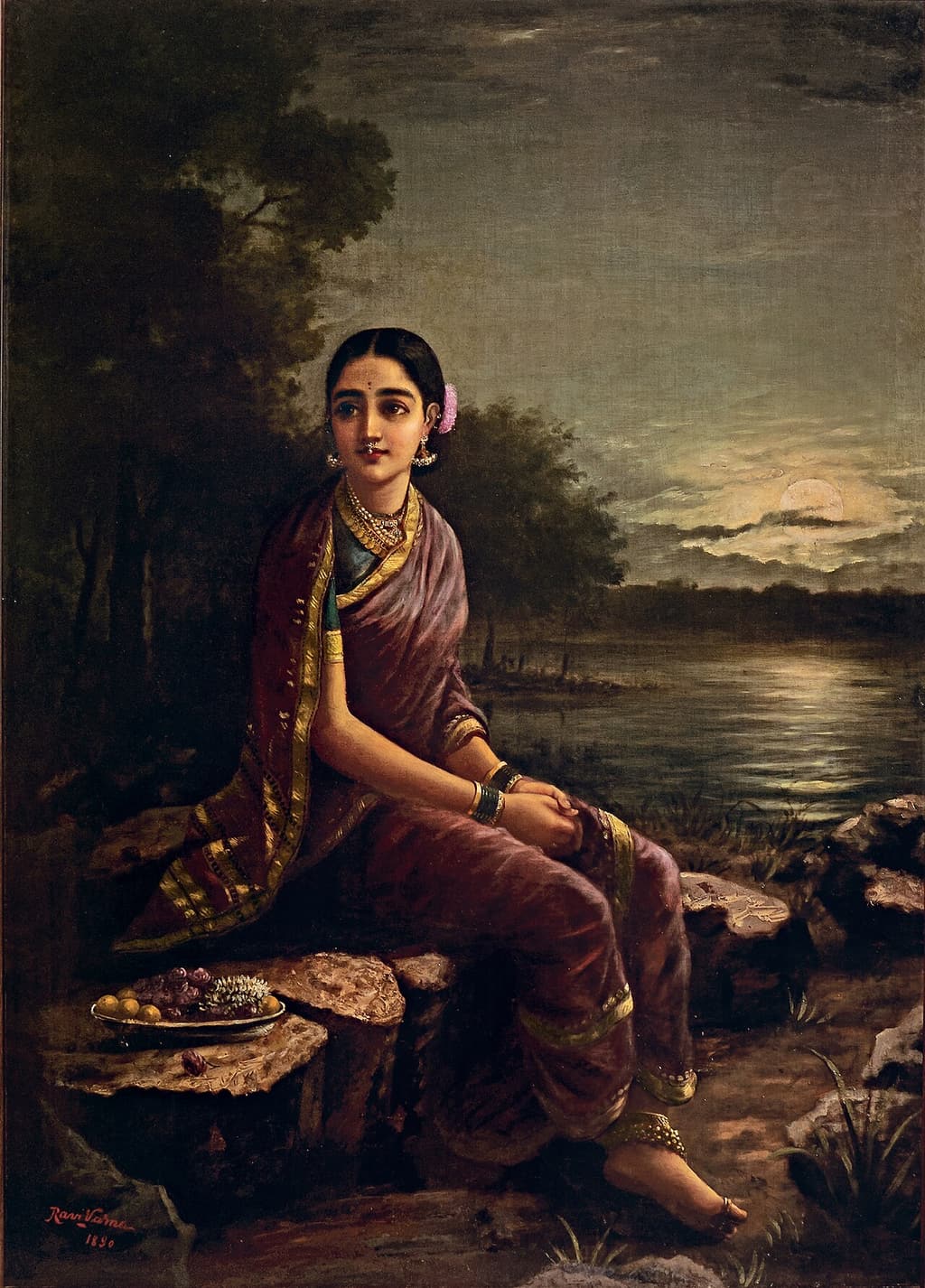
Radha is now inseparable from him. She is not in the Mahabharata and she is not named in the Bhagavata Purana's tenth book at all, though a single unnamed favourite gopi in it may be her ancestor. She surfaces in scattered earlier verse and then arrives fully formed in Jayadeva's twelfth-century Gita Govinda, where the god is jealous, apologetic and finally kneeling. Gaudiya Vaishnavism, following Chaitanya in sixteenth-century Bengal, made her the supreme expression of devotion — the theology holds that Krishna takes her mood in order to know his own sweetness. To describe her as an ancient consort would be to compress five hundred years of development into a sentence, and the temples of Braj where she is worshipped as the senior deity are the product of that development, not of the epic.
Dwarka and the political Krishna
He kills Kamsa, restores the old king, and then abandons Mathura under repeated siege from Jarasandha and builds a new city at Dwarka on the western sea. His marriages number eight principal queens, Rukmini foremost, whom he takes by elopement after she writes to him, and by convention sixteen thousand more — women freed from the demon Naraka's captivity whom no family would take back, married to remove their disgrace.
In the war he refuses to bear arms and offers each side a choice between his army and himself unarmed; Duryodhana takes the troops. As Arjuna's charioteer he then wins the war with advice that is repeatedly, unmistakably underhand: the ambiguous shout that breaks Drona, the reminder to strike Karna while his wheel is stuck, the tacit approval of the blow to Duryodhana's thigh. The epic does not hide this. Gandhari, whose hundred sons are dead, curses him to see his own clan destroy itself, and it happens — the Yadavas kill each other drunk on the shore, and Krishna dies of a hunter's arrow in the sole of his foot, mistaken for a deer.
Where he is worshipped
Vrindavan and the wider Braj region, where the pilgrimage circuit visits the sites of individual childhood episodes; Mathura, his birthplace; Dwarka in Gujarat; Udupi in Karnataka, where Madhva established the temple and the image is viewed through a nine-holed window; Guruvayur in Kerala; Nathdwara in Rajasthan, home of the Pushtimarg tradition's Shrinathji, an image of the Govardhan-lifting form. At Puri he is Jagannath, and the summer chariot festival there sends towers on wheels through the streets — the origin of the English word "juggernaut", coined by observers who assumed the crowds were being crushed deliberately.
Janmashtami, his birth night, is kept with fasting until midnight; in Maharashtra the following day brings dahi handi, human pyramids built to reach a suspended pot of curd, a game reenacting the butter theft that has become large enough to require safety regulation. Holi at Barsana includes lathmar, in which women drive the men of Nandgaon off with sticks. Govardhan Puja the day after Diwali builds a mountain of food.
What the Gita actually argues
Arjuna's collapse between the armies is the premise: he sees his teachers and cousins opposite and puts down his bow. The reply is not "fight because you will win". It sets out that the self is not the body and cannot be slain; that one's own duty done badly is better than another's done well; and, in its most consequential move, that action performed without attachment to its fruit does not bind. Chapter eleven grants Arjuna the sight of the universal form, mouths full of worlds, and the terror of it is the point.
The text has been read as a call to renunciation, a defence of caste duty, a manual for engaged action and an allegory in which the battlefield is the mind — Shankara, Ramanuja, Tilak, Gandhi and Aurobindo all wrote commentaries that disagree fundamentally. Gandhi took ahimsa from a poem about a war. That range is not sloppiness in the text; it is a genuinely compressed argument that different traditions complete differently.
The last century
Bhaktivedanta Swami Prabhupada arrived in New York in 1965 and founded ISKCON the following year; within a decade the Hare Krishna chant was familiar enough in the West to end up on a Beatles-adjacent hit record, George Harrison's "My Sweet Lord". B. R. Chopra's television Mahabharat (1988–90) fixed a generation's mental image of the charioteer. Amar Chitra Katha comics had already done the same in print. Peter Brook's nine-hour stage Mahabharata (1985) brought the epic to Western theatre and drew sustained criticism from Indian scholars for casting and framing that treated the material as universal folklore stripped of its religion — a useful case study in what respectful adaptation is not. Few Indian surnames and personal names are commoner than his, in a range of forms — Krishna, Kishan, Gopal, Shyam, Murali — that each pick out a different scene from his life.
Points that trip readers up
Why is the same god blue?
Colour in Indian painting is descriptive of nature rather than of skin — the name Krishna means dark or black, and Sanskrit poetry repeatedly compares him to a rain cloud, which is a compliment about fertility and relief in a monsoon economy. Blue as a pigment convention appears in later painting; earlier images are dark stone. The Puri image and the black stone of several major shrines preserve the older sense.
Did he have a historical original?
There is no way to settle it, and the interesting evidence is indirect: the second-century-BCE inscriptions show organised Vasudeva worship, and the Mahabharata's war has been placed by traditional reckoning in the fourth millennium BCE and by most academic estimates, if it reflects anything, in a far later and much smaller conflict. Marine archaeology off Dwarka has recovered submerged structures whose dating and identification remain disputed.
What does a Vaishnava mean by calling him svayam bhagavan?
That he is not a descent of Vishnu but the source from which descents proceed — the Bhagavata Purana's line that all the others are portions while Krishna is God himself. This is a specific and contested doctrinal claim, held strongly by Gaudiya and Pushtimarg traditions and not by Sri Vaishnavas, for whom the order runs the other way.
Why do the erotic poems make theologians comfortable rather than nervous?
Because the tradition classifies the love of the gopis as parakiya, love outside marriage, and reads its illegitimacy as the point: it is chosen at cost, without social reward, which makes it the model of devotion that expects nothing. Commentators from Jiva Goswami onward argue this at length, and the arguments are more interesting than any modern embarrassment about the material.