When the gods and demons churned the ocean and the first thing to come up was not nectar but a poison capable of ending everything, the story required somebody to deal with it. Shiva drank it, held it in his throat rather than swallowing it, and the throat turned blue. He is called Nilakantha, blue-throat, for that act, and it is a fair summary of what the tradition thinks he is for: the one who absorbs what nobody else can survive, and neither dies of it nor passes it on.
Shiva is worshipped today by hundreds of millions of people across India, Nepal, Sri Lanka and a global diaspora, and the material below is the classical narrative literature — the Vedas, the epics and the Puranas — not a description of anyone's living faith, which is far larger than its texts.
Rudra first, and the question of whether they are the same god
The name Śiva means "auspicious", and in the Rigveda it is not a name at all but an adjective, applied placatingly to a dangerous god called Rudra — the howler, or possibly the red one; the etymology is unsettled. Rudra gets only three hymns to himself in the whole collection (1.114, 2.33, 7.46) at a time when Indra was receiving hundreds. He is an outsider: an archer who lives away from the settlement, who shoots cattle and men with disease, and whose worshippers ask him mainly to aim elsewhere. The Shatarudriya litany in the Yajurveda widens him considerably, naming him lord of thieves and of the forest and of a hundred other things, and the Shvetashvatara Upanishad is the first surviving text to treat this god as the single supreme reality rather than one power among many.
Whether the classical Shiva simply is Rudra grown up is where tradition and history part company. Devotees have always read the continuity as obvious. Historians point out that the Puranic Shiva has a mountain home, a family, a dance, a yogic identity and a mode of worship — the linga — that Vedic Rudra shows no trace of, and that the god is probably a confluence of Vedic and non-Vedic streams. The single seal from Mohenjo-daro that John Marshall named "Proto-Shiva" in 1931, showing a seated horned figure surrounded by animals, is still cited as evidence of Indus continuity, but the identification has been picked apart repeatedly — the figure may be female, the horns are a common divinity marker, and the yogic posture reading is an assumption. It is honest to call it suggestive and dishonest to call it proof.
Ash, snake, moon, river: reading the iconography
Almost every detail of how Shiva is depicted is a doctrinal statement rather than decoration.
- The ash smeared on his body is cremation ash. He sits in burning grounds, and the point is that what disgusts everyone else is where he is at home.
- The matted hair holds the river Ganga. In the story of Bhagiratha's ancestors, the river's descent from heaven would have shattered the earth, so Shiva takes the fall on his head and lets her out in strands — the Himalayan sources of the Ganges are the geography behind the theology.
- The crescent moon in that hair is Chandra, wearing down and refilling, marking a god who is outside the cycle he wears.
- The third eye is knowledge and it is also a weapon. When Kama, the god of desire, shoots an arrow at him to break his meditation, Shiva opens it and reduces him to ash, which is why one of Kama's names is Ananga, bodiless.
- The snake around his neck is Vasuki, the same serpent used as the churning rope.
- The trident, the trishula, is his weapon and the mark his devotees wear; its three prongs get read as the three qualities of matter, the three times, or the three worlds, depending on who is explaining. It sits alongside the drum, the rudraksha bead and the ash-stripe as identifiers of a Shaiva.
The linga, the aniconic pillar in which he is most commonly worshipped, deserves a straight answer. The word means "mark" or "sign". Anatomical readings of it exist in the tradition and in Sanskrit texts, but the dominant devotional understanding — and the one a worshipper at a temple would give you — is of a formless deity present in an abstract column, and the Shiva Purana's own origin story for it is the lingodbhava: an infinite pillar of fire whose top and bottom Brahma and Vishnu fly for aeons to find and cannot. Nineteenth-century European writing fixated almost exclusively on the phallic reading and much modern Western commentary inherited that fixation without inheriting the texts.
The dance, and what each hand is doing
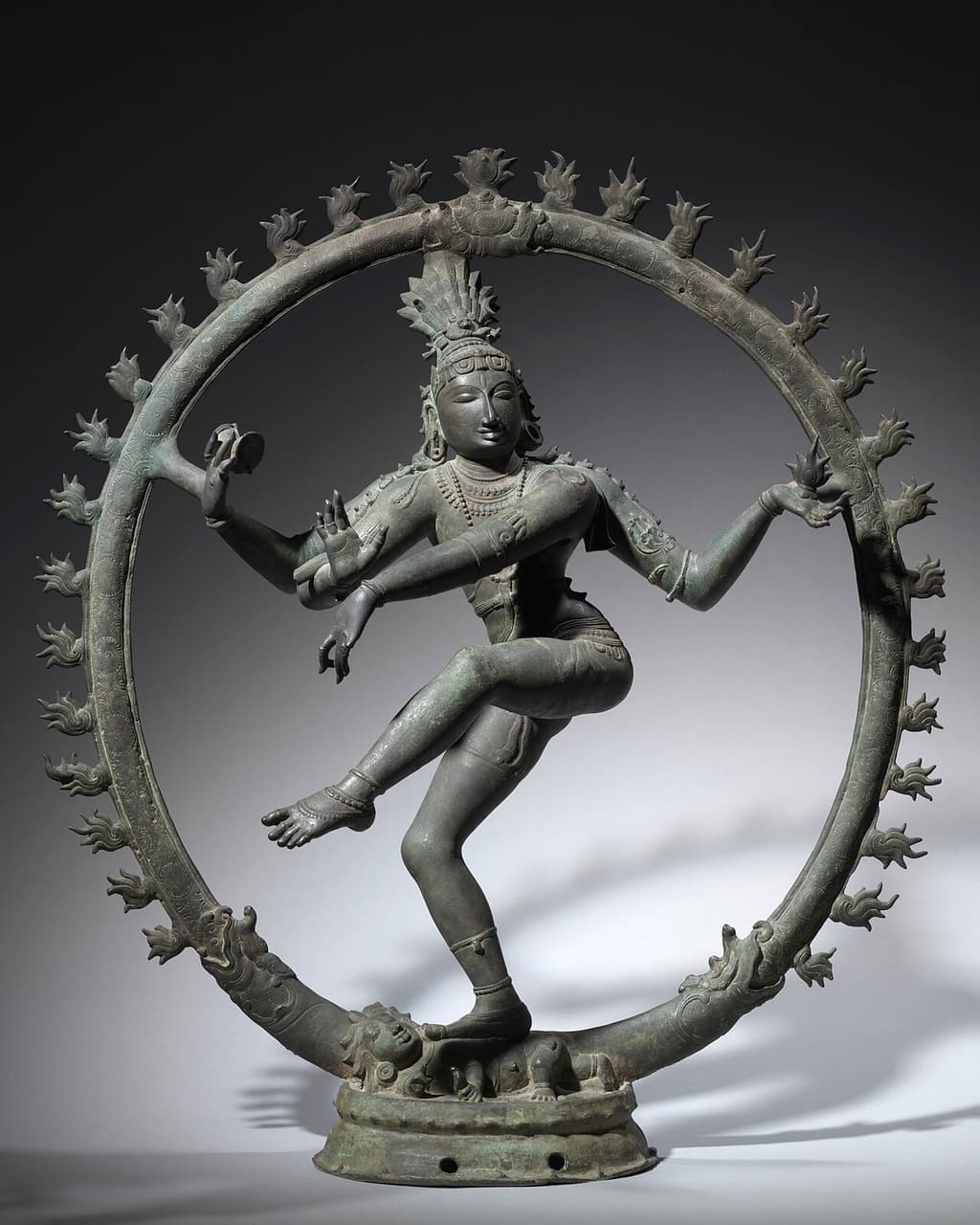
The Chola bronze of Nataraja, Lord of the Dance, cast in south India from around the tenth century and refined for three hundred years after, is one of the few objects in world sculpture that is also an argument. Shiva dances the ananda-tandava inside a ring of flame. The upper right hand holds the damaru, the hourglass drum whose beat is sound and therefore creation. The upper left holds fire, which is dissolution. The lower right is raised palm-out in abhaya mudra, meaning do not be afraid. The lower left points across the body to the raised foot, which is the promise of release. The foot planted on the ground crushes a dwarf, Apasmara, who is forgetfulness. The ring itself is the cosmos, the whole cycle happening at once inside a single figure who is not straining.
Chidambaram in Tamil Nadu is the temple this image belongs to, and the shrine there enshrines akasha, space itself — an empty curtain rather than an image, part of a set of five south Indian temples assigned to the five elements. The Tamil Shaiva devotional tradition around it is enormous and old: the sixty-three Nayanar saints, whose hymns became the Tevaram, and Manikkavacakar's Tiruvacakam, poems of an intimacy that has no equivalent in the Sanskrit Puranas.
Sati, Daksha, and the wound the tradition keeps
The narrative that most shapes his household is the destruction of Daksha's sacrifice. Daksha, a patriarch, holds a great rite and pointedly does not invite Shiva. His daughter Sati, Shiva's wife, goes anyway, is insulted, and destroys herself. Shiva's grief produces Virabhadra, who wrecks the sacrifice, and then Shiva carries the body across the world until Vishnu's discus cuts it apart; where each piece falls a Shakta pitha is founded, and those sites — Kamakhya in Assam most famously — are among the most visited goddess temples in India today. Sati is later reborn as Parvati, who wins him back by out-ascetising him, and their sons are Ganesha and Kartikeya. The family diagram draws the Sati–Parvati link as identity rather than descent, because that is what the sources mean.
Two further images matter. Ardhanarishvara splits the body vertically, male on one side and female on the other, refusing to locate divinity in either. Bhairava is his terrifying form, who beheaded one of Brahma's five heads and wandered as a skull-bearing beggar until the sin wore off at Varanasi — which is why that city claims that dying there ends rebirth altogether.
Where he is worshipped now
Kashi Vishwanath at Varanasi, Kedarnath high in the Garhwal Himalaya, Somnath on the Gujarat coast and nine others make the twelve jyotirlingas, pillars of light, a pilgrimage circuit that is walked in full by real people every year. Maha Shivaratri, the great night of Shiva, falls in February or March and is kept with an all-night vigil, fasting and the pouring of milk, water and bilva leaves over the linga. Mount Kailash in western Tibet is his dwelling and is deliberately unclimbed, out of respect from four religions.
Shaivism is not one thing: Shaiva Siddhanta in the Tamil south, the non-dual Shaivism of Kashmir, and the Lingayat or Virashaiva movement founded in twelfth-century Karnataka around Basava, whose vachanas attacked temple ritual and caste in the god's own name.
Shiva outside India, and Shiva mishandled
Amish Tripathi's Immortals of Meluha (2010) recast him as a Tibetan tribal chief and sold in the millions, opening a whole genre of Indian mythological fiction. The Isha Foundation's 112-foot Adiyogi bust in Coimbatore (2017) presents him as the first yogi and teacher of yoga, a framing that is genuine within some Shaiva traditions and much broader in the global yoga industry than in the texts. A two-metre Nataraja stands outside CERN in Geneva, presented by India in 2004, with Fritjof Capra's cosmic-dance analogy on the plaque — a comparison many physicists find charming and few find rigorous. Against that, the Western fashion trade has repeatedly printed the god on swimwear, shoes and beer labels and has repeatedly had to withdraw them; the objection is not prudishness but the ordinary expectation that a living object of worship is not novelty print.
Things people ask once they start reading the Shaiva texts
If he is the destroyer, why is he asked for children and marriages?
Because "destroyer" is a role assigned to him inside the three-function scheme that pairs him with Brahma and Vishnu, which is a tidy-up applied from outside rather than a Shaiva self-description. In Shaiva theology he performs all five acts — creating, sustaining, dissolving, concealing and revealing — so a devotee asks him for anything. The commonest vow to Shiva, kept by unmarried women on Mondays, is for a good husband.
Why does he keep losing arguments with his own wife?
The domestic quarrels in the Shiva Purana and the Skanda Purana — over dice, over his mendicant habits, over which son is older — are not comic relief bolted on. Shakta-leaning texts use them to establish that the power by which he acts is hers, and one Devi-tradition line puts it bluntly: without shakti, Shiva is inert. The comedy is carrying a doctrine.
Is Shiva worshipped outside Hinduism?
Yes, and in ways that surprise people. Nepal's national shrine at Pashupatinath is Shaiva; Indonesian and Cambodian kingdoms built major Shaiva temple complexes, and Prambanan in Java has Shiva as its central tower; and Tantric Buddhist iconography absorbed Bhairava-type figures directly, sometimes as deities and sometimes, polemically, as subjugated ones.
What is the oldest Shiva image anyone can date?
Coins, not sculpture. Kushan issues of the second century CE show a figure with a trident and a bull, labelled in Bactrian script, and these are among the earliest securely dated depictions. Anything earlier is argued from stone fragments and disputed seals rather than from a legend you can read.